
Design Generator
Definition
A CE.SDK Starter Kit that auto-produces a finished design from structured inputs (brand colors, logo URL, headline, background image) using CE.SDK’s headless API, generating a ready-to-use output without requiring the user to interact with an editor canvas. It is the standard pattern for “AI-powered first draft” and “form-to-design” workflows.
Unlike the interactive Starter Kits (Design Editor, Photo Editor, Video Editor), the Design Generator produces output without presenting any editor UI. The entire pipeline (loading a template, injecting inputs, rendering, exporting) runs through CE.SDK’s headless API. The result can be delivered as a download, stored to a backend, or handed off to an editor for further customization.
Typical Inputs
The Design Generator accepts structured data via form fields, API parameters, or programmatic calls, not manual canvas interaction.
Brand colors
Primary, secondary, accent hex values
Logo URL
Remote image URL or uploaded asset path
Headline text
Campaign tagline or product name
Background image
Product photo or lifestyle image URL
Template selection
Which CE.SDK template to populate
Generation Pipeline
Load Template
CE.SDK’s headless engine initializes and loads a scene from a template file. No UI is rendered. The engine runs in memory only.
Inject Inputs
Structured input values are applied to the template via CE.SDK’s variable, placeholder, and block APIs, replacing text variables, filling image placeholders, applying color overrides.
Render & Export
The engine renders the populated scene and exports to the target format: PNG, JPG, PDF, or others supported by CE.SDK’s export pipeline. The output is returned as a file, blob, or URL depending on the integration.
The generated scene can optionally be passed to an interactive CE.SDK editor rather than directly exported, enabling a “generate then refine” workflow where the Design Generator produces a starting point and the user adjusts it before final export.
Typical Use Cases
Website & Brand Builders
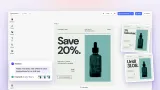
A user enters their business name, picks a color palette, and uploads a logo. The Design Generator automatically creates a set of branded social media graphics and a banner, no user design work required. The output can be downloaded immediately or passed to an editor for further refinement.
AI-Powered ‘First Draft’ Workflows
AI-assisted platforms generate a starting design from user intent (a prompt, a form, or a product feed) and surface it as a finished template the user can review or edit. The Design Generator handles the template population step, bridging the gap between generation input and an editable canvas.
Automated Campaign Production
Marketing platforms generate design variants at scale from structured campaign data (product names, promotional copy, imagery) without requiring each variant to pass through a human designer. The Design Generator runs the same template-population logic for each data row.
Design-as-a-Service APIs
Platforms exposing design generation as an API endpoint to third-party systems (CRMs, e-commerce platforms, PIM systems) use the Design Generator pattern as the server-side implementation: receive structured input, populate template, return rendered output.
Web (Vanilla JS/TS, React, Vue, Angular, Svelte, SvelteKit, Next.js, Nuxt.js), Node.js (server-side via CE.SDK Renderer), Electron.
Links
Documentation and references for this concept.
Related Terms
Starter Kit
A pre-configured, production-ready CE.SDK setup for a specific use case, ready to embed, customize, and ship, providing …
Headless Mode
Running the CreativeEngine as a pure API (without any editor UI) to perform creative operations programmatically: creati…
Creative Automation
The practice of using CE.SDK's headless API to programmatically generate large volumes of design assets from templates a…