

Aviary Creative SDK Alternative & Replacement
Adobe ended their support for the Image Editor UI, Color UI, Markt Browser and Labs in November 2017 for new integrations. It will still run for existing clients, but there will be no updates or fixes. In November 2018 the service stopped completely.
What makes IMG.LY the best Aviary alternative?
Truly cross-platform
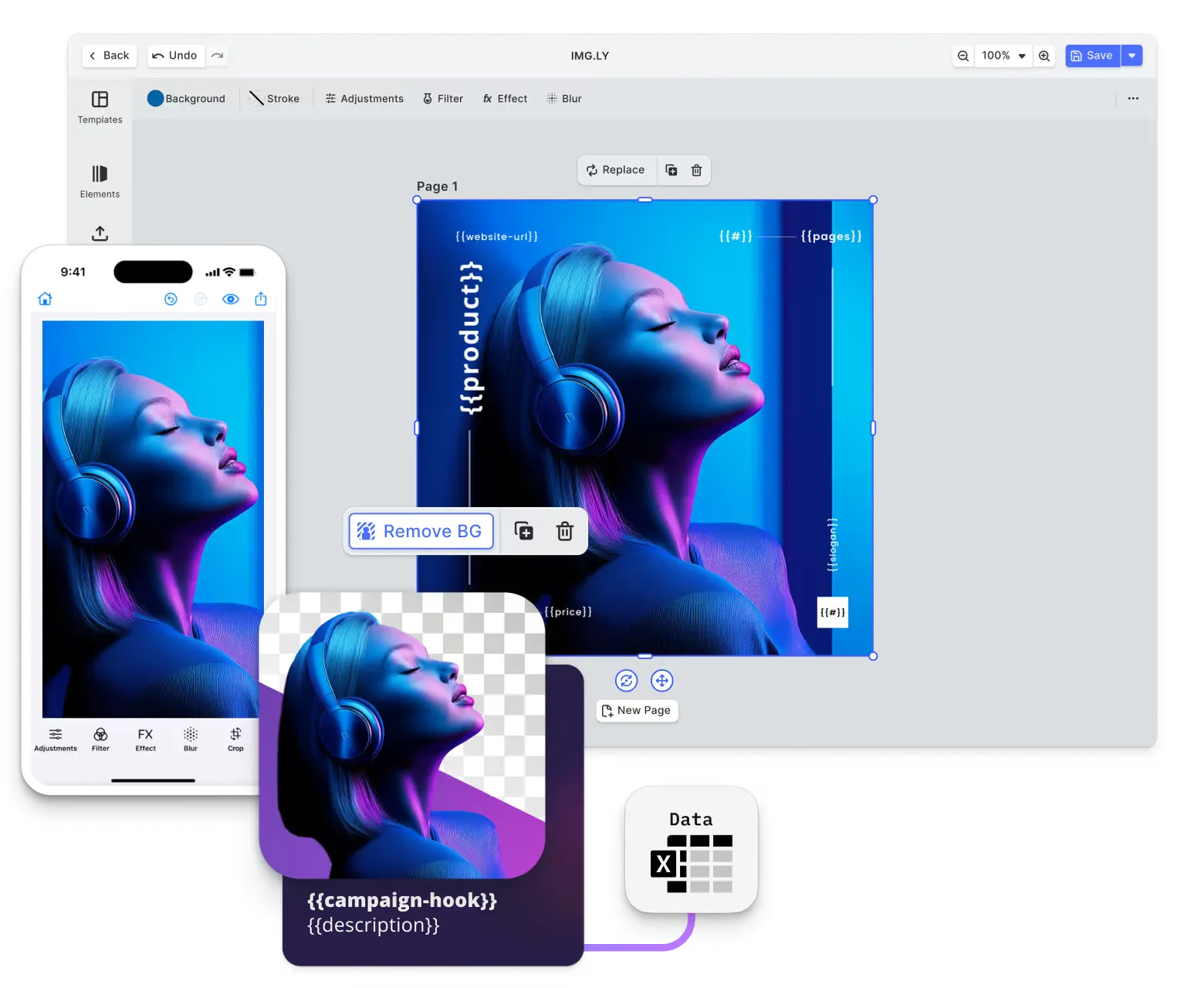
IMG.LY runs everywhere your product does - web, native mobile, desktop, and server. One engine handles interactive editing inside your app and headless rendering on your backend.
Design once, scale everywhere
One template definition drives both user-facing editing and automated batch generation, so you don’t maintain two creative pipelines side by side.
Infrastructure & data ownership
Render client-side in the browser or app, or server-side in your own infrastructure including on-prem deployments. Assets and customer data stay on systems you control.
Full design & print workflow support
Professional layout and typography tools with bleed, ICC color profiles, and PDF/X export, so marketing platforms and web-to-print systems can deliver production-ready output.
Trusted by 100+
industry leaders














What our clients say about us
Integrating IMG.LY’s editor meant we didn’t have to build or maintain a complex editing layer ourselves. That kept our team focused on our core AI ad engine and saved us countless development hours — while still giving our customers the ability to polish and customize creatives at scale.
Hikari Senju
CEO, Omneky

With IMG.LY we built a central creative portal that now powers over 140 dealer campaigns across multiple automotive brands. Before this, asset creation was slow and inconsistent.
Martin Röhr
Product Owner, Digitas

By embedding IMG.LY’s editor we were able to hit key RFP requirements and deliver a template-based creative experience that now serves 1,000+ customers. It helped us win more deals and exceed enterprise expectations without needing to hire dedicated design teams.
Rob Driscoll
Director of PM, Optimizely

Since integrating IMG.LY’s editor, we now deliver 30,000+ ad creatives per month, dramatically shorten time-to-launch, and help our clients cut design spend by up to $10,000 per month.
Logan Welbaum
Founder, Plai

Our customers create over a million personalized postcards each year choosing from over hundreds of templates with IMG.LY’s SDK. It’s the only solution that allows us to build our own specialized, on-brand UI that integrates seamlessly with our platform.
Jeanine Zaalberg
Product Manager, SwissPost

From a developer’s perspective, the most powerful feature of the photo editor is the integration process. It was completely flawless, quick, and easy to integrate.
Stefano Fornari
CTO, Funambol

We compared IMG.LY SDK with other solutions and found that it would be the best fit for us since it provides all the features that are crucial for our use case.
Carem Pereira
SCRUM Manager, HP

IMG.LY vs. Aviary at a glance
| Feature | IMG.LY | Aviary | Notes |
|---|---|---|---|
| Non-destructive | Scene-based editing keeps every change reversible. The scene file is independent of the export, so the same composition can be re-rendered at any resolution. | Discontinued in 2018. The original editor was bitmap-focused; no current SDK available. | IMG.LY uses an actively developed scene model; Aviary is no longer supported. |
| Complete client-sided rendering | Editing runs entirely on the device on web, iOS, and Android. Per the docs, "there's no transfer delay to a cloud or external endpoint." | Discontinued. Aviary relied on hosted services (Markt Browser, Labs) that shut down in 2018. | IMG.LY renders on the user device; Aviary's hosted components are gone. |
| Engine (HTML5) | WebGL. | Canvas. | IMG.LY uses a GPU-accelerated WebGL pipeline; Aviary's editor was Canvas-based. |
| API for rendering engine | Headless CreativeEngine exposes a full API for programmatic scene creation, manipulation, and export. | Discontinued. No actively maintained rendering API available. | IMG.LY ships a programmatic engine API; Aviary's API surface is unsupported. |
| Multiple layers & layer handling | Block-based scene with groups, ordering, locking, and per-block transforms. Per the docs: "group elements together to easily move, resize, or modify them as a single unit." | Discontinued. Aviary added overlays, stickers, and frames as flat additions rather than a true layer model. | IMG.LY offers a true layer model; Aviary worked with flat overlay additions. |
| Supported platforms | Web, Server, Android, and iOS, plus React Native, Flutter, Electron, macOS, and Node.js. | HTML5, Android and iOS, none of which are supported any more (service discontinued). | IMG.LY covers a broader platform set, all actively maintained. |
| Support for the latest iOS | Native iOS SDK is actively maintained against current iOS versions. | Discontinued. The Aviary iOS SDK stopped receiving OS-version updates after 2017. | IMG.LY supports current iOS releases; Aviary is unsupported on modern devices. |
| Support for the latest Android | Native Android SDK is actively maintained against current Android versions. | Discontinued. The Aviary Android SDK stopped receiving OS-version updates after 2017. | IMG.LY supports current Android releases; Aviary is unsupported on modern devices. |
| Frequent updates | Regular versioned releases with a public changelog (CE.SDK is currently in active 1.x development). | No updates since the SDK was retired in November 2018. | IMG.LY ships regular releases; Aviary has had no updates for 7+ years. |
| Hardware accelerated | GPU-accelerated rendering across platforms: WebGL on the web, Metal on iOS, GPU pipelines on Android, and native acceleration on desktop and server. | Discontinued. The Canvas-based web editor relied primarily on CPU rasterization. | IMG.LY uses GPU acceleration everywhere; Aviary's rendering was CPU-bound on the web. |
| Fully customizable UI | Per the docs, "Out-of-the-Box UIs that can be configured or modified at source level when needed." Toolbars, panels, icons, colors, and copy are all configurable; a headless mode lets you build a fully custom UI. | Discontinued. Aviary advertised a customizable editor (per Wikipedia: "a customizable photo editor"), but the SDK and customization tooling are no longer available. | IMG.LY ships a current, configurable UI plus a headless mode; Aviary's tooling is gone. |
| Exchangeable assets | Frames, overlays, fonts, stickers, and filters, all swappable with your own libraries or third-party sources (Unsplash, Getty, Pexels, your DAM). | Discontinued. Aviary shipped frames, overlays, stickers, and filters as bundled packs; the asset feeds are no longer hosted. | IMG.LY lets you swap in your own asset libraries; Aviary's asset feeds were retired. |
| Save & reedit | The scene file format preserves the full editable state so users can save a draft, leave, and continue exactly where they left off. | Discontinued. No actively supported save-and-reedit flow available. | IMG.LY persists the editable scene; Aviary has no current save-and-reedit support. |
| Undo / redo | Per the docs: "Easily correct mistakes and explore design changes with unlimited undo and redo." | Discontinued. No actively supported SDK to ship undo/redo for new integrations. | IMG.LY ships unlimited undo and redo; Aviary is no longer integrable. |
| Edit high-resolution images on mobile devices | Native iOS and Android SDKs handle high-resolution photo editing on-device, using the same C++ engine that powers desktop and server. | Discontinued. Aviary mobile SDKs are abandoned and unsupported on current devices. | IMG.LY handles high-res on current native SDKs; Aviary mobile is abandoned. |
| White label | No IMG.LY branding visible to end users. Theme tokens, custom icons, translated copy, and full UI configuration let the editor read as part of your product. | Discontinued. Aviary historically supported branding configuration, but the service no longer accepts new licenses. | IMG.LY is white-label out of the box; Aviary is no longer licensable. |
| Bulk editing / bulk processing | Headless CreativeEngine runs on Node.js for server-side bulk and scheduled renders. Templates designed once power both the editor and the automated pipeline. | Discontinued. Aviary was a consumer-focused editor; bulk processing was not part of the SDK. | IMG.LY ships a headless rendering pipeline; Aviary never offered bulk processing. |
Get in touch
Contact our sales team to scope a migration off Aviary and explore licensing for CE.SDK on the platforms you need.
FAQs
No. Adobe ended support for the Aviary SDK (Image Editor UI, Color UI, Markt Browser, and Labs) for new integrations in November 2017 and shut down the service completely in November 2018. Existing integrations may still function but receive no updates or fixes.
IMG.LY's CreativeEditor SDK is actively developed, runs on web, iOS, Android, desktop, and Node.js servers, and ships layer-based editing, client-side WebGL rendering, white-labeling, and a fully customizable UI - covering the core capabilities Aviary teams relied on while adding templates, AI plugins, and headless automation.
Yes. IMG.LY offers JavaScript, React, Angular, Vue, Svelte, Next.js, native iOS, native Android, React Native, Flutter, macOS, Mac Catalyst, Electron, and Node.js. Whichever stack your Aviary integration used, IMG.LY has a matching SDK.
Yes. IMG.LY routinely helps teams replace deprecated photo editor SDKs (including Aviary) with CE.SDK. Contact sales for a migration plan tailored to your platform mix and the features you depend on.
Yes. The UI is configurable through a single configuration object plus CSS, supports white-label deployment with your branding and copy, and exposes a headless API so teams that want a completely custom interface can build one on top of the engine.