


IMG.LY vs. Shotstack
The best Shotstack alternative for a client-side video editor with turn-key UIs, creative automation and powerful templates.

What makes IMG.LY the best Shotstack alternative?
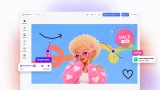
Real-time, in-browser video editing
Fully interactive video editor where users can edit, preview, and manipulate media in real time inside the browser.
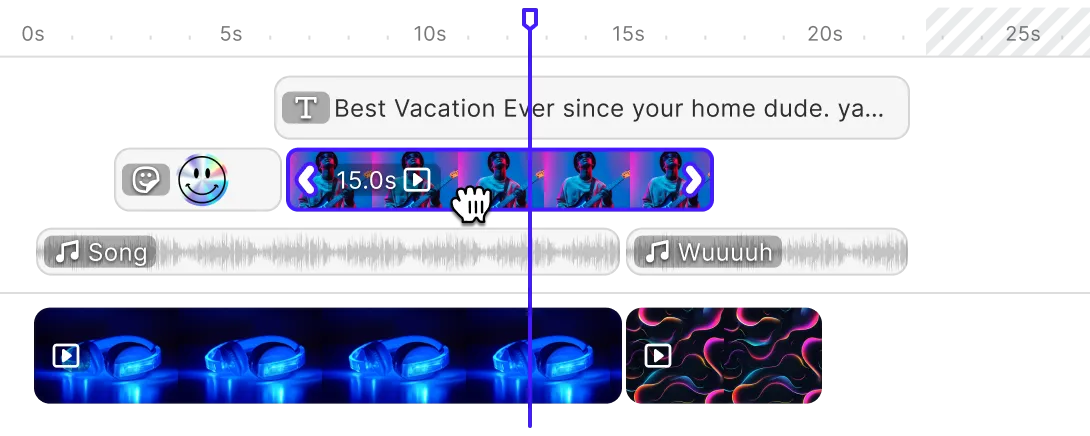
Timeline editing and video composition
Multi-track video editing, allowing video, images, text, overlays, and animations to be layered and adjusted dynamically.
Turn-key solutions
Pre-built editors for video content creation, short-form video, and social media workflows.
Pre-built UI with full customization
Pre-built, use case-specific UIs for video editing, social media content, and marketing automation.
Trusted by 100+
industry leaders















What our clients say about us
Integrating IMG.LY’s editor meant we didn’t have to build or maintain a complex editing layer ourselves. That kept our team focused on our core AI ad engine and saved us countless development hours — while still giving our customers the ability to polish and customize creatives at scale.
Hikari Senju
CEO, Omneky

With IMG.LY we built a central creative portal that now powers over 140 dealer campaigns across multiple automotive brands. Before this, asset creation was slow and inconsistent.
Martin Röhr
Product Owner, Digitas

By embedding IMG.LY’s editor we were able to hit key RFP requirements and deliver a template-based creative experience that now serves 1,000+ customers. It helped us win more deals and exceed enterprise expectations without needing to hire dedicated design teams.
Rob Driscoll
Director of PM, Optimizely

Since integrating IMG.LY’s editor, we now deliver 30,000+ ad creatives per month, dramatically shorten time-to-launch, and help our clients cut design spend by up to $10,000 per month.
Logan Welbaum
Founder, Plai

Our customers create over a million personalized postcards each year choosing from over hundreds of templates with IMG.LY’s SDK. It’s the only solution that allows us to build our own specialized, on-brand UI that integrates seamlessly with our platform.
Jeanine Zaalberg
Product Manager, SwissPost

From a developer’s perspective, the most powerful feature of the photo editor is the integration process. It was completely flawless, quick, and easy to integrate.
Stefano Fornari
CTO, Funambol
We compared IMG.LY SDK with other solutions and found that it would be the best fit for us since it provides all the features that are crucial for our use case.
Carem Pereira
SCRUM Manager, HP

IMG.LY vs. Shotstack at a glance
| Feature | IMG.LY | Shotstack | Notes |
|---|---|---|---|
| Primary Use Case | Dual-purpose creative platform serving both user-facing embedded editors and backend automation workflows. Embeds interactive editing interfaces directly into applications for end-user content creation while simultaneously functioning as headless automation engine for programmatic generation. Single SDK handles template-driven personalization across video, design, and print, whether created by users through visual interfaces or generated automatically via APIs from data pipelines, CRMs, or marketing systems. | Cloud video editing API for automated video generation at scale, plus the Studio SDK for browser-based editing. Built for template rendering in batches. | IMG.LY serves both interactive editing and headless automation with unified SDK. Shotstack focuses on cloud API automation for high-volume video generation. |
| Target Audience | Teams building applications with creative capabilities, both user-facing editing tools and backend content generation systems. Serves businesses embedding visual editors for customer personalization alongside engineering teams implementing automated asset production pipelines. Customers include social media apps, web-to-print providers, marketing platforms, e-commerce sites, DAM systems, and enterprises requiring both interactive creation interfaces and programmatic generation at scale. | Developers and engineers who need to integrate video creation into applications programmatically. Also automation builders, product teams that embed a video editor, and people working through AI assistants such as Claude, ChatGPT or Cursor. | IMG.LY serves businesses needing both interactive editors and automation workflows. Shotstack targets developers automating video production at scale. |
| Technical Approach | Unified SDK architecture separating rendering engine from UI layer. Supports three deployment modes: full UI for embedded editing, custom UI with engine APIs, or pure headless for automation. Same C++ engine processes content identically whether user clicks buttons in browser or backend script calls APIs. Rendering happens client-side (browsers, mobile apps) or server-side (Node.js) based on infrastructure preferences. Organizations control where code runs and data resides without cloud service dependencies. | RESTful API with JSON edit specs, rendered in Shotstack's cloud, across the Edit API (rendering, templates and AI generation), the Serve API (hosting) and the Ingest API (upload, transcoding, transcription). | IMG.LY provides unified engine supporting UI-based editing and headless automation. Shotstack offers cloud-based API service with server-side processing. |
| Advanced Video Editing | Timeline-driven video editor with multi-track composition supporting frame-level precision. Direct browser-based MP4 manipulation using WebCodecs eliminates transcoding delays. Layering system handles video clips, images, audio tracks, and graphic overlays simultaneously. Scene management, adaptive template rendering, and export flexibility across formats enable both interactive user editing and programmatic batch generation. | Programmatic editing in JSON on a timeline. Supports trim, concatenation, rotate, skew, flip, crop, filters, motion effects, transitions (fade, reveal, wipe, slide), chroma key, keyframe tweens and animated rich text. | With IMG.LY, users edit video on an interactive multi-track timeline with frame-level precision. With Shotstack, edits are described in a JSON timeline with trim, crop, filters, transitions, chroma key and keyframe tweens. |
| Templating & Dynamic Editing | Intelligent template engine with self-adjusting layouts that respond to content dimensions and aspect ratios. Placeholder-driven system supports both UI-based template creation and API-driven population. Role-based template access controls enable team collaboration with defined permissions. Templates maintain consistency whether rendered through interactive editors or automation pipelines, with the same template definition driving both workflows. | Templates use handlebars-style merge fields and are saved as reusable JSON edits. Smart clips can fit timing to the content, and an output scaling option renders other sizes. Layouts that re-flow per aspect ratio are not documented. | IMG.LY provides fully customizable templates with adaptive layouts and programmatic control. Shotstack offers template system optimized for bulk generation. |
| Creative Automation | Provides equal-weight automation capabilities alongside embedded editing. Operates headless in Node.js for programmatic generation pipelines; the same SDK handles both user editing interfaces and backend automation without additional components. Integrates with data sources, CRMs, marketing platforms for automated asset generation. Template definitions work identically whether rendered through UI or API calls. Organizations deploy automation workflows on infrastructure they control without cloud service dependencies or vendor lock-in. | Automation is Shotstack's main focus. A saved template renders a new version for every record in your data, and a webhook reports when each render is ready. No-code apps for n8n, Make and Zapier. | IMG.LY offers embedded editing and automation as unified solution. Shotstack specializes in cloud API automation. |
| Advanced Design Editing | Vector graphics, text manipulation, layout systems, and print-ready output including CMYK and Pantone. Enables customizable collage editors with configurable layout templates, cutout shapes for web-to-print, and advanced typography. Includes smart layouts, role-based templates, pixel-perfect print designs, and flexible canvas management. Export options include PNG, JPEG, TGA, binary, PDF, IDML, and PSD (on the server). | A design editor or print workflow is not documented. The Edit API renders still images as JPG, PNG or BMP, not PDF, and accepts SVG markup as a clip. | IMG.LY offers full-featured design editor supporting print and web design workflows. Shotstack renders video and still images from JSON. |
| AI Capabilities | Extensible AI framework supporting custom model integration alongside built-in intelligent features. Smart layout algorithms automatically optimize designs for readability and visual balance. Plugin architecture enables teams to connect proprietary or third-party AI services for specialized workflows. AI enhancements operate as editing assistants while preserving full manual control over final creative decisions. | Generates video, images, speech and music from prompts inside a render, or uses files you generate with your own AI provider. Captions can be transcribed automatically. Director, an AI agent in Shotstack's hosted Studio (research preview), builds edits from a prompt. | IMG.LY focuses on design assistance and content generation with plugin extensibility. Shotstack generates AI assets inside a render, or renders files from your own AI provider. |
| Asset Management | Asset system combining embedded libraries with external integrations; Getty Images, Unsplash, and Pexels connect directly without middleware. Organizations extend the default library with custom asset sources while maintaining local data control. Supports both video and design assets through unified management interface. Client-side architecture keeps all media under application control rather than external service dependencies. | Edits can use video, image, audio and font files fetched by URL or from sources uploaded to Shotstack, and hosted files can be looked up, transferred or deleted through the API. A media library in the Studio SDK and stock media integrations are not documented. | IMG.LY combines embedded libraries with Getty Images, Unsplash, Pexels and custom asset sources. Shotstack works from files fetched by URL or uploaded to Shotstack. |
| User Interface | Production-ready modular interface available for applications requiring user-facing editors. Canvas-based interaction with timeline controls, filter palettes, effect panels, and audio mixers enable direct content manipulation. Component architecture permits reorganizing panels, substituting controls, or building entirely custom interfaces. Alternatively, headless mode bypasses UI entirely for automation workflows. Same SDK supports both UI-based editing applications and invisible backend generation systems. | The Edit API is code-only. The Studio SDK supplies a browser editor with canvas, timeline and playback controls that you embed and extend in your own app. | IMG.LY offers optional UI for interactive editing or headless operation for automation. Shotstack separates API-only approach from optional browser-based Studio SDK. |
| White-labeling | Zero-branding architecture ensures no vendor identification appears in user-facing interfaces or rendered outputs. Visual customization encompasses complete UI restructuring, not merely cosmetic theming. Internationalization built-in supports global deployments. Headless mode eliminates UI entirely for fully custom implementations. Organizations achieve pixel-perfect brand alignment including custom color palettes matching corporate guidelines. | Products built on Shotstack can be fully white-labeled, with no Shotstack attribution required in the product or on rendered output. The Studio SDK can be embedded and restyled to appear as a native part of your app. | IMG.LY ensures comprehensive white-labeling with structural UI customization. Shotstack allows full white-labeling, including restyling the Studio SDK. |
| Interactive Editing | Canvas-first interaction model delivers instantaneous visual feedback as users manipulate content. Timeline scrubbing, zooming, and playback respond without server latency. Effect previews render in real-time using GPU acceleration. Multi-platform consistency ensures identical behavior whether editing on web, mobile, or desktop. Direct manipulation paradigm (click, drag, adjust) matches professional creative tools rather than code-based workflows. | The Studio SDK is a fully interactive editing environment in the browser, with track and clip management, undo/redo and keyboard shortcuts. | IMG.LY supports responsive interactive editing optimized for cross-platform web and mobile use. Shotstack offers browser-based interactive Studio SDK; core Edit API is non-interactive automation. |
| Multi-Layer Editing | Unlimited-depth layer system organizes video clips, graphics, audio, and effects with sophisticated composition controls. Blending modes, opacity gradients, and z-axis management enable professional-grade visual effects. Grouping and parenting relationships create reusable composition hierarchies. Lock and visibility controls keep complex projects manageable. Layer architecture maintains consistency across all deployment targets: web, mobile, and desktop. | Multi-track JSON timeline in the Edit API, shown visually in the Studio SDK, with video, image, audio and text layers. Supports overlays, picture-in-picture, opacity and luma matte masks. Clip blend modes are not documented. | IMG.LY supports comprehensive multi-layer composition with advanced controls and unlimited layers. Shotstack layers tracks in both the Edit API and the Studio SDK. |
| Component Architecture | Decoupled engine and editor layers enable flexible integration patterns: full UI, custom UI, or headless operation. Granular component registration system lets developers inject custom tools without SDK modifications. Order APIs control component layout programmatically. Plugin framework extends core capabilities while preserving upgrade paths. Architecture supports partial adoption: use only needed components rather than monolithic implementation. | The Studio SDK is a framework-agnostic JavaScript library split into separate Edit, Canvas, Timeline, Controls and exporter classes that you assemble in your own app. | IMG.LY lets developers register custom tools, order components through APIs and extend the core with plugins. Shotstack's Studio SDK splits the editor into Edit, Canvas, Timeline and Controls classes you assemble yourself. |
| Cross-Platform Support | Platform-spanning deployment model covers web frameworks (React, Angular, Vue, Svelte, Next.js), native mobile (iOS, Android), cross-platform mobile (React Native, Flutter), desktop (Electron, macOS), and backend (Node.js). Single codebase adapts to each platform's idioms while maintaining functional parity. Same templates render identically whether processed on user devices or backend servers. | Cloud API called from your backend, no-code tools or AI agents. The Studio SDK runs in web browsers (TypeScript, React, Vue, Angular, Next.js). Native iOS, Android or desktop SDKs are not documented. | IMG.LY supports web, mobile, desktop, and server environments. Shotstack works via server-side API with browser-based Studio SDK only. |
| Customizability | Granular configuration system spanning UI appearance, functional workflows, and architectural patterns. Toolbar reconfiguration, asset library customization, and workflow adjustments occur through code-based APIs. Role-based permission models enable multi-tenant deployments. Headless APIs bypass default UI entirely for completely custom implementations. | Full control of composition in JSON, with custom sizes, formats and destinations. Custom animated effects can be built as HTML5 clips, and the clip filter list is fixed. The Studio SDK can switch on merge field controls. | With IMG.LY, developers configure UI appearance, toolbars, workflows and role-based permissions through code-based APIs. With Shotstack, the composition is set in JSON, and the Studio SDK can switch on merge field controls. |
| Extensibility | First-class plugin architecture enables custom tool development without SDK modification. Extension points cover UI components, export formats, asset sources, and processing pipelines. Teams integrate proprietary services or third-party APIs while maintaining SDK upgrade compatibility. Modular design supports selective feature adoption: load only needed capabilities to optimize bundle size. | A plugin system is not documented. The Studio SDK supports custom toolbar buttons and events. | IMG.LY has a plugin system that extends the editor without forking it. |
| Ease of Integration | Platform-specific integration guides with working code samples across React, Angular, Vue, Flutter, React Native, and server frameworks. Pre-built editor solutions reduce initial implementation to configuration rather than development. Evaluation period includes full SDK access for production-readiness assessment. Multi-tier documentation serves both quick-start and deep-dive needs. | SDKs available for Node.js, Python, PHP, Ruby. Developer sandbox for testing. Well-documented API with tutorials and guides. Straightforward API integration from your backend. An MCP server, a CLI and a Claude Code skill let AI agents use the API. | IMG.LY offers comprehensive documentation for deeper SDK integration across more platforms. Shotstack provides API integration with multiple SDK languages. |
| Flexible Rendering Approach | Flexible rendering deployment: client-side processing keeps data local and uses device GPUs for interactive editing, while the CE.SDK Renderer provides server-side automation on Node.js infrastructure. A single engine ensures pixel-identical output whether rendering happens in the browser or on backend servers. Choose client-side for user editing and server-side for automation, both powered by the same SDK. | API renders run on Shotstack's cloud infrastructure, and rendering on your own servers is not documented. The Studio SDK can also export video from the browser. | IMG.LY adapts rendering location to workflow type (user editing vs automation). Shotstack renders in its cloud, with a browser export option in the Studio SDK. |
| Mobile Performance | Native mobile SDKs for iOS and Android plus cross-platform framework support (React Native, Flutter) ensure editing capabilities match desktop experiences. Same rendering engine across all platforms maintains consistent output quality. Performance tuning targets modern device capabilities without degrading older hardware support. Codec handling and memory management optimize for mobile constraints. | Editing in mobile browsers through the Studio SDK is not documented. | IMG.LY provides native iOS and Android SDKs plus React Native and Flutter support, with the same rendering engine on every platform. |
| Production Readiness | Battle-tested across enterprise deployments generating 500M+ creative outputs monthly. Continuous release cycle maintains compatibility while introducing features. Multi-tier support structure scales from community resources to dedicated engineering assistance. Organizations deploy without infrastructure concerns, SDK handles complexities internally. | Shotstack runs its video editing API as a managed cloud service on AWS, backed by a service level agreement with service credits. Its support team is available around the clock. | IMG.LY is battle-tested across enterprise deployments, with a continuous release cycle and multi-tier support. Shotstack runs as a managed service on AWS with a service level agreement and support around the clock. |
| Scalability | Scales through two complementary approaches: distributed client-side rendering where user devices handle processing, and centralized server-side automation on organization-controlled Node.js infrastructure. Template-driven workflows enable generating variations whether users create one-off content or automation pipelines produce millions of assets. Architecture handles both interactive editing at scale (millions of users) and batch automation workloads without performance degradation. Organizations scale horizontally by adding infrastructure capacity they manage. | Renders run in parallel on Shotstack's cloud. | IMG.LY scales through both user-driven creation and backend automation on controlled infrastructure. Shotstack scales through cloud infrastructure for concurrent high-volume rendering. |
| Storage & Data Ownership | Zero data exfiltration architecture, all content remains within application boundaries during editing. Client-side operation eliminates external service dependencies for storage. Optional server deployment maintains team control over infrastructure and data residency. Asset integrations (Getty, Unsplash) occur only when explicitly configured. | Renders are hosted on Shotstack's CDN by default and stay there until you delete them; only the temporary link in the render status expires. You can also send files to S3, Google Cloud Storage, Azure Blob, Google Drive or Vimeo, or opt out of Shotstack hosting, in which case the raw file is kept only for a limited time. Uploaded sources are stored for use in edits until you delete them, and you keep ownership of source media and rendered files. | IMG.LY offers client-side/on-premise operation with full user data control. Shotstack provides cloud storage with CDN delivery and third-party destination options. |
| Offline Capabilities | Full-featured editing without network connectivity after initial SDK delivery. Local rendering, export, and template manipulation operate independently of internet access. Asset libraries function offline when using embedded or custom sources. Particularly valuable for mobile apps and intermittent connectivity scenarios. | API renders run in Shotstack's cloud, so they need a connection. Offline use of the Studio SDK, including its browser export, is not documented. | IMG.LY supports editing, processing, and export without internet connectivity. |
| Clear Pricing Model | Usage-based enterprise licensing adapts to platform mix, deployment scale, and feature requirements. Evaluation period provides production SDK access for thorough assessment before commitment. | Usage-based pricing: rendering and AI generation are paid for in credits, bought pay-as-you-go or through a subscription. | IMG.LY licenses by platform mix, deployment scale and features, with an evaluation period. Shotstack charges credits for rendering and AI generation, bought pay-as-you-go or through a subscription. |
| Community & Support | Platform-segmented documentation addresses web, mobile, desktop, and server integration patterns. Enterprise licensing includes dedicated support channels with SLA guarantees. Solution architects assist with complex integrations and performance optimization. | Support is available by email and through in-app messaging in the dashboard, plus a help center for common questions. The docs come with llms.txt files and a Markdown version of every page. | IMG.LY provides comprehensive documentation and direct support channels based on license tier. Shotstack offers a help center and support by email and in-app messaging. |
Key capabilities
Learn more about some of the functionalities of IMG.LY’s SDK.
Editing
Printing


Templating
Text variables.
Enable mass personalization and creative automation by embedding variables.
Placeholders & lockable designs.
Constrain templates to guide your users’ design and ensure brand consistency.
Configurable presets.
Enforce a consistent aesthetic across all creations by using preset filters, adjustments, fonts, and crop ratios.
Customizability
Build custom UIs.
Use the headless API powering all creative operations to implement an entirely custom UI.
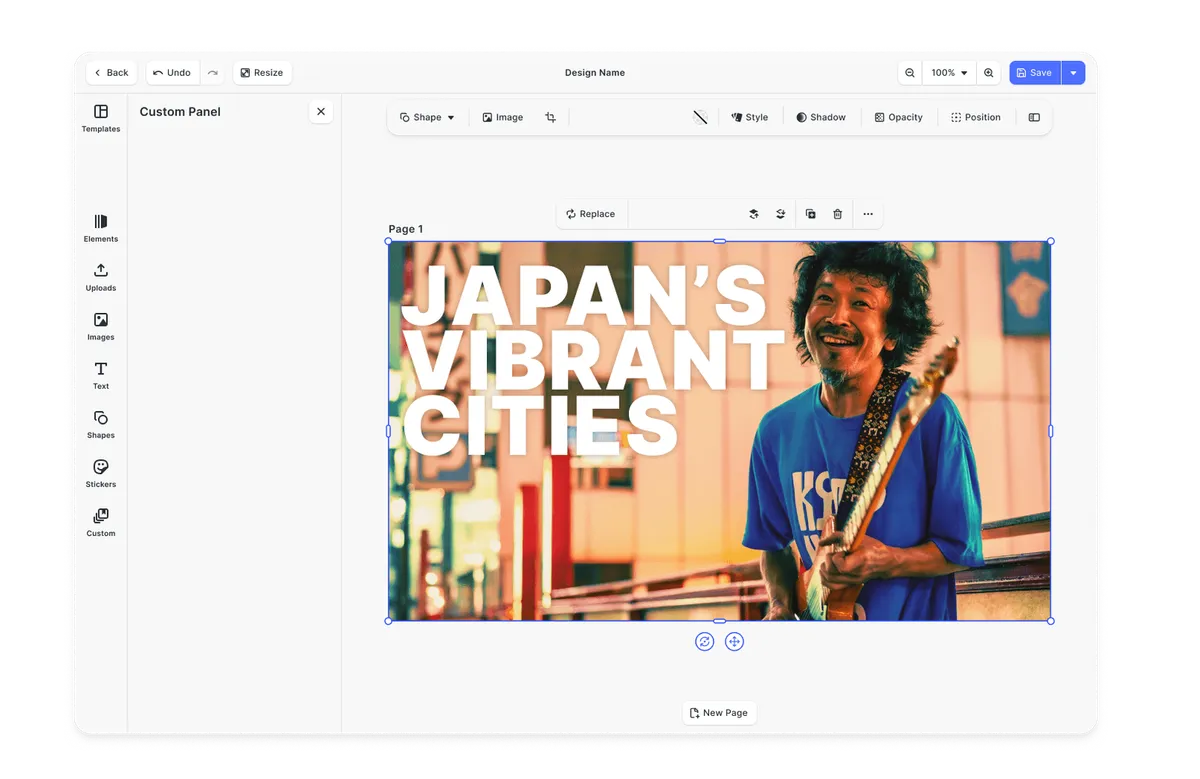
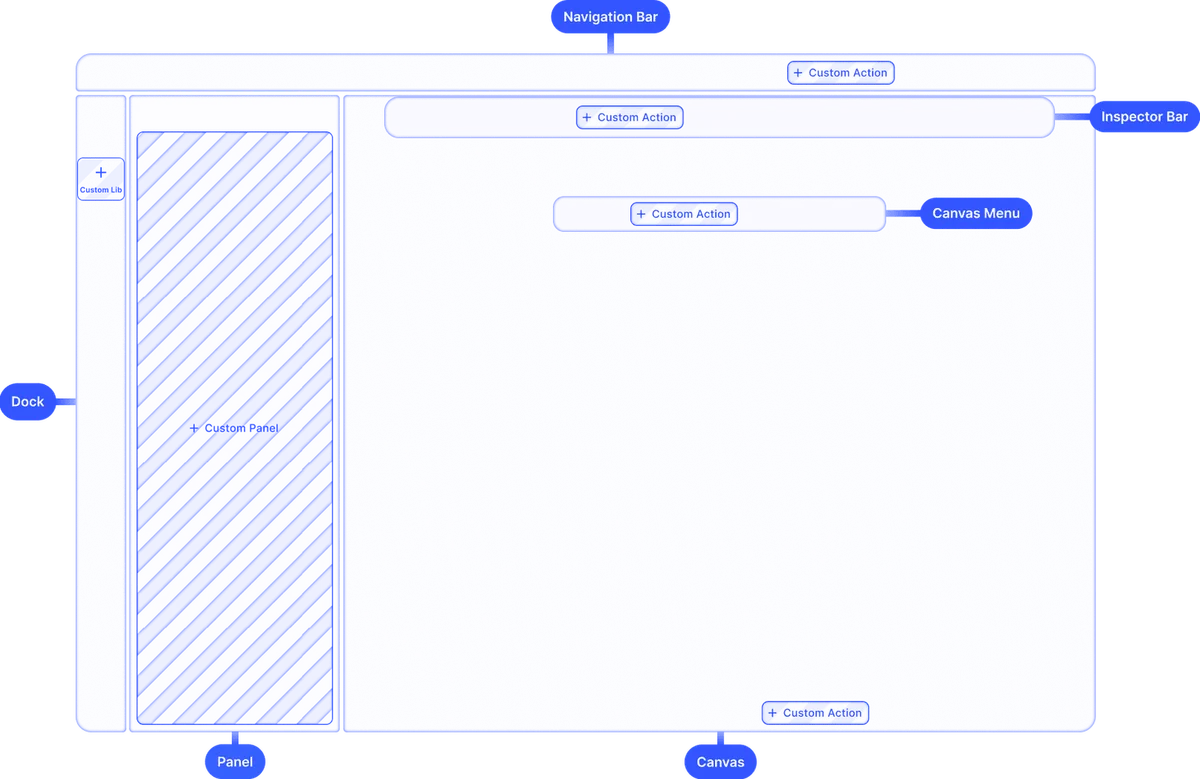
Theming.
Theme the editor to match your app.
Media libraries.
Set up custom libraries that are easily sortable.
Toolbar customization.
Reposition toolbar elements, change icons, or rename tools to fit your use case.
Internationalization.
Add support for additional languages, and customize any button label.
Export options.
Export designs in JPG, PNG, or PDF with custom quality, page ranges, and dimensions.
Check out other use cases
Learn more about related solutions.
Apparel Designer
Whether t-shirts, hoodies or caps, build for any use case, deploy on any platform.
Get in touch
Contact our sales team to learn more about licensing options and get access to our AI plugins for CE.SDK.
FAQs
IMG.LY serves as a strong alternative to Shotstack, providing video automation, templating, and real-time video editing. It allows users to edit, preview, and manipulate media directly within the browser while supporting scalable rendering for high-volume media generation.
Shotstack centers on cloud video rendering through its API, with a browser editor SDK on top. IMG.LY provides an interactive, user-friendly editor for real-time video editing.
IMG.LY provides a white-label UI with customizable components and a plugin system, allowing for extensive customization. Shotstack offers the Studio SDK, an embeddable browser editor with a canvas, timeline and custom toolbar buttons.
Yes, both platforms support video templating and automation. IMG.LY offers headless mode and template-based automation, while Shotstack specializes in automated video rendering through its API.
IMG.LY supports a wide range of platforms, including Web, iOS, Android, and server-side environments. Shotstack is a cloud API used from your backend, no-code tools or AI agents, plus a browser editor SDK for React, Vue, Angular, Next.js and TypeScript.
IMG.LY supports a variety of assets, including videos, images, text, stickers, and flexible overlays. Shotstack edits accept video, image, audio, rich text, captions, shapes, luma mattes, SVG and HTML5 clips, plus AI-generated media.
IMG.LY provides advanced video editing capabilities with automation for dynamic content creation and multi-track editing for video, images, audio, and overlays. Shotstack specializes in automated rendering via APIs and also offers a browser editor SDK.
IMG.LY is the better option for real-time user-driven editing. Shotstack is primarily used for batch processing and automated video creation.
Shotstack renders MP4, GIF, MP3, JPG, PNG and BMP, while IMG.LY supports a broader range, including PNG, JPG, SVG, MP4, editable IDML design files, and PSD on the server.