
“I want my users to create designs in my app”
Social posts, invitations and personal designs created by your users inside your product. What matters when a person is watching a spinner: latency first, unit cost at user volume, and output that lands close enough to edit.
Recommended models
| Use-case score | Criteria covered | $ / image | |
|---|---|---|---|
| 1. FLUX.2 Best fit | 4.35 / 5 | 100% | $0.012 |
| 2. FLUX.2 [dev] Turbo | 4.35 / 5 | 100% | $0.008 |
| 3. Nano Banana 2 Lite | 4.23 / 5 | 100% | $0.042 |
| 4. Muse Image | 4.03 / 5 | 100% | $0.010 |
| 5. Recraft V4.1 | 3.89 / 5 | 100% | $0.035 |
| 6. Gemini 2.5 Flash Image | 3.84 / 5 | 100% | $0.040 |
| 7. Seedream 4.5 | 3.83 / 5 | 100% | $0.040 |
| 8. Qwen-Image | 3.81 / 5 | 100% | $0.020 |
| 9. Nano Banana 2 | 3.77 / 5 | 100% | $0.080 |
| 10. FLUX.2 [pro] | 3.75 / 5 | 100% | $0.030 |
| 11. Seedream 5.0 Lite | 3.75 / 5 | 100% | $0.035 |
| 12. GPT Image 2.5 Flare | 3.75 / 5 | 100% | $0.042 |
| 13. GPT Image 2.5 Sunburst | 3.73 / 5 | 100% | $0.036 |
| 14. Seedream 5.0 Pro | 3.56 / 5 | 100% | $0.135 |
| 15. Grok Imagine Image 2.0 | 3.53 / 5 | 100% | $0.060 |
| 16. Luma Photon | 3.50 / 5 | 100% | $0.021 |
| 17. GPT Image 1.5 | 3.48 / 5 | 100% | $0.140 |
| 18. Nano Banana Pro | 3.45 / 5 | 100% | $0.150 |
| 19. Ideogram 3.0 | 3.45 / 5 | 100% | $0.060 |
| 20. Recraft V3 | 3.36 / 5 | 100% | $0.040 |
| 21. Qwen Image 3.0 | 3.36 / 5 | 100% | $0.040 |
| 22. GPT Image 2 | 3.29 / 5 | 100% | $0.155 |
| 23. Stable Diffusion 1.5 | 3.19 / 5 | 100% | $0.002 |


How this is weighted
A person is watching the spinner, so latency leads and cost follows: consumer products generate on every tap and pay for every retry. Prompt adherence weighs the same as cost because a result that ignores the prompt is a retry. The fidelity criteria stay light: UGC is judged by its creator, not by a brand team.
- Latency 25%
- Cost 20%
- Prompt Adherence 20%
- Composition 10%
- Text Accuracy 10%
- Color Accuracy 10%
- Resolution 5%
The evidence: FLUX.2
FLUX.2 takes the top spot where this job puts its weight: latency at 4.8 / 5 (25% of the matrix), cost at 4.9 / 5 (20% of the matrix) and prompt adherence at 4.4 / 5 (20% of the matrix).
Get the 2026 Benchmark Report
23 models, 37 prompts, 2,550 measured images. Every finding and ranking from this benchmark, with the methodology behind the numbers, as a PDF in your inbox.
Check your inbox.
Your report is on the way.
The last mile: what no model delivers
In-app generation is where the editing canvas stops being a nice-to-have and becomes the product surface: the model proposes, the user refines. The data supports routing for speed here, since the fastest tier returns in around two seconds and still ranks seventh and ninth overall, while slow endpoints run over thirty. What no model provides is the refinement step itself: swapping the headline, nudging the layout, applying the user's colors. That loop is the canvas, and it is also what turns one generation into a kept, personalized design instead of a re-roll.
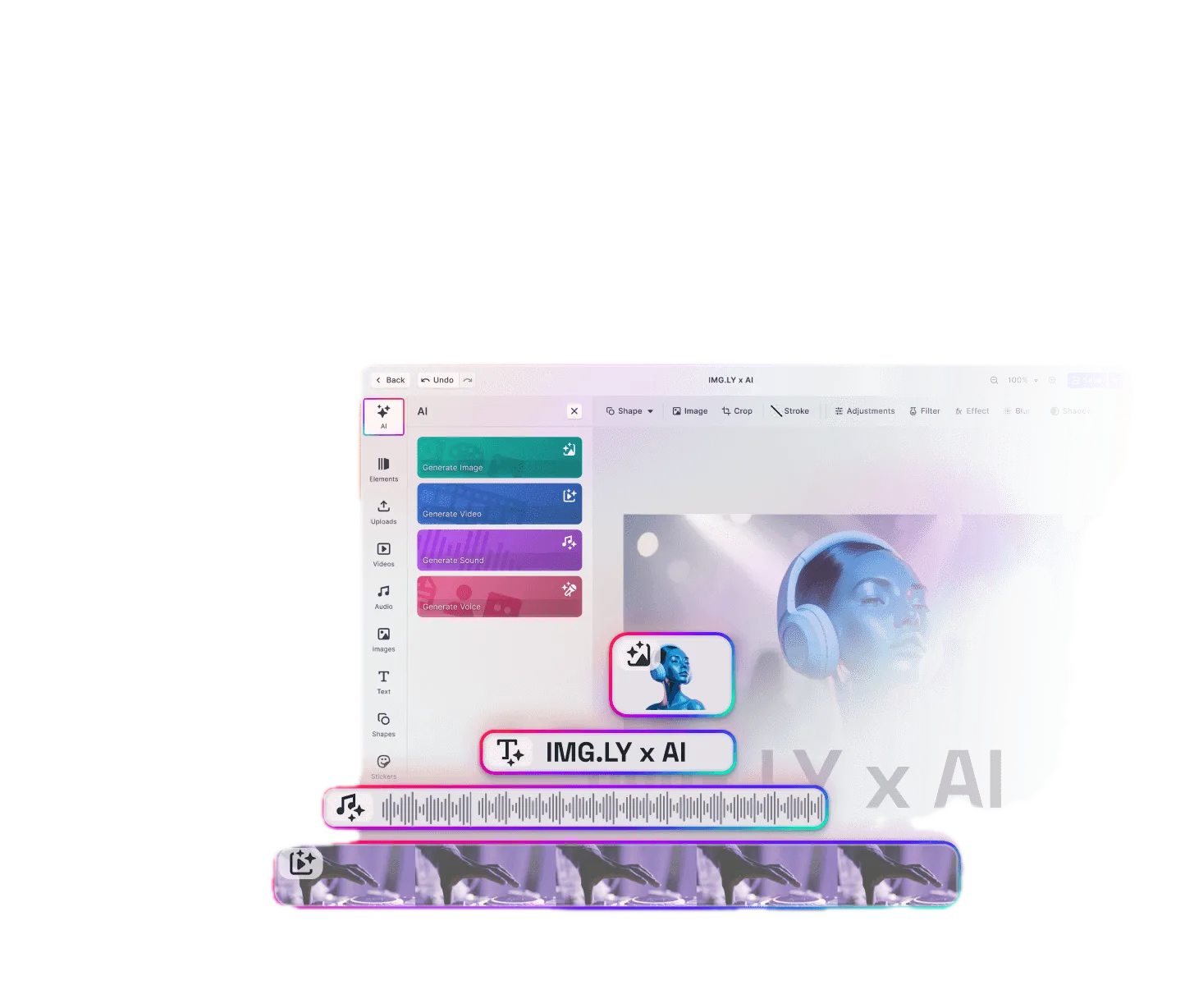
Generate with any model. Finish in the AI Editor.
Give your users the control they need to be productive with generative AI. The IMG.LY AI Editor turns in-app ugc creation generations into finished, on-spec assets: background removal, brand kits and editable text on a real canvas.