


Catalog-driven product ads in your marketplace or shop builder
An ad editor for marketplaces, shop builders and ad platforms. The price, the sale badge and the stock count come from your catalog, so each new render carries the current offer, while sellers keep the headline in their own words.
Trusted by 100+
industry leaders















Integrating IMG.LY’s editor meant we didn’t have to build or maintain a complex editing layer ourselves. That kept our team focused on our core AI ad engine and saved us countless development hours — while still giving our customers the ability to polish and customize creatives at scale.
Hikari Senju
CEO, Omneky

With IMG.LY we built a central creative portal that now powers over 140 dealer campaigns across multiple automotive brands. Before this, asset creation was slow and inconsistent.
Martin Röhr
Product Owner, Digitas

By embedding IMG.LY’s editor we were able to hit key RFP requirements and deliver a template-based creative experience that now serves 1,000+ customers. It helped us win more deals and exceed enterprise expectations without needing to hire dedicated design teams.
Rob Driscoll
Director of PM, Optimizely

Since integrating IMG.LY’s editor, we now deliver 30,000+ ad creatives per month, dramatically shorten time-to-launch, and help our clients cut design spend by up to $10,000 per month.
Logan Welbaum
Founder, Plai

Our customers create over a million personalized postcards each year choosing from over hundreds of templates with IMG.LY’s SDK. It’s the only solution that allows us to build our own specialized, on-brand UI that integrates seamlessly with our platform.
Jeanine Zaalberg
Product Manager, SwissPost

From a developer’s perspective, the most powerful feature of the photo editor is the integration process. It was completely flawless, quick, and easy to integrate.
Stefano Fornari
CTO, Funambol

We compared IMG.LY SDK with other solutions and found that it would be the best fit for us since it provides all the features that are crucial for our use case.
Carem Pereira
SCRUM Manager, HP

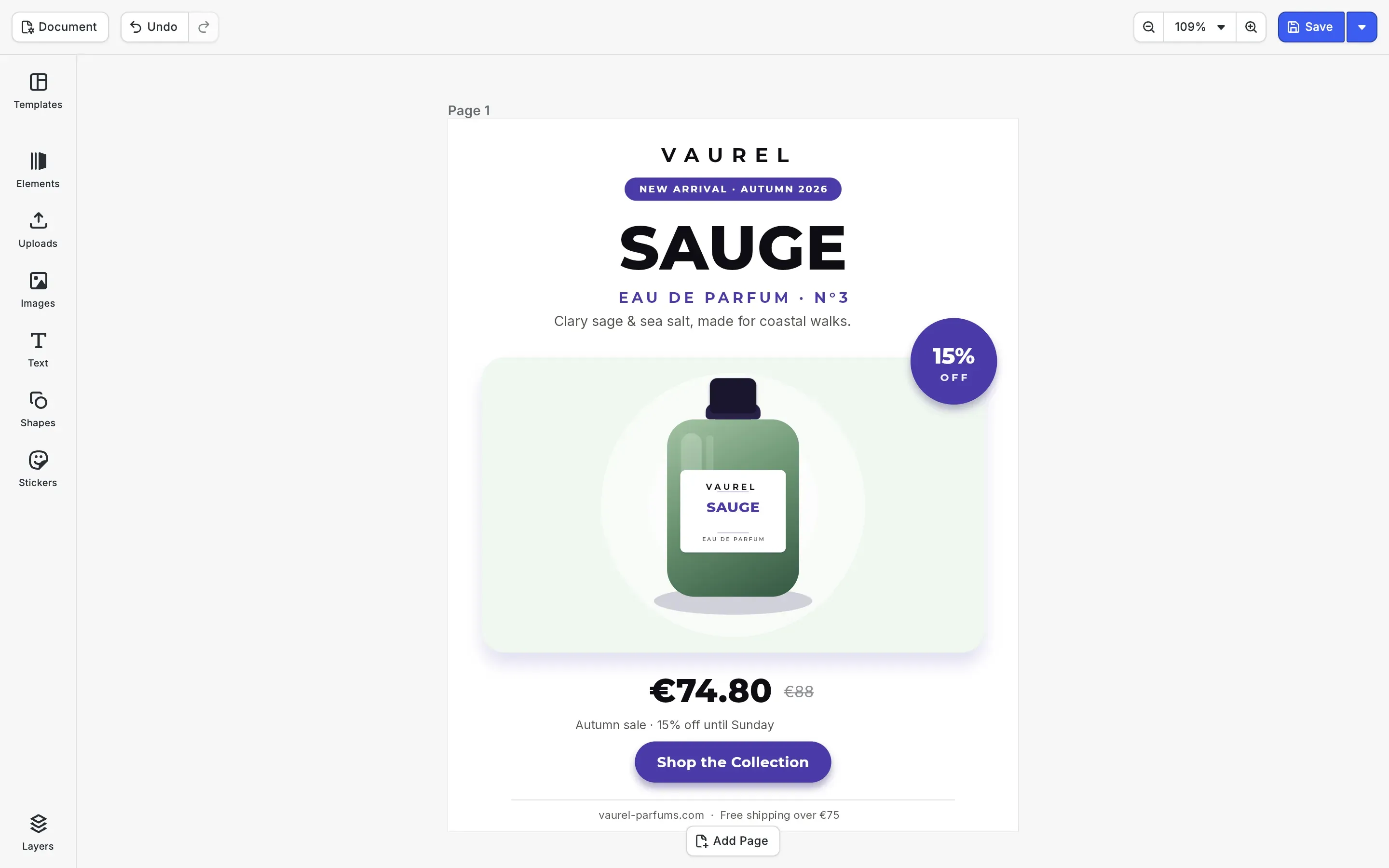
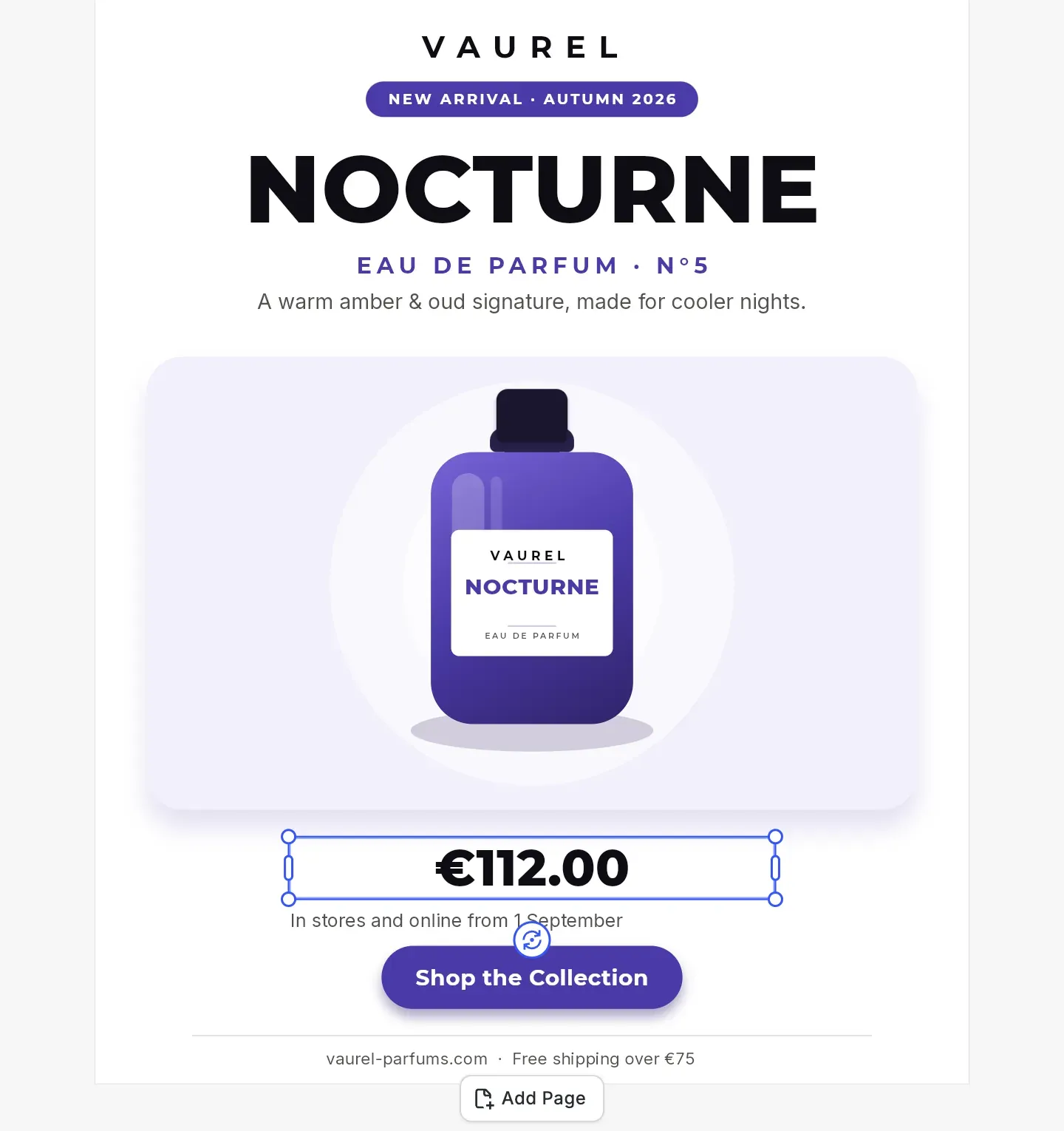
Full price, on sale or nearly sold out
One price from the product record
At full price the ad carries a single figure, filled from the product’s price field. The old price and the badge are part of the template as well, hidden until the catalog gives a reason to show them.
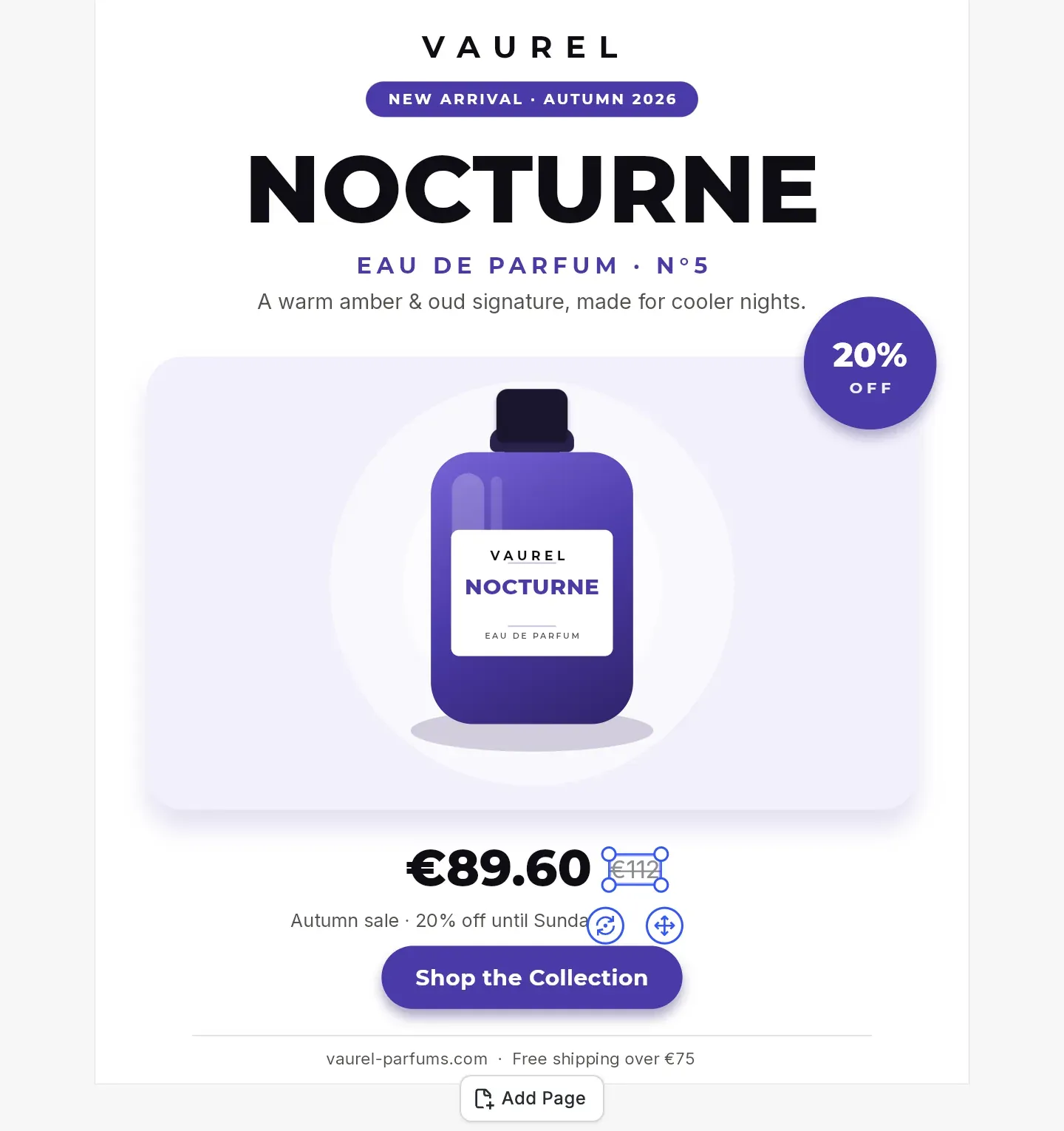
The old price struck through, the discount in the badge
When the catalog puts a product on sale, your platform fills in the sale price, shows the old price with its strikethrough and writes the discount into the badge. The strikethrough is a text decoration, so the old price stays live text that the next price change can update.
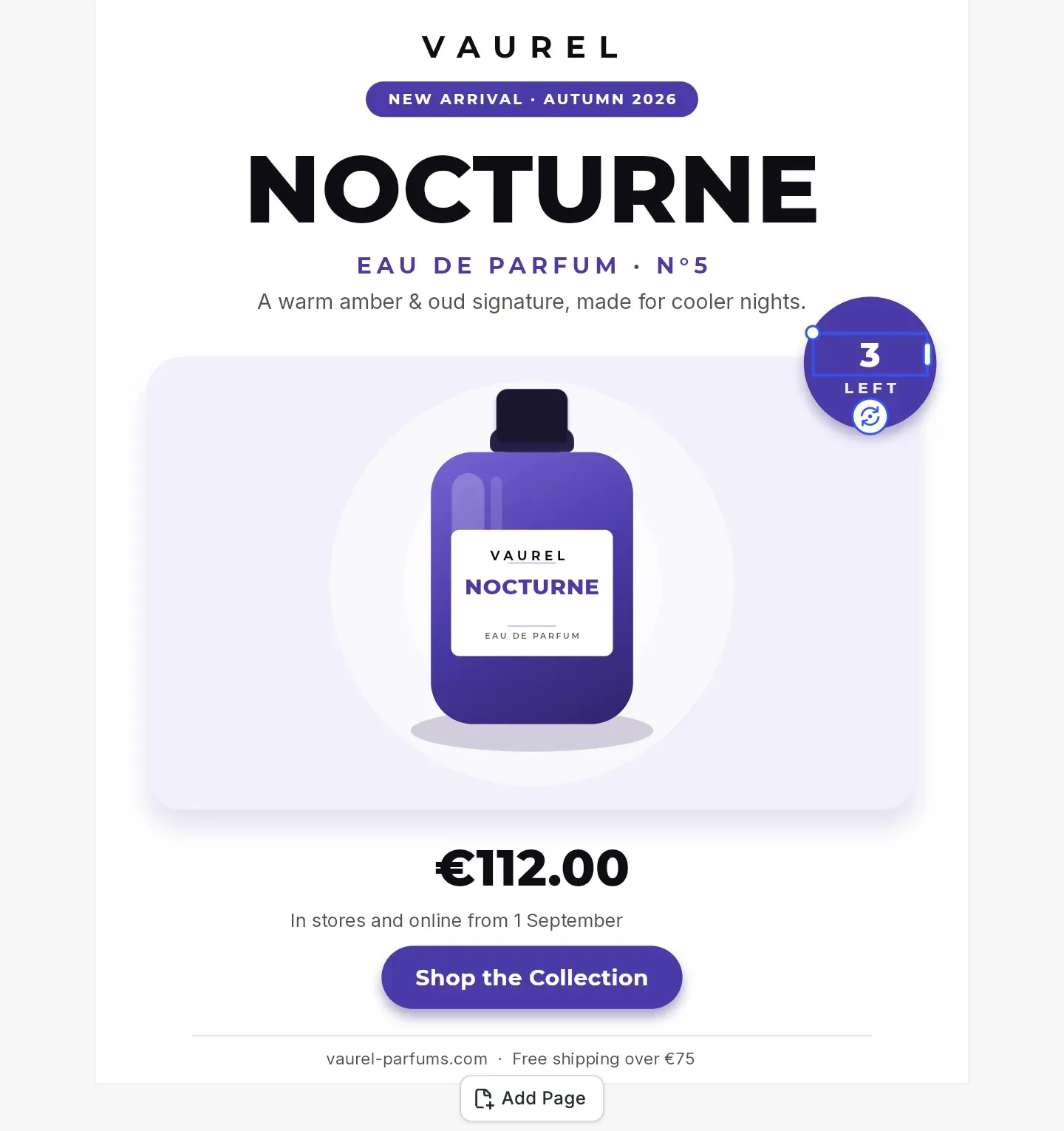
A stock count in the same badge
Below a stock level your team sets, the badge shows how many bottles are left instead of a discount. One badge covers both offers, so the template does not need a second version for low stock.
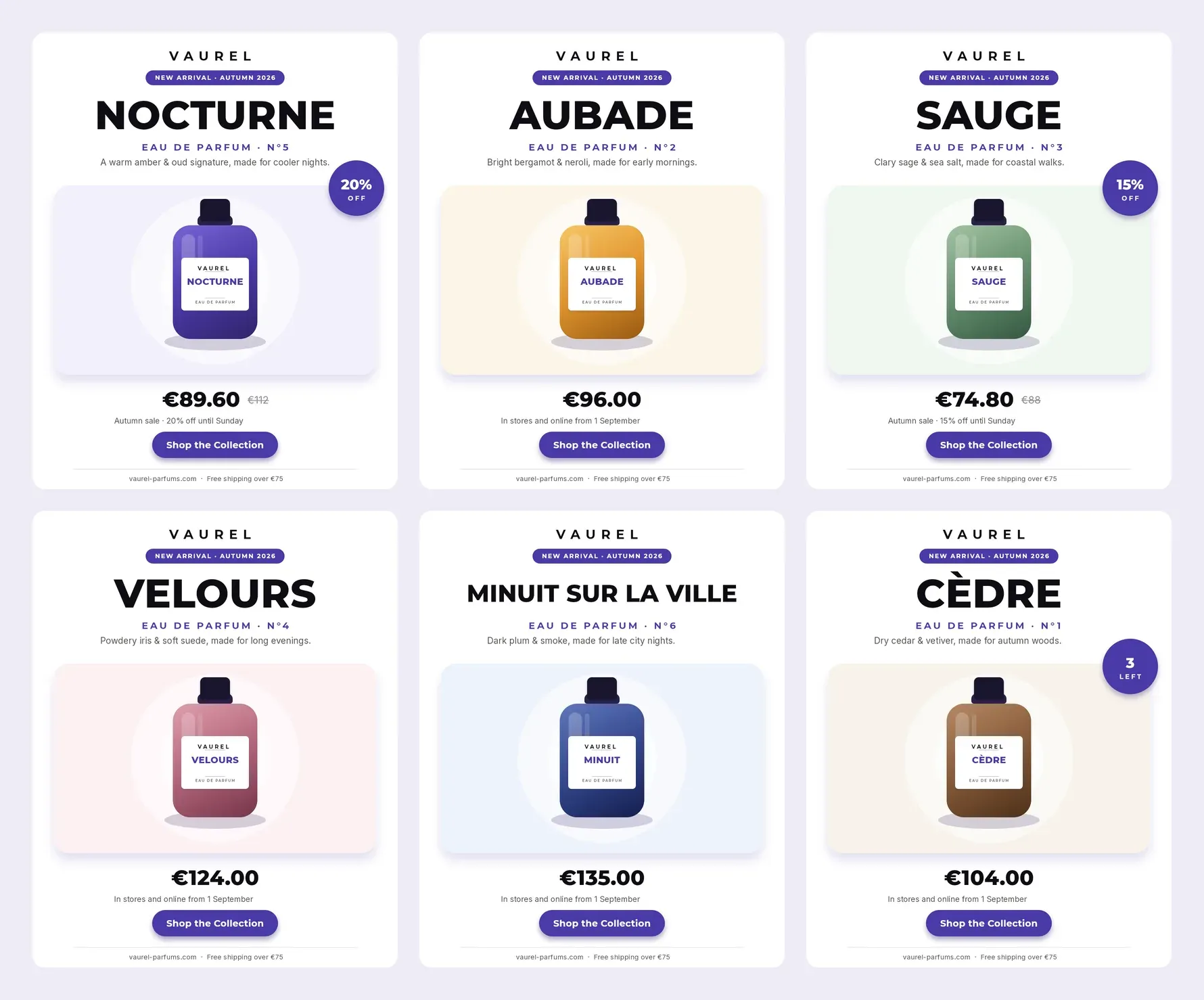
Six scents from one ad template
Each product record fills the name, the scent notes, the price and the bottle color. Text auto scale fits a long name such as Minuit sur la ville into the headline, and your servers can render one ad per product each time the feed changes.
Seller copy, test versions and other markets
Sellers write the headline, the catalog sets the price
In the seller view, the headline and the scent line are open to edit, while the price, the old price and the badge are locked because they come from the catalog.
Headline versions to test
With a language model connected to the web editor, a seller asks for a shorter headline or a different tone, compares it with the original and keeps both as separate ads to run against each other.
The same ad for another market
The same AI tools translate the headline and the scent line inside their text blocks, and the price field takes the figure and currency the catalog holds for that market.
Powered by IMG.LY: Plai Doubles Annual Revenue and Produces 30,000+ Ad Creatives Monthly

37K
creative exports per month
campaign prep from weeks to minutes
$10K
monthly savings per client
Plai is an AI-powered advertising platform founded by growth marketer Logan Welbaum. The platform helps businesses of all sizes launch ads across 11 platforms with ease, catering to a wide range of clients from global acts like Green Day and Red Hot Chili Peppers to local service providers. Plai’s mission is to make ad creation as simple as typing in a prompt, automatically generating brand-aligned creative across multiple platforms.
Since integrating IMG.LY’s editor, we now deliver 30,000+ ad creatives per month, dramatically shorten time-to-launch, and help our clients cut design spend by up to $10,000 per month.
Plai

Challenge
While Plai excelled at generating highly on-brand images and videos with AI, the product faced a common limitation: AI can create assets, but it can’t finish them. Users needed to tweak layouts, adjust text, fix proportions, refine colors, or make brand-specific edits that the model couldn’t reliably control. Without an integrated editing layer, users had to export AI outputs, edit in external tools, and then re-upload, introducing friction and slowing down the campaign readiness process.
Solution
Plai integrated IMG.LY’s Creative Editor SDK to bridge the gap between AI-generated assets and user customization. By adopting IMG.LY, Plai enabled users to directly adjust, personalize, and finalize AI-generated creative within the same flow without the need for tool switching or sacrificing brand accuracy.
- 30,000–37,000 creative exports per month.
- Faster time to launch — cutting campaign prep from weeks to minutes.
- $1,000–$10,000/month in savings.
Run your product ads off the catalog
Tell us where your product feed lives and which placements your users buy, and we’ll get back to you with a custom quote for your use case.
Product ads FAQs
The headline rewrites and translations above use AI text generation in the web editor. For the visuals around an ad, see the mockup editor, the product demo editor and the product graphics editor SDK they belong to.
A product ads editor SDK lets a marketplace, a shop builder or an ad platform make ads from catalog data inside its own product. With CE.SDK, the ad templates hold fields for the name, the price and the offer, and your platform fills them per product and per state, such as a sale.
Yes, once your platform renders them again. The template stays as it is: the new figure goes into the price field, and CE.SDK exports a fresh ad, in the browser or on your servers.
Your platform sets the visibility of the badge, the old price and any other optional element from the product data. Hidden elements stay in the template and come back as soon as the data calls for them.
Not if you lock it. Each element can be opened or locked for the seller role, so prices, legal lines and logos stay as the catalog and the brand set them.
CE.SDK works with the values your platform passes to it. Your platform reads the feed it already uses, whatever the source, and the ads are built the same way from any catalog.