

Halftone
Also known as: Halftone screening
What Is a Halftone?
A halftone is how a press prints shades it has no ink for. A press can only put ink down or leave the paper bare, so a photo is turned into a grid of tiny dots: bigger dots read as darker tones, smaller ones as lighter tones, and from normal viewing distance the eye blends them into smooth shading.
CE.SDK also has a Half Tone effect, which puts a visible dot pattern on an image as a design style.
Do You Need to Halftone Your Own Files?
No. The print shop’s raster image processor, or RIP, turns every file into halftone dots when it prepares the job, at the shop’s own line screen. What you control is the resolution: photos at about twice the shop’s LPI give the RIP enough detail to build clean dots.
The Half Tone effect is a design choice, not print preparation. Its dots become part of the artwork, and the press screens them like everything else on the page.
What Is LPI in Halftone Printing?
LPI, or lines per inch, is how many rows of halftone dots fit in an inch. A higher LPI means smaller dots and finer detail, and images need about twice the LPI in pixels per inch to fill it.
| Typical LPI | Image resolution | |
|---|---|---|
| Newspapers | 85 LPI | About 170 PPI |
| Magazines | 133 to 150 LPI | About 266 to 300 PPI |
| Commercial offset | 150 LPI | 300 PPI |
| Premium print | 175 to 200 LPI | About 350 to 400 PPI |
Why Are Halftone Screens Set at Different Angles?
Each of the four inks gets its own dot grid. Lined up the same way, the grids clash into a wavy pattern called moiré, so each one is turned to a different angle, and together they form a small rosette pattern instead.
15°
Cyan
75°
Magenta
0°
Yellow
45°
Black
dots show least at this angle
AM vs. FM Screening: What’s the Difference?
AM screening is the classic method, and FM screening is an alternative for fine detail.
AM screening
Dots sit on a fixed grid and change size with the tone. It’s the classic halftone method and the one the screen angles above apply to.
FM screening
Dots stay the same tiny size and change in number, scattered without a grid. Also called stochastic screening, it holds fine detail and can’t form moiré.
How to Use the Halftone Effect in CE.SDK
Add the effect
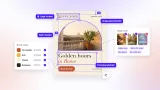
Add the Half Tone effect to a photo or graphic, and it overlays a dot pattern on the image.
Set the angle and scale
Turn the pattern to any angle and change its scale, from fine dots to large ones.
Combine it with other effects
Stack it with effects such as Duotone for a two-color look. The order of the effects changes the result.
Halftone Effects in Posters and Merch
Retro posters
A poster template applies a coarse halftone to its hero photo, so every customer’s version gets the same printed-dot style.
Merch graphics
A merch editor lets customers turn a photo into a bold dot graphic for a tee or sticker before they order.
Links
Documentation and references for this concept.
Related Terms
DPI vs. PPI
Two measures of resolution that often get mixed up. PPI counts the pixels per inch of a digital image, and DPI counts th…
CMYK vs. RGB
The two color models behind screen and print. RGB adds red, green, and blue light, while CMYK layers four process inks a…
Registration Marks
Alignment targets placed beyond the finished edge of a printed piece. They print on every color plate, so the press oper…
Print Resolution
How many pixels of an image land in each inch of paper once it prints, usually requested as 300 DPI. CE.SDK's scene DPI …
Screen Printing vs. DTG
The two main ways to print apparel: screen printing lays down one ink per mesh screen, DTG sprays full color directly on…