
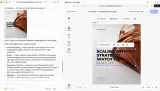


Set up CE.SDK with Claude Desktop
Claude Desktop is Anthropic’s desktop app, and the fastest way for a product person to explore what CE.SDK can do. Connect the CE.SDK MCP server and it answers from the live docs: scope a feature, write a build spec, then hand it to a coding agent.
This page is about an agent that writes your CE.SDK integration. For an agent that makes the designs, see CoDesign, the free MCP server or, for your product, CoDesign SDK.
Before you start
No terminal, no config files, no license key. You need two things.
- Claude Desktop installed and signed in.
- A recent version: custom connectors ship in current releases, so update if you haven’t in a while.
From connector to build spec in three steps
Add the CE.SDK connector
Four clicks, no API key: open Settings in Claude Desktop via your profile icon, select Connectors in the sidebar, choose Add custom connector, then paste the server URL and click Add.
https://mcp.img.ly/mcpVerify it works
Confirm the connector shows as connected in Settings, then ask a test question. If the answer cites CE.SDK documentation, you’re set.
What export formats does CE.SDK support?Scope your product against the docs
This is where Claude Desktop shines for product work: check what CE.SDK covers out of the box, pressure-test an idea, and turn it into a spec a coding agent can build from.
Using the IMG.LY docs, write a one-page build spec for an ad designer:
stock photos from Unsplash, background removal for product shots, AI image
generation for campaign variants, and PNG plus print-ready PDF export. List
what CE.SDK provides out of the box, what needs configuration, and a
step-by-step plan I can hand to a coding agent.
What you can do
Ask CE.SDK questions and get answers grounded in the live documentation.
Scope a feature
Ask what CE.SDK covers out of the box, what needs configuration, and where the limits are, before anyone writes code.
Answer from the docs
Get exact capabilities, configuration options, and integration steps straight from the current reference docs, not stale training data.
Write the spec
Turn a product idea into a build plan with requirements and steps, ready to hand to Claude Code, Cursor, or your dev team.
Example prompts
Ask in plain language once the connector is added.
We want users to design social posts inside our app without leaving it. What does CE.SDK give us out of the box, and what would we build ourselves? Can CE.SDK do background removal and AI image generation in the browser? What video features does CE.SDK support: trimming, captions, audio, export? Write a build spec for a greeting card maker: seasonal templates, photo upload with filters, and print-ready PDF export Draft a comparison of building our own editor versus embedding CE.SDK, based on what the docs say it handles Ready to build? Hand off the spec
Claude Desktop researches and specs; a coding agent builds. Paste the spec you wrote into Claude Code, Cursor, or another agent from the list below and it scaffolds a working CE.SDK editor from it.
Tips
Get better answers from the connector.
- Name your platform in the question (web, iOS, Android) so answers match your stack.
- Ask for sources: “link the docs pages you used” makes specs easy for your team to verify.
- End scoping chats with “summarize this as a build spec” so nothing gets lost in the thread.
- Custom connectors need a recent Claude Desktop version; update if you don’t see the option.
Set up another agent
Point a different coding agent at CE.SDK.
Scope it here, build it anywhere
Add the connector, spec your editor from the live docs, and hand the plan to your coding agent.
Claude Desktop FAQs
Claude Desktop is a chat app: it researches, scopes, and specs from the live CE.SDK docs, but it doesn't scaffold and run projects on your machine. Pair it with a coding agent like Claude Code, Cursor, or Copilot for the build, ideally starting from a spec you wrote together in Claude Desktop.
No. The CE.SDK MCP server at https://mcp.img.ly/mcp requires no authentication. Add it as a custom connector and you're ready.
It connects Claude Desktop to real-time CE.SDK documentation search over the Model Context Protocol, so answers stay grounded in the current docs instead of the model's training data.
Update Claude Desktop to the latest version; custom connectors are only available in recent releases.