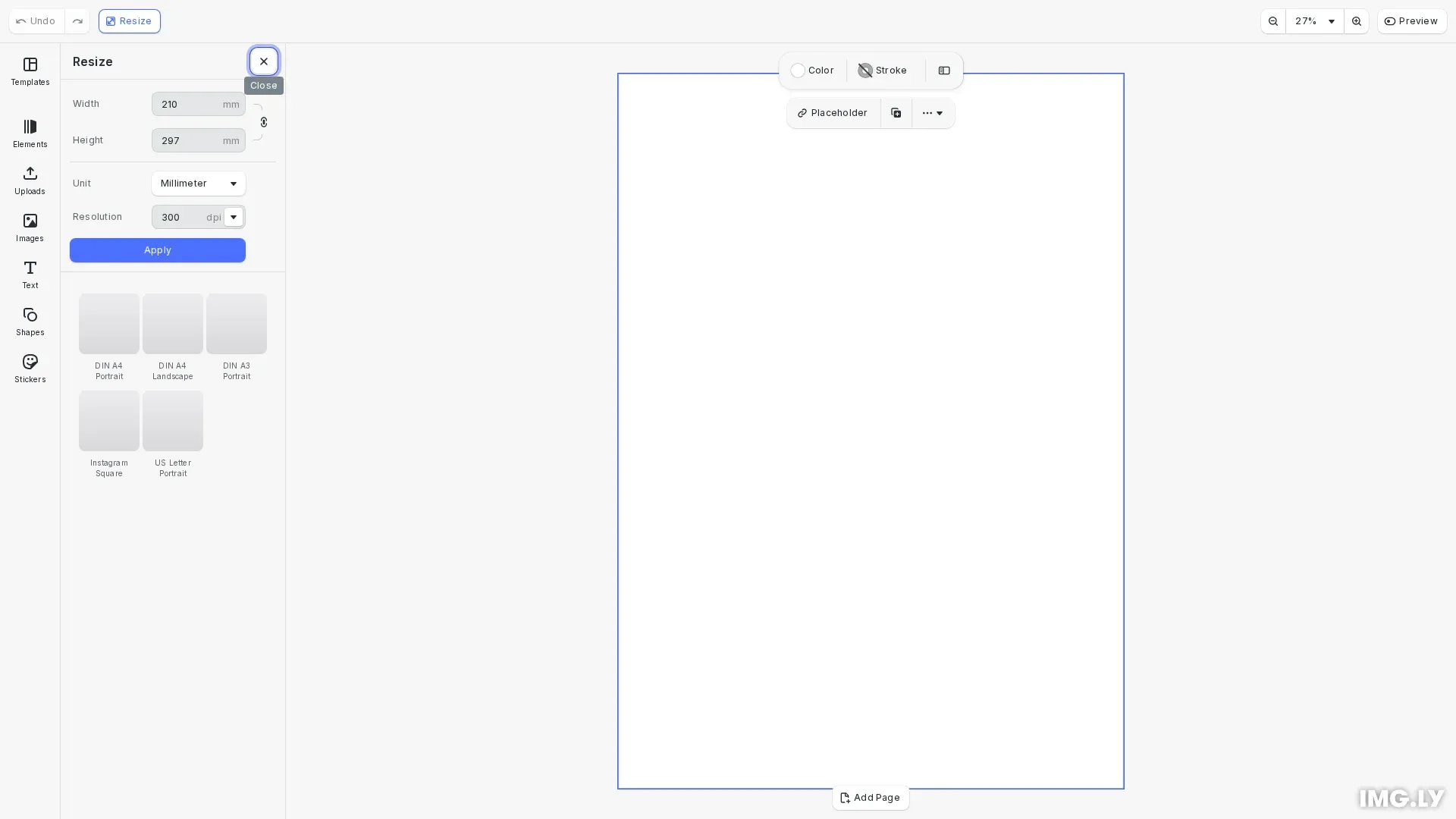
CE.SDK includes a built-in page format selector in the resize panel that lets users choose from predefined page sizes. You can customize which formats appear by registering custom asset sources. This is useful when offering print-ready formats, specific social media dimensions, or limiting available sizes for brand consistency.
This guide covers how to create custom page format presets, configure dimensions using different design units, and register formats with the built-in resize panel.
Using the Built-in Page Format UI#
The page format selector is part of the resize panel, which users with the Creator role can access from the document inspector. When a user selects a format, the page dimensions change accordingly. The orientation toggle allows switching between portrait and landscape unless the format has a fixed orientation.
To display custom formats in this panel, you register them with the ly.img.pagePresets asset library entry using updateAssetLibraryEntry. Your custom formats then appear alongside or replace the default options.
Adding Default Asset Sources#
Before adding custom formats, we load the default CE.SDK asset sources to ensure the editor has access to standard assets.
await cesdk.addPlugin(new DesignEditorConfig());
// Add asset source pluginsawait cesdk.addPlugin(new BlurAssetSource());await cesdk.addPlugin(new ImageColorsAssetSource());await cesdk.addPlugin(new ColorPaletteAssetSource());await cesdk.addPlugin(new CropPresetsAssetSource());await cesdk.addPlugin(  new UploadAssetSources({ include: ['ly.img.image.upload'] }));await cesdk.addPlugin(  new DemoAssetSources({    include: [      'ly.img.templates.blank.*',      'ly.img.templates.presentation.*',      'ly.img.templates.print.*',      'ly.img.templates.social.*',      'ly.img.image.*'    ]  }));await cesdk.addPlugin(new EffectsAssetSource());await cesdk.addPlugin(new FiltersAssetSource());await cesdk.addPlugin(new PagePresetsAssetSource());await cesdk.addPlugin(new StickerAssetSource());await cesdk.addPlugin(new TextAssetSource());await cesdk.addPlugin(new TextComponentAssetSource());await cesdk.addPlugin(new TypefaceAssetSource());await cesdk.addPlugin(new VectorShapeAssetSource());
Creating a Custom Page Format Source#
We create a local asset source to hold our custom page formats. Each format is added as an asset with a payload.transformPreset property that defines its dimensions.
// Create a local asset source to hold custom page formatsengine.asset.addLocalSource('my-custom-formats');Adding Page Format Assets#
Each page format asset requires a payload.transformPreset configuration with the following properties:
type: Must be'FixedSize'for page format presetswidth: Page width in the specified design unitheight: Page height in the specified design unitdesignUnit: Unit for dimensions ('Pixel','Millimeter', or'Inch')
You can also set optional properties in the meta object:
default: Boolean to mark as the default format applied when creating new scenesfixedOrientation: Boolean to prevent orientation changes in the UI
Using Millimeter Dimensions#
For print formats, we specify dimensions in millimeters. Setting default: true on a format makes it the initial page size when creating a new scene.
// Add print formats using millimeter dimensionsengine.asset.addAssetToSource('my-custom-formats', { id: 'a4-portrait', label: { en: 'A4 Portrait' }, payload: { transformPreset: { type: 'FixedSize', width: 210, height: 297, designUnit: 'Millimeter' } }, meta: { default: 'true' }});engine.asset.addAssetToSource('my-custom-formats', { id: 'a5-landscape', label: { en: 'A5 Landscape' }, payload: { transformPreset: { type: 'FixedSize', width: 210, height: 148, designUnit: 'Millimeter' } }});Using Pixel Dimensions#
For digital formats like social media, we use pixel dimensions. Setting fixedOrientation: true disables the orientation toggle for formats where aspect ratio should not change.
// Add digital format using pixel dimensionsengine.asset.addAssetToSource('my-custom-formats', { id: 'instagram-square', label: { en: 'Instagram Square' }, payload: { transformPreset: { type: 'FixedSize', width: 1080, height: 1080, designUnit: 'Pixel' } }, meta: { fixedOrientation: 'true' }});Using Inch Dimensions#
For formats common in regions using imperial measurements, we specify dimensions in inches.
// Add format using inch dimensionsengine.asset.addAssetToSource('my-custom-formats', { id: 'letter', label: { en: 'US Letter' }, payload: { transformPreset: { type: 'FixedSize', width: 8.5, height: 11, designUnit: 'Inch' } }});Registering Custom Sources with the UI#
We use updateAssetLibraryEntry to configure which sources appear in the page format selector. The ly.img.pagePresets entry ID controls the resize panel’s page format UI.
// Register custom formats with the page format selectorcesdk.ui.updateAssetLibraryEntry('ly.img.pagePresets', { sourceIds: ['my-custom-formats']});By specifying only our custom source ID, we replace the default formats entirely. To keep the default formats alongside custom ones, include 'ly.img.page.presets' in the sourceIds array:
cesdk.ui.updateAssetLibraryEntry('ly.img.pagePresets', { sourceIds: ['ly.img.page.presets', 'my-custom-formats']});Applying Formats to Existing Pages#
By default, applying a page format from the resize panel creates a new page with that format. To apply formats to an existing page instead, we register an apply middleware that intercepts format application.
// Register middleware to apply formats to existing pages instead of creating new onesengine.asset.registerApplyMiddleware( async (sourceId, assetResult, apply, context) => { if (sourceId === 'my-custom-formats') { const pages = engine.block.findByType('page'); if (pages.length > 0) { await engine.asset.applyToBlock(sourceId, assetResult, pages[0]); await engine.scene.zoomToBlock(pages[0]); return pages[0]; } return undefined; } return apply(sourceId, assetResult, context); });The middleware checks if the applied asset comes from your custom format source. If so, it applies the format to the first page using applyToBlock instead of creating a new page. After applying, it zooms to show the updated page dimensions.
Page Orientation#
Orientation is determined by the width and height values in the format definition. When width is greater than height, the format defaults to landscape. When height is greater than width, it defaults to portrait.
Users can toggle orientation in the resize panel unless fixedOrientation is set to true in the preset. This is useful for formats like Instagram Square where the 1:1 aspect ratio should remain fixed.
Creating the Scene#
After configuring the page formats, we create a design scene. The format marked with default: true is automatically applied.
await cesdk.actions.run('scene.create', { page: { sourceId: 'ly.img.page.presets', assetId: 'ly.img.page.presets.print.iso.a6.landscape' }});Opening the Resize Panel on Startup#
To give users immediate access to page formats when the editor loads, we open the resize panel programmatically after creating the scene.
// Open the page resize panel on startupcesdk.ui.openPanel('//ly.img.panel/inspector/pageResize');Troubleshooting#
- Custom formats not appearing: Verify the source is registered with
updateAssetLibraryEntrybefore creating the scene - Default format not applied: Ensure the asset source with the default format is loaded before scene initialization
- Orientation toggle disabled: Check if
fixedOrientationis set totruein the preset
API Reference#
| Method | Category | Description |
|---|---|---|
cesdk.addPlugin(new XyzAssetSource()) |
CESDK | Add individual asset source plugins (imported from @cesdk/cesdk-js/plugins) |
cesdk.engine.asset.addLocalSource(sourceId) |
Asset | Create a new local asset source for page formats |
cesdk.engine.asset.addAssetToSource(sourceId, asset) |
Asset | Add a page format asset to a local source |
cesdk.engine.asset.registerApplyMiddleware(middleware) |
Asset | Register middleware to intercept asset application |
cesdk.engine.asset.applyToBlock(sourceId, asset, block) |
Asset | Apply an asset to a specific block |
cesdk.ui.updateAssetLibraryEntry(id, options) |
UI | Configure which sources appear in the page format selector |
cesdk.ui.openPanel(panelId) |
UI | Open a panel programmatically |