Text variables enable data-driven template personalization in CE.SDK. Insert
placeholder tokens like {{ firstName }} into text blocks, then populate them
with actual values programmatically. This separates design from content,
enabling automated document generation, batch processing, and mass
personalization workflows.
This guide covers how to discover, create, update, and manage text variables both through the UI and programmatically using the Variables API.
Introduction#
Text variables allow you to design templates once and personalize them with different content for each use. At render time, CE.SDK replaces variable tokens with actual values provided through the Variables API. This approach is ideal for:
- Automated document generation - Certificates, invoices, reports
- Mass personalization - Marketing materials with recipient data
- Data-driven design - Templates populated from JSON, CSV, or APIs
- Form-based editing - Expose variables through custom interfaces
Using the Built-in Insert Variable UI#
CE.SDK includes an Insert Variable dropdown in the text editing canvas menu that allows template authors to insert variable tokens into text blocks.
To use the Insert Variable UI:
- Define variables using
engine.variable.setString()— the dropdown won’t appear without this step - Enter text edit mode by double-clicking a text block
- Click the Insert Variable dropdown in the canvas menu (or press
Ctrl+Shift+L/Cmd+Shift+L)
The dropdown allows you to:
- Insert tokens into text blocks using
{{variableName}}syntax - Select from all defined variables in the current scene
Variables appear with localized labels when you configure translations through the i18n API.
Discovering Variables#
When working with templates that already contain variables, discover what variables exist before populating them with values.
// Pattern 1: Discover all existing variables in the scene// This is useful when loading templates to see what variables need valuesconst existingVariables = engine.variable.findAll();console.log('Existing variables:', existingVariables); // []The findAll() method returns an array of all variable keys defined in the scene. This is essential when loading templates to understand what data needs to be provided.
Creating and Updating Variables#
Create or update variables using setString(). If the variable doesn’t exist, it will be created. If it already exists, its value will be updated.
// Pattern 2: Create and update text variables// If a variable doesn't exist, setString() creates it// If it already exists, setString() updates its valueengine.variable.setString('firstName', 'Alex');engine.variable.setString('lastName', 'Smith');engine.variable.setString('email', 'alex.smith@example.com');engine.variable.setString('company', 'IMG.LY');engine.variable.setString('title', 'Creative Developer');Reading Variable Values#
Retrieve the current value of a variable at runtime using getString(). This is useful for validation or displaying current values in custom UI.
// Pattern 3: Read variable values at runtimeconst firstName = engine.variable.getString('firstName');console.log('First name variable:', firstName); // 'Alex'Binding Variables to Text Blocks#
Insert variable tokens directly into text block content using the {{variableName}} syntax. CE.SDK automatically detects and resolves these tokens at render time.
Single Variable#
    // Create a single comprehensive text block demonstrating all variable patterns    const textBlock = engine.block.create('text');
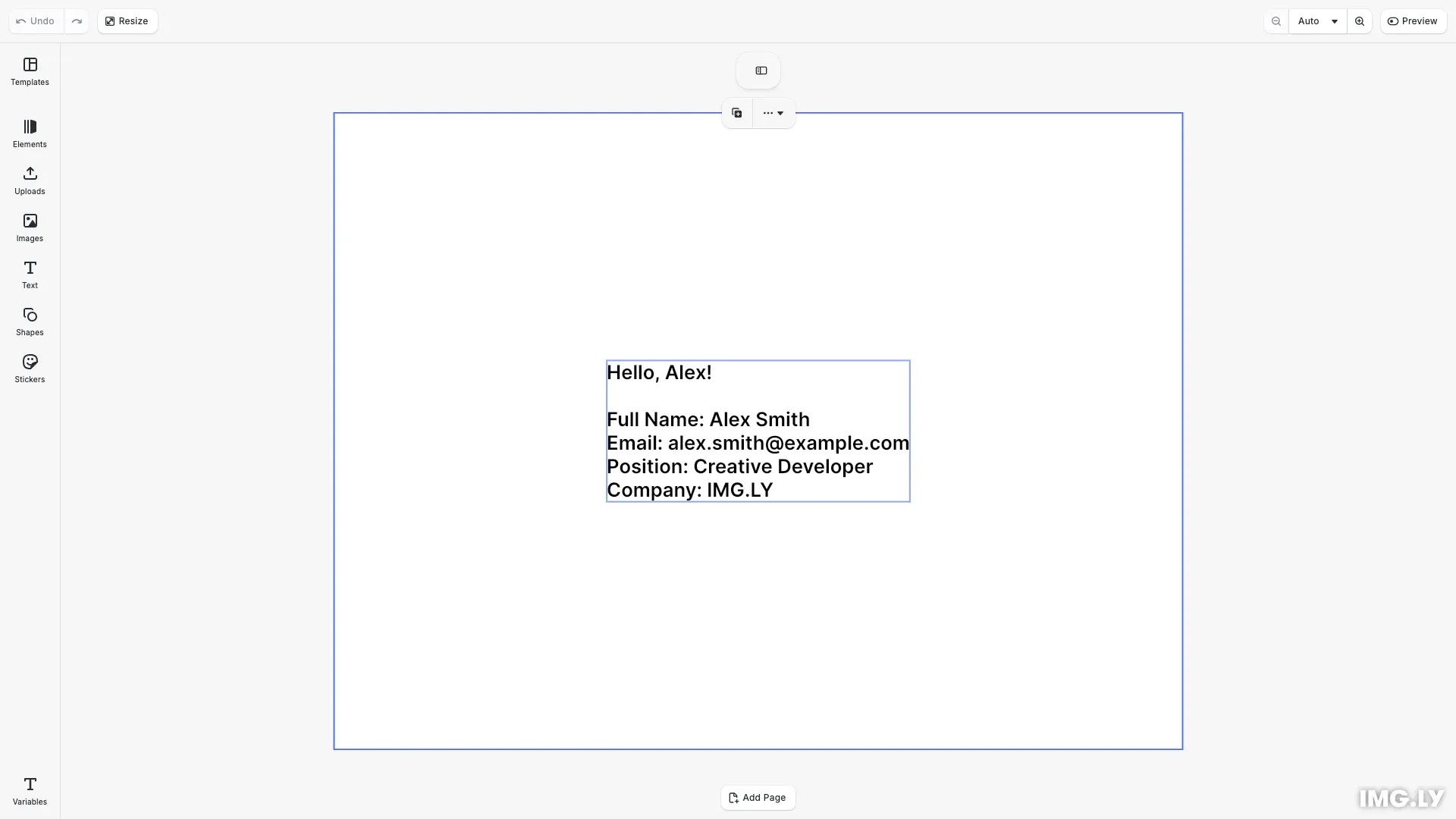
    // Multi-line text combining:    // - Single variable ({{firstName}})    // - Multiple variables ({{firstName}} {{lastName}})    // - Variables in context (Email: {{email}})    const textContent = `Hello, {{firstName}}!
Full Name: {{firstName}} {{lastName}}Email: {{email}}Position: {{title}}Company: {{company}}`;
    engine.block.replaceText(textBlock, textContent);    engine.block.setWidthMode(textBlock, 'Auto');    engine.block.setHeightMode(textBlock, 'Auto');    engine.block.setFloat(textBlock, 'text/fontSize', 52);    engine.block.appendChild(page, textBlock);
Multiple Variables#
Combine multiple variables in a single text block:
    // Create a single comprehensive text block demonstrating all variable patterns    const textBlock = engine.block.create('text');
    // Multi-line text combining:    // - Single variable ({{firstName}})    // - Multiple variables ({{firstName}} {{lastName}})    // - Variables in context (Email: {{email}})    const textContent = `Hello, {{firstName}}!
Full Name: {{firstName}} {{lastName}}Email: {{email}}Position: {{title}}Company: {{company}}`;
    engine.block.replaceText(textBlock, textContent);    engine.block.setWidthMode(textBlock, 'Auto');    engine.block.setHeightMode(textBlock, 'Auto');    engine.block.setFloat(textBlock, 'text/fontSize', 52);    engine.block.appendChild(page, textBlock);
The variables resolve in place, maintaining the surrounding text and formatting.
Detecting Variable References#
Check if a block contains variable references using referencesAnyVariables(). This returns true if the block’s text contains any {{variable}} tokens.
// Check if the block contains variable referencesconst hasVariables = engine.block.referencesAnyVariables(textBlock);console.log('Text block has variables:', hasVariables); // trueThis is useful for identifying which blocks need variable values before export or for implementing validation logic.
Removing Variables#
Remove unused variables from the scene with remove(). This cleans up the variable store when certain variables are no longer needed.
// Create and then remove a temporary variable to demonstrate removalengine.variable.setString('tempVariable', 'Temporary Value');console.log('Variables before removal:', engine.variable.findAll());
// Remove the temporary variableengine.variable.remove('tempVariable');console.log('Variables after removal:', engine.variable.findAll());
After removal, the variable no longer exists in the scene. Text blocks that reference removed variables will display the token literally (e.g., {{removedVar}}).
Localizing Variable Labels#
In CE.SDK (with UI), display friendly labels for variables in the inspector panel using i18n translations. Map variable keys to human-readable names that appear in the UI.
// Localize variable labels that appear in the Variables panel UIcesdk.i18n.setTranslations({ en: { 'variables.firstName.label': 'First Name', 'variables.lastName.label': 'Last Name', 'variables.email.label': 'Email Address', 'variables.company.label': 'Company Name', 'variables.title.label': 'Job Title' }});Without localization, the Insert Variable dropdown shows the technical variable key (e.g., firstName). With localization, it shows the friendly label (e.g., “First Name”).
Combining with Other Features#
Text variables work seamlessly with other CE.SDK template features:
With Placeholders#
Use placeholders for dynamic images and videos while variables personalize text content. This combination enables fully dynamic templates where both visuals and copy change per use case.
With Editing Constraints#
Lock layout elements while allowing only variable token editing. This ensures brand consistency while enabling content personalization.
With Role-Based Editing#
Show the Insert Variable dropdown only to template authors (Creator role) and hide it from end users (Adopter role). This guides the editing experience based on user permissions.
Building a Variables Manager Panel#
CE.SDK’s built-in Insert Variable dropdown only allows users to insert existing variables — it doesn’t provide a UI for creating or managing variables. If you want end users to create, edit, and delete variables through the editor interface, you can build a custom panel using the Panel Builder API.
The following example creates a Variables Manager panel with:
- A form to create new variables with a name and default value
- A list of existing variables with editable values and delete buttons
- A dock button to toggle the panel
// Build a custom Variables Manager panel// CE.SDK doesn't include a built-in UI for creating/managing variables,// so you can build one using the Panel Builder APIcesdk.ui.registerPanel(  'ly.img.variablesManager',  ({ builder, engine: panelEngine, state }) => {    const { Section, TextInput, Button } = builder;
    // State for creating new variables    const newVariableName = state('newVariableName', '');    const newVariableValue = state('newVariableValue', '');
    // Section: Create New Variable    Section('create-variable', {      title: 'Create New Variable',      children: () => {        TextInput('new-name', {          inputLabel: 'Variable Name',          ...newVariableName        });
        TextInput('new-value', {          inputLabel: 'Default Value',          ...newVariableValue        });
        Button('create-btn', {          label: 'Create Variable',          color: 'accent',          isDisabled: !newVariableName.value.trim(),          onClick: () => {            const name = newVariableName.value.trim();            if (name) {              panelEngine.variable.setString(name, newVariableValue.value);              newVariableName.setValue('');              newVariableValue.setValue('');            }          }        });      }    });
    // Section: Existing Variables    const variables = panelEngine.variable.findAll();    Section('existing-variables', {      title: `Manage Variables (${variables.length})`,      children: () => {        if (variables.length === 0) {          builder.Text('no-vars', { content: 'No variables defined yet.' });          return;        }
        variables.forEach(varName => {          TextInput(`var-${varName}`, {            inputLabel: varName,            value: panelEngine.variable.getString(varName),            setValue: value => {              panelEngine.variable.setString(varName, value);            },            suffix: {              icon: '@imgly/TrashBin',              tooltip: 'Delete variable',              onClick: () => {                panelEngine.variable.remove(varName);              }            }          });        });      }    });  });
// Set the panel titlecesdk.i18n.setTranslations({  en: {    'panel.ly.img.variablesManager': 'Custom Variables Panel'  }});
// Add a dock button to open the panelcesdk.ui.registerComponent('variablesManager.dock', ({ builder: b }) => {  const isPanelOpen = cesdk.ui.isPanelOpen('ly.img.variablesManager');  b.Button('variables-dock-btn', {    label: 'Variables',    icon: '@imgly/Text',    onClick: () => {      if (isPanelOpen) {        cesdk.ui.closePanel('ly.img.variablesManager');      } else {        cesdk.ui.openPanel('ly.img.variablesManager');      }    },    isActive: isPanelOpen  });});
// Add button to dockcesdk.ui.setComponentOrder({ in: 'ly.img.dock' }, [  ...cesdk.ui.getComponentOrder({ in: 'ly.img.dock' }),  'ly.img.spacer',  'variablesManager.dock']);
This panel integrates with the dock and provides a complete variable management experience. Users can create new variables, edit existing values, and remove variables they no longer need.
API Reference#
| Method | Description |
|---|---|
engine.variable.findAll() |
Get array of all variable keys in the scene |
engine.variable.setString() |
Create or update a text variable |
engine.variable.getString() |
Read the current value of a variable |
engine.variable.remove() |
Delete a variable from the scene |
engine.block.referencesAnyVariables() |
Check if a block contains variable tokens |
engine.block.replaceText() |
Set text content (supports variable tokens) |
cesdk.i18n.setTranslations() |
Set UI labels for variable names |