The navigation bar is the horizontal toolbar at the top of the editor containing buttons for back navigation, undo/redo, zoom controls, and action buttons. This guide covers navigation bar-specific features like the actions dropdown, back/close buttons, and callback integration.
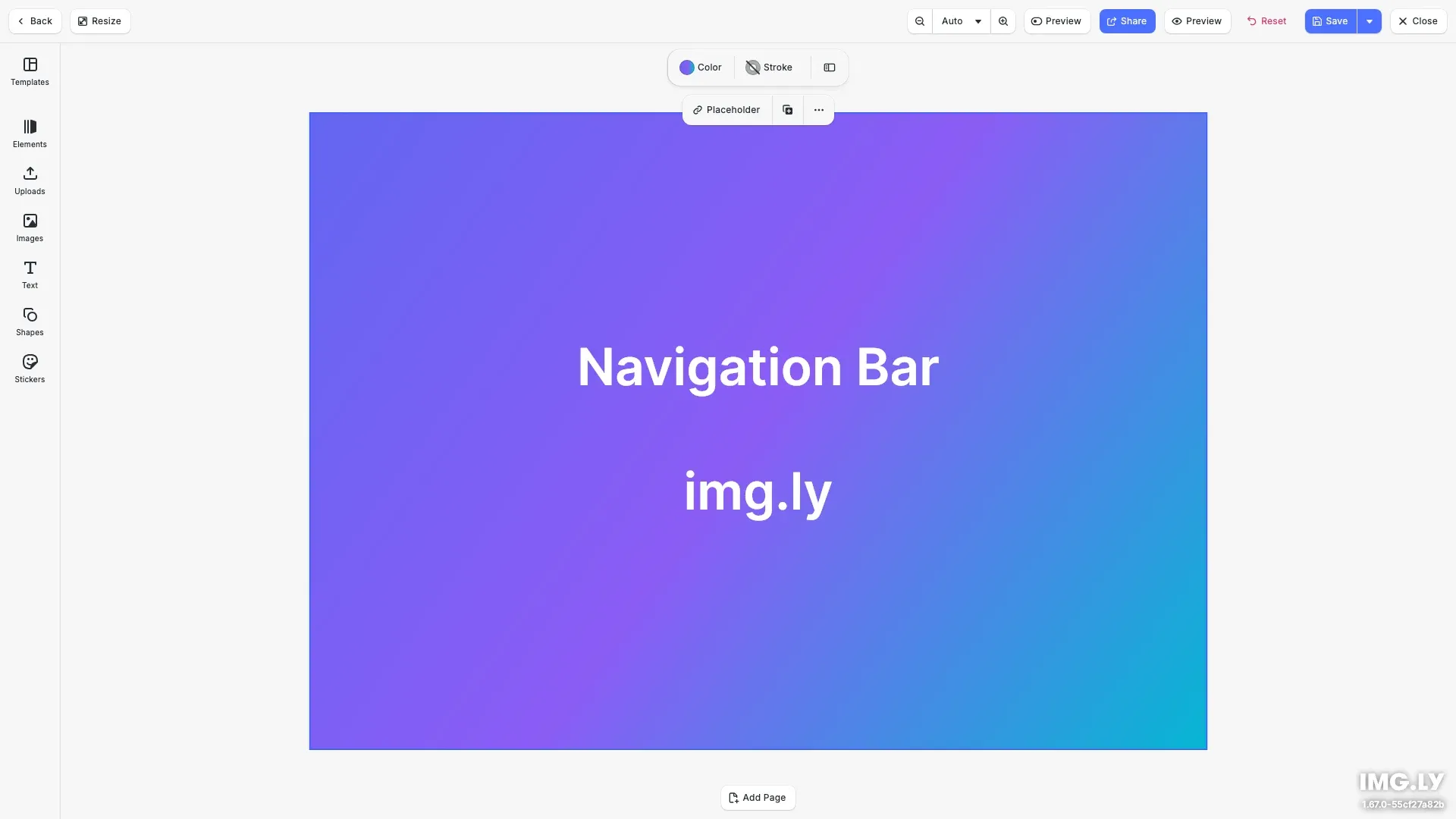
Actions that affect browser navigation (e.g., going back or closing the editor), have global effects on the scene (e.g., undo/redo and zoom), or process the scene in some way (e.g., saving and exporting) belong in the navigation bar.
For general component manipulation (reordering, inserting, removing), see the Component Order API Reference. For a complete list of navigation bar component IDs, see the Component Reference.
This guide covers:
- Showing or hiding the navigation bar and sub-components
- Configuring the actions dropdown with grouped actions
- Adding back and close buttons with handlers
- Customizing button styles and variants
- Integrating with the Callbacks API
Show or Hide the Navigation Bar#
Use the Feature API to control navigation bar visibility. The Feature API hides features globally across the entire editor.
// Hide undo/redo using the Feature APIcesdk.feature.disable('ly.img.navigation.undoRedo');The following feature keys control navigation bar sub-components:
| Feature Key | Controls |
|---|---|
ly.img.navigation.bar |
Entire navigation bar |
ly.img.navigation.undoRedo |
Undo/redo buttons |
ly.img.navigation.zoom |
Zoom controls |
ly.img.navigation.preview |
Preview toggle |
ly.img.navigation.documentSettings |
Document settings button |
For more visibility control options, see Show/Hide Components.
Add Back and Close Buttons#
Back and close buttons only appear when explicitly inserted with an onClick handler. Use insertOrderComponent with explicit positioning to place them at the start and end of the navigation bar.
Add a back button at the start using position: 'start':
// Insert a back button at the start of the navigation barcesdk.ui.insertOrderComponent( { in: 'ly.img.navigation.bar', position: 'start' }, { id: 'ly.img.back.navigationBar', onClick: () => { console.log('Back button clicked'); window.history.back(); } });Add a close button at the end using position: 'end':
// Insert a close button at the end of the navigation barcesdk.ui.insertOrderComponent( { in: 'ly.img.navigation.bar', position: 'end' }, { id: 'ly.img.close.navigationBar', onClick: () => { console.log('Close button clicked'); } });Both buttons require an onClick handler. Without one, the button will not render.
Configure the Actions Dropdown#
The ly.img.actions.navigationBar component groups multiple actions into a dropdown menu. The first child appears as a prominent button, while additional children appear in the overflow dropdown.
The actions dropdown is not in the navigation bar by default. Use insertOrderComponent to add it with your own actions:
// Insert the actions dropdown with export optionscesdk.ui.insertOrderComponent( { in: 'ly.img.navigation.bar', before: 'ly.img.close.navigationBar' }, { id: 'ly.img.actions.navigationBar', children: [ { id: 'ly.img.saveScene.navigationBar', onClick: async () => { const scene = await cesdk.engine.scene.saveToString(); console.log('Scene saved:', scene.length, 'characters'); cesdk.ui.showNotification({ message: 'Scene saved to console', type: 'success', duration: 'short' }); } }, { id: 'ly.img.exportImage.navigationBar', onClick: async () => { const { blobs } = await cesdk.utils.export({ mimeType: 'image/png' }); cesdk.utils.downloadFile(blobs[0], 'image/png'); } }, { id: 'ly.img.action.navigationBar', key: 'print', label: 'Print', icon: '@imgly/Print', onClick: () => { window.print(); } } ] });Children can be built-in action buttons (referenced by ID like ly.img.saveScene.navigationBar) or custom actions with a unique key. Each child needs an onClick handler to define its behavior.
Button Styles and Variants#
Custom action buttons support different visual styles through the variant and color properties.
// Add buttons demonstrating different style variantscesdk.ui.insertOrderComponent( { in: 'ly.img.navigation.bar', before: 'ly.img.close.navigationBar' }, [ // Regular variant (default) - standard button appearance { id: 'ly.img.action.navigationBar', key: 'preview', label: 'Preview', icon: '@imgly/EyeOpen', variant: 'regular' as const, onClick: () => { cesdk.ui.showNotification({ message: 'Opening preview...', type: 'info', duration: 'short' }); } }, // Plain variant - subtle/borderless appearance { id: 'ly.img.action.navigationBar', key: 'reset', label: 'Reset', icon: '@imgly/Reset', variant: 'plain' as const, color: 'danger' as const, onClick: () => { cesdk.ui.showNotification({ message: 'Reset would clear all changes', type: 'warning', duration: 'short' }); } } ]);The available properties for action buttons are:
| Property | Type | Description |
|---|---|---|
key |
string |
Unique identifier (required for custom actions) |
label |
string |
Text label or i18n key |
icon |
string |
Icon from the Essentials set or custom icon via addIconSet |
variant |
'regular' | 'plain' |
Button style (default: 'regular') |
color |
'accent' | 'danger' |
Button color for emphasis |
onClick |
() => void | Promise<void> |
Click handler (shows spinner if returning a promise) |
isDisabled |
boolean |
Disable the button |
isLoading |
boolean |
Show loading state |
Integration with Callbacks API#
Action buttons can trigger registered callbacks. Register a callback using cesdk.actions.register(), then reference it by inserting a built-in action button that maps to that callback name.
// Register a custom callbackcesdk.actions.register('saveScene', async () => { const scene = await cesdk.engine.scene.saveToString(); console.log('Custom save callback:', scene.length, 'characters'); cesdk.ui.showNotification({ message: 'Scene saved via custom callback', type: 'success', duration: 'short' });});When you insert a built-in action button by its ID (e.g., ly.img.saveScene.navigationBar), it will call the registered callback with the matching name. You can also override the default behavior by providing a custom onClick handler directly on the button.
Default Callback Behaviors#
When using built-in action button IDs without registering a custom callback, the default behavior is triggered:
| Component ID | Callback | Default Behavior |
|---|---|---|
ly.img.saveScene.navigationBar |
saveScene |
Downloads .imgly file |
ly.img.importScene.navigationBar |
importScene |
Opens file picker for .imgly or .scene |
ly.img.exportImage.navigationBar |
exportDesign |
Exports and downloads image |
ly.img.exportPDF.navigationBar |
exportDesign |
Exports and downloads PDF |
ly.img.exportVideo.navigationBar |
exportDesign |
Exports and downloads video |
ly.img.shareScene.navigationBar |
shareScene |
Requires callback registration |
Standalone Action Buttons#
In addition to the actions dropdown, you can insert standalone action buttons directly into the navigation bar. This is useful for frequently-used actions that should always be visible.
// Add a standalone action button with accent stylingcesdk.ui.insertOrderComponent( { in: 'ly.img.navigation.bar', before: 'ly.img.close.navigationBar' }, { id: 'ly.img.action.navigationBar', key: 'share', label: 'Share', icon: '@imgly/Share', color: 'accent', onClick: async () => { cesdk.ui.showNotification({ message: 'Share dialog would open here', type: 'info', duration: 'short' }); } });Standalone buttons appear alongside the other navigation bar components. Use the before and after position options to control placement relative to other components.
Troubleshooting#
- Back/close button not appearing — These require an explicit
onClickhandler when inserted. - Actions not showing children — Ensure
childrenarray contains valid action components with uniquekeyvalues. - Sub-component still visible after disable — Verify exact Feature API key spelling.
Next Steps#
- Component Order API Reference — Full API for component manipulation
- Component Reference — All navigation bar component IDs
- Add Action Buttons — Quick start for adding simple buttons
- Register New Component — Create fully custom components