


IMG.LY vs. Polotno
Looking for full customization, scalability, and enterprise-grade features? With IMG.LY, you get it all. See why CreativeEditor SDK is the best alternative to Polotno.
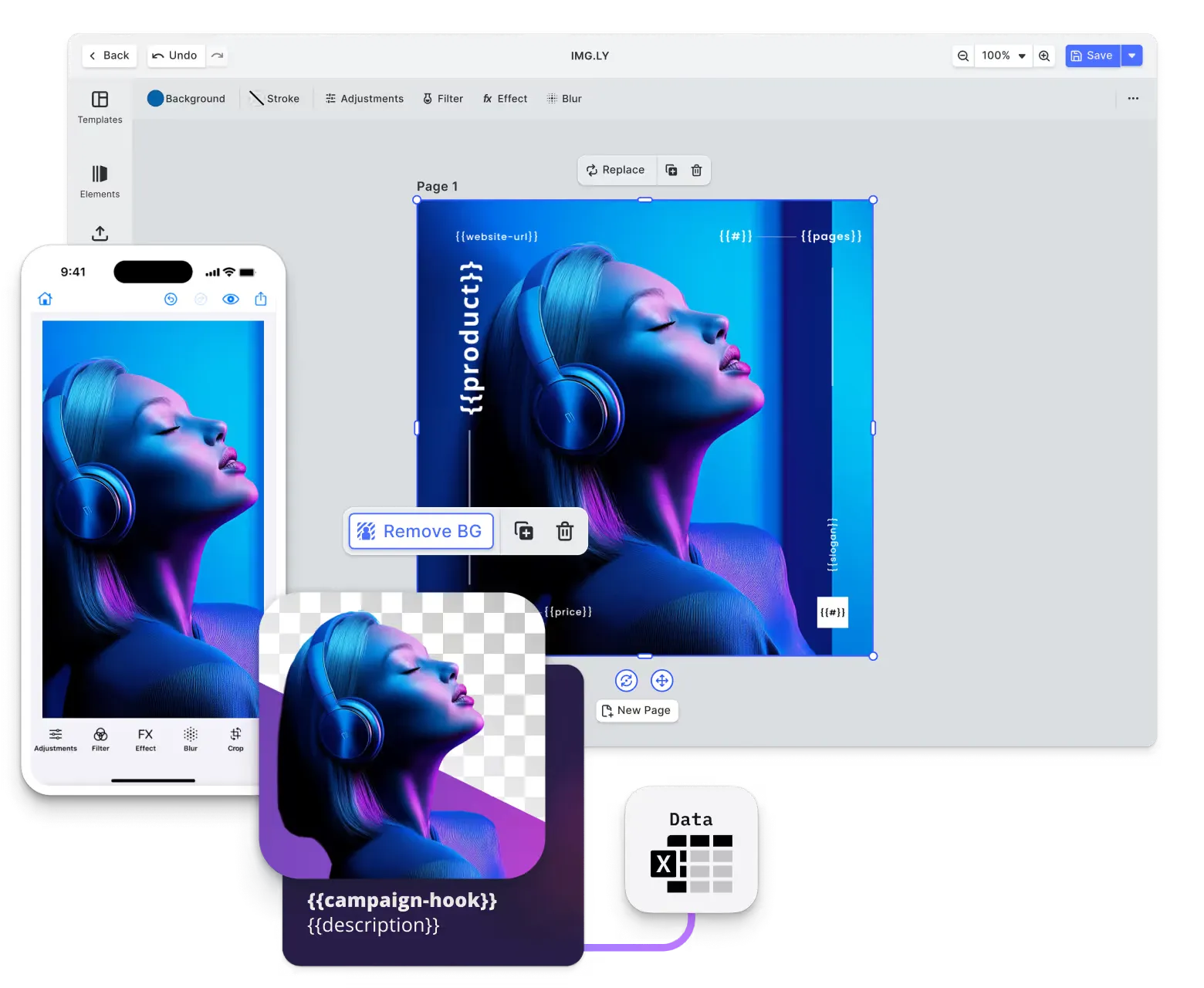
What makes IMG.LY the best Polotno alternative?
Turn-key solutions
Pre-built editors for specific use cases including print, photo editing, social media design, and short-form video. Drop them in and customize, instead of building the editor surface yourself.
Extensibility & plugin system
A first-class plugin framework lets teams register custom panels, components, AI providers, asset sources, and export formats through a stable contract across every platform.
Advanced video composition
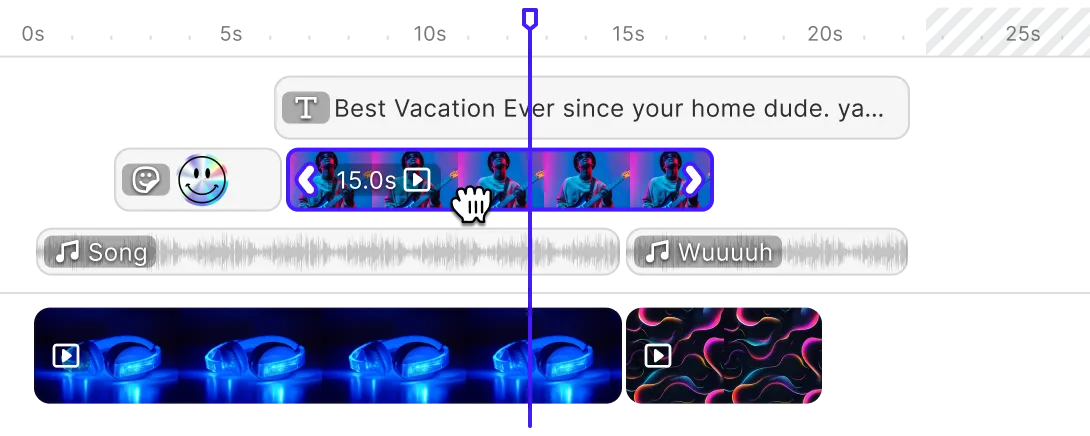
Mix videos, images, overlays, animations, and voice-overs with full creative control across web, iOS, and Android. Multi-track timeline editing on every supported surface.
Creative automation & headless mode
A headless mode on Node.js enables programmatic design generation, batch processing, and automation. The same template definition powers both interactive editing and the pipeline.
Trusted by 100+
industry leaders














What our clients say about us
Integrating IMG.LY’s editor meant we didn’t have to build or maintain a complex editing layer ourselves. That kept our team focused on our core AI ad engine and saved us countless development hours — while still giving our customers the ability to polish and customize creatives at scale.
Hikari Senju
CEO, Omneky

With IMG.LY we built a central creative portal that now powers over 140 dealer campaigns across multiple automotive brands. Before this, asset creation was slow and inconsistent.
Martin Röhr
Product Owner, Digitas

By embedding IMG.LY’s editor we were able to hit key RFP requirements and deliver a template-based creative experience that now serves 1,000+ customers. It helped us win more deals and exceed enterprise expectations without needing to hire dedicated design teams.
Rob Driscoll
Director of PM, Optimizely

Since integrating IMG.LY’s editor, we now deliver 30,000+ ad creatives per month, dramatically shorten time-to-launch, and help our clients cut design spend by up to $10,000 per month.
Logan Welbaum
Founder, Plai

Our customers create over a million personalized postcards each year choosing from over hundreds of templates with IMG.LY’s SDK. It’s the only solution that allows us to build our own specialized, on-brand UI that integrates seamlessly with our platform.
Jeanine Zaalberg
Product Manager, SwissPost

From a developer’s perspective, the most powerful feature of the photo editor is the integration process. It was completely flawless, quick, and easy to integrate.
Stefano Fornari
CTO, Funambol
We compared IMG.LY SDK with other solutions and found that it would be the best fit for us since it provides all the features that are crucial for our use case.
Carem Pereira
SCRUM Manager, HP

IMG.LY vs. Polotno at a glance
| Feature | IMG.LY | Polotno | Notes |
|---|---|---|---|
| Primary Use Case | SDK serving two equal-priority purposes: embedding visual editors into applications for end-user content creation, and enabling headless automation for programmatic asset generation at scale. Handles video editing, graphic design, and print production through unified architecture. Organizations deploy for both user-facing creative tools and backend generation pipelines. Templates and content processes work identically whether users interact through interfaces or automation systems generate outputs via APIs. | JavaScript library and React components for building web-based canvas design editors. Enables developers to create Canva-like editing experiences within web applications. Focuses on static image design and video composition for web platforms. Supports both interactive user editing through browser-based UI and server-side programmatic generation via Node.js. Built on Konva.js canvas library providing foundation for design manipulation and rendering. | IMG.LY provides broader capabilities serving interactive editing and automation with unified cross-platform SDK across all deployment targets. Polotno SDK focuses on React-based canvas editor for web applications only. |
| Target Audience | Organizations building creative systems for two scenarios: embedding editors where end users generate content interactively, and implementing automation where systems create assets programmatically. Serves print-on-demand platforms, marketing automation tools, e-commerce personalization, content management systems, and enterprises requiring both human-driven creativity and systematic asset generation. Addresses businesses needing user interfaces and backend workflows within same deployment. | Web developers and SaaS builders creating design tools within browser-based applications. Targets teams building marketing platforms, social media tools, template systems, digital asset management interfaces, and web-to-print services. Serves businesses requiring embeddable design editors without building from scratch. Focuses on React developers seeking white-label editor components for web products. | IMG.LY targets broader enterprise needs with comprehensive cross-platform creative systems supporting both user editing and automation workflows. Polotno SDK serves web developers building React-based design editors exclusively. |
| Technical Approach | Tri-modal SDK architecture: pre-built UI for deployment, engine APIs for custom interface development, or headless mode for automation. Cross-platform engine ensures consistent rendering across browsers, mobile apps, desktop applications, and Node.js servers. Organizations control deployment architecture and infrastructure. No mandatory cloud services, all processing occurs on controlled infrastructure. | React component library built on Konva.js and MobX for state management. Provides Store for data management, Workspace for canvas rendering, and UI components for editing controls. Primarily browser-based with optional Node.js support via polotno-node package for server-side generation. Requires API key for production use. Offers client-side rendering, self-hosted rendering service, or cloud rendering API options. | IMG.LY offers more comprehensive native cross-platform engine with expanded three integration modes and full infrastructure control. Polotno SDK provides React/Konva-based web components with optional Node.js generation requiring API key. |
| Advanced Video Editing | Includes features tailored for social content creation: animated text captions with customizable styles and timing, video speed controls (slow motion and time-lapse), dual camera/picture-in-picture support, transitions and effects, stickers and overlays, audio mixing, and aspect ratio presets for different platforms. Combines social media editing capabilities with broader creative tools in a single SDK. | Video editing limited to web browsers, no native mobile video editing. Timeline-based video composition combining video clips, images, text, and animations. Supports MP4, MOV, and WebM formats with in-browser decoding and preview. Includes trimming, resizing, masking, and animation capabilities. Video elements rendered alongside design elements on same canvas. Cloud Render API or self-hosted rendering for MP4 and GIF export. | Both provide timeline-based video editing with multi-track composition. IMG.LY offers broader platform coverage with cross-platform deployment and native performance across web, mobile, and desktop. Polotno SDK focuses exclusively on browser-based editing. |
| Advanced Design Editing | Full design editor supporting vector graphics, text manipulation, layout tools, and print-ready output. CMYK and Pantone color support for commercial printing workflows. Collage creation, web-to-print templates, professional typography, adaptive layouts, and role-based permissions. Exports to PNG, JPEG, TGA, binary, and PDF formats for both digital and print media. | Canvas-based design editor supporting text, images, SVG graphics, shapes, and filters. Includes typography controls, visual transformations, selection tools, and layer management. Template system with variable data for personalized designs. Exports to PNG, JPEG, PDF, PPTX, HTML, SVG, GIF, and MP4. Focuses on digital design rather than print-specific workflows. No CMYK or Pantone color space support for commercial printing. | Both provide canvas-based design editing with typography and export capabilities. IMG.LY includes additional comprehensive print workflows with CMYK/Pantone support for commercial printing. Polotno SDK focuses on digital design without print capabilities. |
| Templating & Dynamic Editing | Adaptive template engine with intelligent layouts responding to content dimensions and aspect ratios automatically. Placeholder-based templates populated through visual editors or programmatic APIs with identical template definitions. Role-based permissions enable collaborative template creation with access controls. Templates maintain consistency across interactive editing sessions and automation execution using same specifications for both workflows. | Limited adaptive layout capabilities compared to full layout intelligence systems. Template system supporting variable data and programmatic generation. JSON schema defines templates with placeholders for dynamic content population. Automatic design resizing to fit preferred dimensions with single-click aspect ratio adjustments. Templates work in both browser-based editor and server-side generation. | Both support template-based editing with variable data and programmatic population. IMG.LY offers more advanced adaptive layouts with intelligent resizing and role-based collaboration features. Polotno SDK provides JSON-based templates with basic resizing. |
| Creative Automation | Equal-weight automation alongside interactive capabilities using identical SDK. Headless Node.js operation enables programmatic generation workflows without UI dependencies. Same SDK powers both user-facing editors and backend automation without additional components. Integrates with external databases, CRM systems, and marketing platforms for data-driven asset generation. Templates function identically whether rendered through UI interactions or API calls. Organizations control infrastructure deployment. | Automation capabilities secondary to interactive editing focus. Server-side generation via polotno-node package for Node.js environments. Programmatic design creation using Store API for element manipulation. Supports headless browser rendering with Puppeteer or Playwright for automation workflows. Cloud Render API available for production rendering at scale. Batch processing for multiple design variations. | IMG.LY provides more comprehensive unified SDK enabling equal-weight editing and automation workflows within single deployment. Polotno SDK supports automation through separate Node.js package and rendering services as secondary capability. |
| AI Capabilities | Extensible AI framework allowing custom model integration alongside built-in intelligence. Smart layout algorithms automatically optimize design arrangements for visual appeal and readability. Plugin architecture enables connecting proprietary or third-party AI services for specialized workflows. AI functions as creative assistant while preserving full manual control over outputs. | Limited extensibility for custom AI model integration compared to full plugin frameworks. AI-powered image generation from text prompts integrated into editor. AI proofreading, rewriting, and tone adjustment for text content. Automatic design suggestions and layout recommendations. AI capabilities integrate through cloud services accessed via API. | Both provide AI-powered design assistance and layout optimization. IMG.LY offers greater extensibility with comprehensive framework for custom AI integration and plugin architecture. Polotno SDK focuses on built-in cloud-based AI features with limited extensibility. |
| Asset Management | Federated architecture integrating embedded libraries with external services directly. Getty Images, Unsplash, and Airtable connect without middleware. Organizations extend default libraries with custom sources while maintaining data governance. Manages video and design assets through unified interface. Client-side architecture keeps media under application control without external dependencies. | No pre-built integrations with major stock providers requiring custom implementation. Integration capabilities for stock photos and custom asset sources. Supports connecting external asset libraries through SDK configuration. Local browser storage and cloud storage options for user assets. Auto-save functionality for design preservation. Asset management focuses on web-based workflows. | IMG.LY offers more comprehensive asset management with direct integrations with major providers (Getty, Unsplash, Airtable) and custom sources. Polotno SDK provides integration framework requiring custom implementation for external asset providers. |
| User Interface | Production-ready modular UI components for applications requiring user-facing editors. Canvas interactions with timeline controls, filter palettes, effect adjustments, and audio mixing. Component architecture allows panel reorganization, control replacement, or complete custom UI development. Headless mode bypasses UI entirely for automation. Single SDK supports both visual applications and invisible backend systems. | React component library with pre-built UI including side panels, toolbar, workspace, and zoom controls. Built using Blueprint UI framework for consistent appearance. Customizable components allowing reorganization and custom styling. UI components optional, developers can use only Store and Workspace for completely custom interfaces. No headless mode, requires UI components or custom implementation for rendering. | IMG.LY offers broader deployment flexibility with production-ready UI or additional headless operation for complete automation. Polotno SDK provides customizable React components requiring browser environment with no headless option. |
| White-labeling | Zero-branding architecture with no vendor identification in interfaces or outputs. Visual customization includes complete UI restructuring beyond cosmetic theming. Internationalization support for global deployments. Headless mode eliminates UI entirely for custom implementations. Organizations achieve exact brand alignment including custom color systems matching corporate guidelines. | Paid licenses remove "Powered by Polotno" attribution from outputs and interface. Full UI customization through React component styling and replacement. White-label design editor integration into host applications. Branding-free experience with commercial license. Control over appearance and user experience within browser environments. | Both support complete white-labeling without vendor branding. IMG.LY offers zero-branding by default with additional headless mode option for greater deployment flexibility. Polotno SDK removes attribution with commercial license only. |
| Interactive Editing | Canvas-first interactions with instantaneous visual feedback during manipulation. Timeline navigation, zoom, and playback without server round-trips. Real-time effect preview using GPU acceleration. Consistent behavior across browsers, mobile devices, and desktop applications. Direct manipulation matching professional creative tools rather than code-based workflows. | Interactive editing limited to web browser environments. Real-time canvas editing with immediate visual feedback in browser. Direct manipulation of elements through drag, resize, and transform operations. Undo/redo functionality for all editing actions. | Both provide real-time interactive editing with immediate visual feedback. IMG.LY offers broader cross-platform deployment including native mobile, desktop, and web. Polotno SDK focuses exclusively on browser-based editing. |
| Multi-Layer Editing | Unlimited layer depth for video clips, graphics, audio, and effects with sophisticated composition. Blending modes, opacity controls, and z-axis management enable professional visual effects. Grouping and parent-child relationships create reusable hierarchies. Lock and visibility controls for complex project management. Layer system consistent across web, mobile, and desktop deployments. | Layer-based canvas system with element stacking and z-index control. Grouping capabilities for organizing related elements. Basic blending and opacity controls for composition. Layer management through programmatic API or UI controls. Limited advanced blending modes compared to professional composition systems. Layer functionality optimized for web-based design workflows. | Both support multi-layer editing with stacking and grouping. IMG.LY offers unlimited layer depth with more advanced blending controls and professional-grade capabilities across all platforms. Polotno SDK provides web-optimized layer system with basic blending. |
| Component Architecture | Decoupled engine and editor enabling three integration patterns: full UI, custom UI, or headless operation. Granular component registration for injecting custom functionality without SDK modification. Order APIs for programmatic component layout control. Plugin framework extending capabilities while maintaining upgrade compatibility. Selective component adoption rather than monolithic integration. | Modular React architecture with Store, Workspace, and UI components as separate modules. Store handles data and state management independently from rendering. Workspace provides canvas rendering without UI dependencies. UI components optional and replaceable with custom implementations. Built on React and MobX enabling integration with existing React applications. | IMG.LY offers more comprehensive engine-editor separation with granular plugin architecture enabling unlimited extensibility. Polotno SDK provides React-based modularity with replaceable components within framework constraints. |
| Cross-Platform Support | Platform-spanning coverage including web frameworks (React, Angular, Vue, Svelte, Next.js), native mobile (iOS, Android), cross-platform mobile (React Native, Flutter), desktop (Electron, macOS), and backend (Node.js). Single codebase maintains functional consistency across platforms. Templates render identically on client devices or backend servers. | Web-focused with React, Vue.js, and Angular integration support. Works in modern browsers with HTML5 Canvas support. Server-side rendering via polotno-node package for Node.js environments. No native mobile SDKs for iOS or Android. No React Native or Flutter support. Desktop support limited to Electron applications. Cross-platform capabilities constrained to web and Node.js environments. | IMG.LY offers significantly broader cross-platform deployment including comprehensive web, mobile, desktop, and server support. Polotno SDK focuses exclusively on web browsers and Node.js environments with no native mobile capabilities. |
| Customizability | Granular configuration across UI presentation, functional workflows, and architectural patterns. Toolbar reorganization, asset library customization, and workflow modifications through code-based APIs. Print features include CMYK and Pantone handling. Role-based permissions for multi-tenant deployments. Headless APIs bypass default interfaces for completely custom implementations. | Customization through React component replacement and styling. Store API enables programmatic control over canvas elements and behaviors. Custom side panel sections and toolbar controls. UI built with Blueprint framework allowing theme customization. Developers control workflow and feature set. Customization occurs at component and API level within web environment constraints. | IMG.LY provides more comprehensive architectural customization with unlimited flexibility across all platforms including print workflows and multi-tenant deployments. Polotno SDK offers component-level customization within React and web constraints. |
| Extensibility | First-class plugin framework enabling custom functionality without SDK source modification. Extension points cover UI components, export formats, asset sources, and processing pipelines. Organizations integrate proprietary or third-party APIs while maintaining upgrade compatibility. Modular architecture supports selective feature loading for optimized bundles. | No formal plugin marketplace or ecosystem. Extensibility through custom React components and Store API integration. Developers add custom element types, side panels, and toolbar controls. Integration capabilities for external services through JavaScript APIs. Open architecture built on standard web technologies. | IMG.LY supports more comprehensive formal plugin system enabling architectural extension with upgrade compatibility. Polotno SDK extends through React component integration and custom code without formal plugin architecture. |
| Ease of Integration | Platform-specific guides with working code samples across React, Angular, Vue, Flutter, React Native, and server frameworks. Pre-built editors reduce setup to configuration rather than development. Full SDK access during evaluation for production assessment. Multi-tier documentation from quick-start to advanced implementation. | Non-React frameworks require additional integration effort. Documentation covering React, Vue.js, Angular, and frameworkless integration. NPM package installation. Trial period available on dev server for evaluation but no integration support provided. | IMG.LY offers more comprehensive documentation spanning broader range of platforms and frameworks with pre-built editor implementations. Polotno SDK provides React-focused integration with web framework documentation requiring additional effort for non-React frameworks. |
| Flexible Rendering Approach | Client-side rendering delivers GPU-accelerated, local processing for interactive editing, while the CE.SDK Renderer enables server-side automation on Node.js. Both use the same engine to ensure identical visual output across environments, letting teams choose the right mode for editing or large-scale generation. | Three rendering options: client-side in browser using Canvas API, self-hosted rendering service using headless browsers, or Cloud Render API for managed rendering. Client-side rendering for interactive editing with immediate feedback. Server-side rendering via polotno-node for automation or Cloud Render API for production workloads. Rendering approach selected based on performance and scale requirements. | IMG.LY offers greater rendering flexibility with unified engine across client and server producing identical output on controlled infrastructure. Polotno SDK offers multiple rendering options including cloud service with dependency. |
| Mobile Performance | Native SDKs for iOS and Android with cross-platform framework support (React Native, Flutter). Editing capabilities match desktop experiences. Consistent rendering engine maintains uniform output quality across platforms. Performance optimization targets contemporary devices while supporting older hardware. Codec management and memory optimization for mobile constraints. | No native mobile apps, runs in mobile browsers only. Performance depends on browser canvas implementation and device capabilities. Mobile performance limited by web browser constraints and canvas rendering overhead compared to native implementations. | IMG.LY provides native mobile SDKs with desktop-equivalent performance across iOS, Android, React Native, and Flutter. Polotno SDK delivers browser-based mobile experience through responsive design with performance limitations. |
| Production Readiness | Battle-tested in enterprise deployments generating 500M+ creative outputs monthly. Continuous release cycles maintain compatibility while introducing capabilities. Multi-tier support from community resources to dedicated engineering assistance. Organizations deploy without infrastructure concerns as SDK manages complexities internally. | Production-ready SDK used by web platforms and SaaS applications. Built by Konva.js creator. Regular updates. Commercial licenses include support channels. Suitable for web-based production deployments. Requires API key management and license compliance for production use. | Both battle-tested in production. IMG.LY generates greater volume with 500M+ monthly outputs across broader enterprise deployments. Polotno SDK production-ready for web-based applications. |
| Scalability | Dual scaling approach: distributed client-side rendering where user devices provide processing, and centralized server-side automation on organization-managed infrastructure. Template-driven workflows generate unlimited variations whether users create individually or automation produces millions. Handles both interactive editing at scale (millions of users) and batch automation without degradation. | Scalability through three mechanisms: client-side rendering distributes processing to user browsers, self-hosted rendering services scale horizontally, or Cloud Render API handles rendering at scale. Batch processing via Node.js for multiple design variations. Scalability limited by chosen rendering approach and infrastructure. Web-based architecture scales for interactive users through distribution. | IMG.LY offers broader scalability through both distributed client-side rendering and additional centralized server-side automation on controlled infrastructure. Polotno SDK scales via browser distribution or cloud rendering services with external dependencies. |
| Storage & Data Ownership | Zero exfiltration architecture keeps all content within application boundaries during editing. Client-side processing eliminates external storage requirements. Server deployment preserves organizational control over infrastructure and data location. Asset integrations (Getty, Unsplash) activate only when configured. | Designs stored as JSON in local browser storage or custom cloud storage. All rendering occurs client-side or on self-hosted infrastructure by default. Cloud Render API optional for organizations preferring managed services. User content remains under application control. API key required for SDK access but content stays local unless Cloud Render API used. | Both process content locally with user control. IMG.LY offers complete client-side/on-premise operation with full data control and infrastructure independence. Polotno SDK processes locally with optional cloud rendering service creating dependency. |
| Offline Capabilities | Complete editing functionality without network connectivity after initial SDK delivery. Local rendering, export, and template manipulation work independently of internet access. Asset libraries operate offline when using embedded or custom sources. Valuable for mobile applications and intermittent connectivity scenarios. | Full editing functionality offline after initial application load. Canvas rendering and manipulation work without internet connection. Design exports to image formats function offline. Cloud-dependent features (AI, stock photos, Cloud Render API) require connectivity. Local storage enables offline work with later synchronization. Offline capability depends on chosen features and rendering approach. | Both support offline editing after initial load. IMG.LY works fully offline from SDK delivery with complete independence across all features. Polotno SDK core features work offline, cloud-dependent features require connectivity. |
| Clear Pricing Model | Usage-based enterprise licensing adapts to platform combinations, deployment scale, and feature requirements. Evaluation period provides production SDK access for comprehensive assessment before commitment. | Subscription-based licensing with three tiers. Trial period on development server. Cloud Render API available at additional cost. Commercial license required for production use. | IMG.LY offers comprehensive enterprise licensing covering all capabilities across platforms without user limits. Polotno SDK uses subscription pricing with user and domain limits per tier requiring additional costs for scale. |
| Community & Enterprise Support Level | Platform-specific documentation covering web, mobile, desktop, and server integration. Enterprise licensing includes dedicated support with SLA commitments. Solution architects assist with complex integrations and performance optimization. | Single developer project, no dedicated solution architects for integration assistance. Documentation covering React, Vue.js, Angular, and Node.js integration. Email and Discord support channels. Priority support for Business tier customers. Community support through Discord. | Both provide documentation and support channels. IMG.LY offers more comprehensive multi-platform documentation with additional dedicated solution architects for complex integrations. Polotno SDK offers web-focused documentation with email and Discord support. |
Key capabilities
Learn more about some of the functionalities of IMG.LY’s SDK.
Editing
Printing





Templating
Text variables.
Enable mass personalization and creative automation by embedding variables.
Placeholders & lockable designs.
Constrain templates to guide your users’ design and ensure brand consistency.
Configurable presets.
Enforce a consistent aesthetic across all creations by using preset filters, adjustments, fonts, and crop ratios.
Customizability
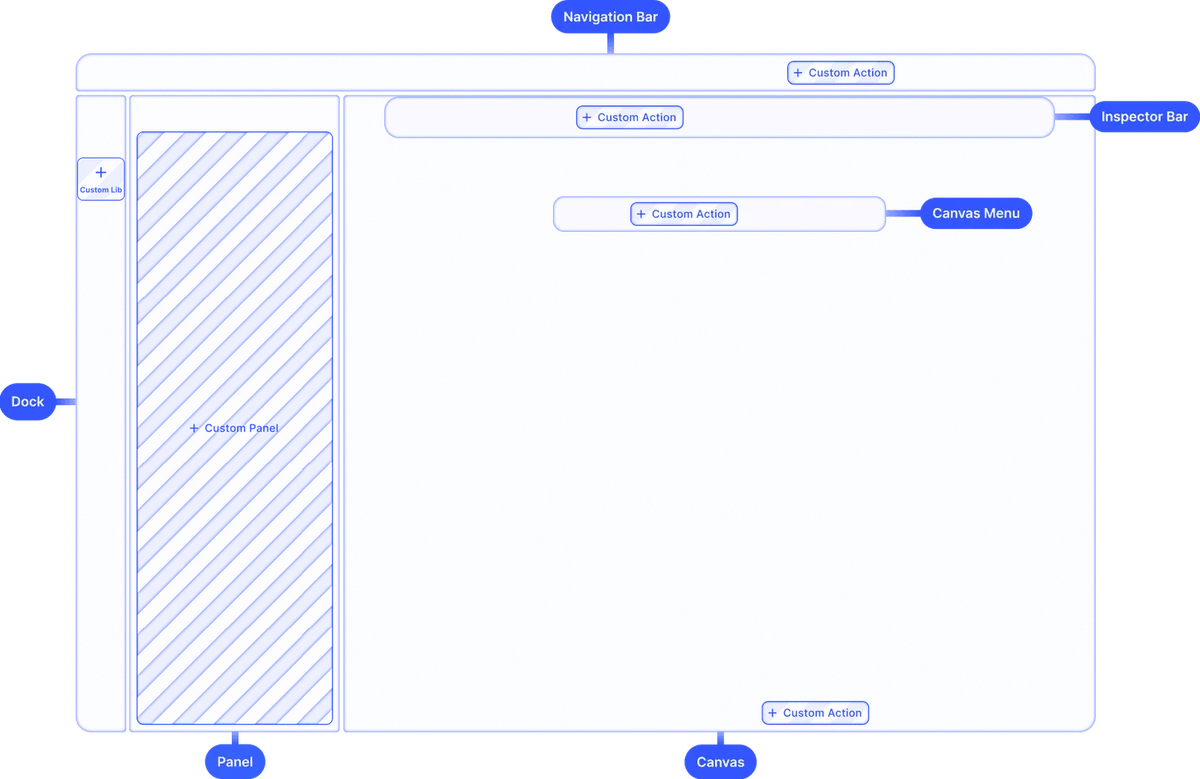
Build custom UIs.
Use the headless API powering all creative operations to implement an entirely custom UI.
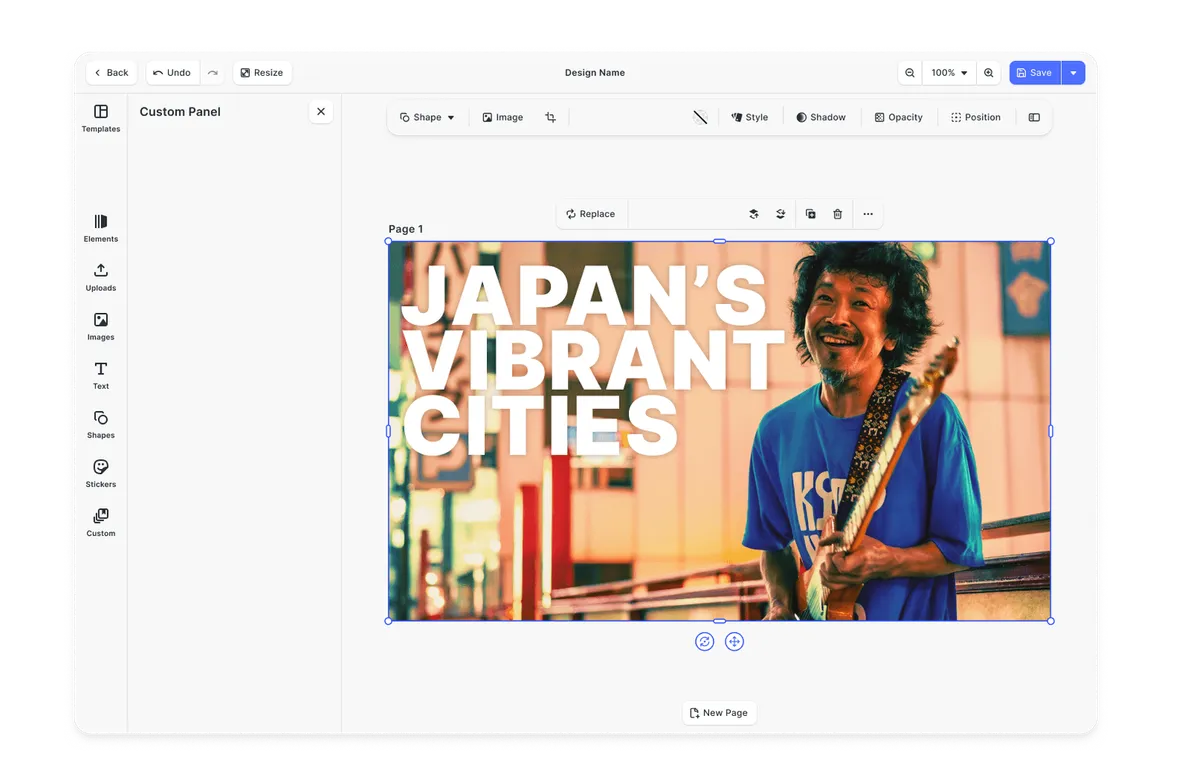
Theming.
Change the editor theme to fit seamlessly with your app.
Media libraries.
Set up custom libraries that are easily sortable.
Toolbar customization.
Reposition toolbar elements, change icons, or rename tools to fit your use case.
Internationalization.
Add support for additional languages, and customize any button label.
Export options.
Export designs in JPG, PNG, or PDF with custom quality, page ranges, and dimensions.
Check out other use cases
Learn more about related solutions.
Web-to-Print Designer
Elevate your web-to-print application with a best-in-class design editor.
Creative Automation
Automate and scale content creation across every channel.
Variable Data Printing
Enable mass-personalization in your design and print workflows.
Photo Prints
Provide a seamless design experience and inspire users with personalized templates.
Print Personalization
Streamline personalization for every print product in your catalog.
Apparel Designer
Build apparel and merchandise design experiences on any platform.
Get in touch
Contact our sales team to learn more about licensing options and get access to our AI plugins for CE.SDK.
FAQs
IMG.LY is a strong alternative to Polotno, providing a full-featured design and media editor with extensive customization capabilities. It lets developers embed a flexible design experience into their applications, supporting images, text, and layered compositions while offering an intuitive user interface.
Polotno is an open-source JavaScript framework for building design editors, while IMG.LY is a feature-rich, enterprise-ready SDK for creative editing with native mobile support, video editing, and a headless automation engine.
Yes. IMG.LY provides more advanced features like multi-track video editing, AI-powered design tools, native iOS and Android SDKs, and a headless rendering engine for backend automation.
IMG.LY provides full API access to modify templates programmatically with placeholders and constraints, allowing dynamic text and image replacement and adaptive resizing. Polotno offers a basic JSON-based templating system but lacks advanced automation capabilities.
IMG.LY supports dynamic content insertion, batch processing, and generative AI for automation, accelerating high-volume content production. Polotno allows programmatic design generation but with limited automation features through its separate Node.js package.
IMG.LY ships direct integrations with Unsplash, Getty Images, Airtable, and Pexels for streamlined asset management. Polotno does not offer built-in support for third-party asset libraries, requiring custom implementation to achieve similar functionality.
IMG.LY offers cross-platform support across web (JavaScript, React, Angular, Vue, Svelte, Next.js), native iOS and Android, React Native, Flutter, macOS, Electron, and Node.js. Polotno is primarily web-based with optional Node.js support for automation.
IMG.LY ships a first-class plugin system, allowing teams to tailor the editor to specific use cases by adding custom features and connecting third-party services through a stable plugin contract. Polotno has limited extension capabilities and lacks a formal plugin system — customization happens by composing React components.
IMG.LY enables mixing videos, images, overlays, animations, and voice-overs with full creative control across web, iOS, and Android. Polotno offers basic video editing in the browser but does not support multi-track video composition or native mobile video editing.
IMG.LY can import design files from Photoshop (PSD), InDesign (IDML), and Illustrator (AI), and export scene files for saving work-in-progress, ensuring seamless integration with existing design workflows. Polotno uses a proprietary JSON format, limiting compatibility with standard design software.
IMG.LY is designed for enterprise use, with headless server-side rendering, native mobile SDKs, on-premise deployment options, and SLA-backed support. Polotno is well-suited to lightweight projects and React-first SaaS builders.
Polotno lacks native mobile support, multi-track video editing, advanced AI-driven design automation, a formal plugin system, pre-built asset library integrations, and CMYK/PDF/X print production — capabilities IMG.LY provides out of the box.