


How Omneky Unified AI Generation and Creative Editing for Faster Campaign Launches

Omneky is an AI-powered advertising platform that turns brand assets and campaign data into high-quality ad creatives, generating, testing, and launching ads across Meta, Google, LinkedIn, TikTok, and other channels. Its engine produces over a thousand ads a day, but every one of those creatives still needed a human in the loop before it went live.
That last mile, reviewing, customizing, and approving AI-generated assets, is where Omneky turned to IMG.LY’s CE.SDK. Here’s how the two pieces came together, and what changed for Omneky’s customers and roadmap as a result.
The Challenge: AI Got Them Most of the Way There
Omneky’s competitive advantage is its AI: the data-driven engine that analyzes performance, generates creatives, and optimizes spend across channels. But generating an ad is not the same as shipping one. Customers needed to review each AI-generated asset, tweak the messaging, swap fonts, adjust layouts, and bring everything in line with brand guidelines before launching a campaign.
Doing that well meant a full creative editor: layer manipulation, video support, typography controls, and brand-asset integration. Omneky faced the classic build-versus-buy decision, and the build side of the ledger looked expensive.
It’s a lot of work to create the image and video editing platform. And we just didn’t want to. We wanted to focus on our core differentiation, which is really the AI component.
Building an editor in-house would have pulled engineers off the AI and optimization work that made Omneky worth using in the first place. Every hour spent maintaining a typography control or a video timeline was an hour not spent improving the generation engine. The editing layer was necessary, but it was never going to be the differentiator.
Why They Chose CE.SDK
The decision came down to focus. Omneky wanted to own the part of the stack only it could build, the AI, and partner for the part that was solved better elsewhere. CE.SDK gave them a production-grade editor for both image and video without committing the company to building and maintaining one.
Just as important, CE.SDK could meet the AI output where it was. Omneky didn’t need an editor that opened a flat exported image; it needed one that could take a generated creative apart and hand the pieces back to the customer as editable content.
We’re able to generate an ad from scratch, parse it into layers, and give customers full control to customize or build variations.
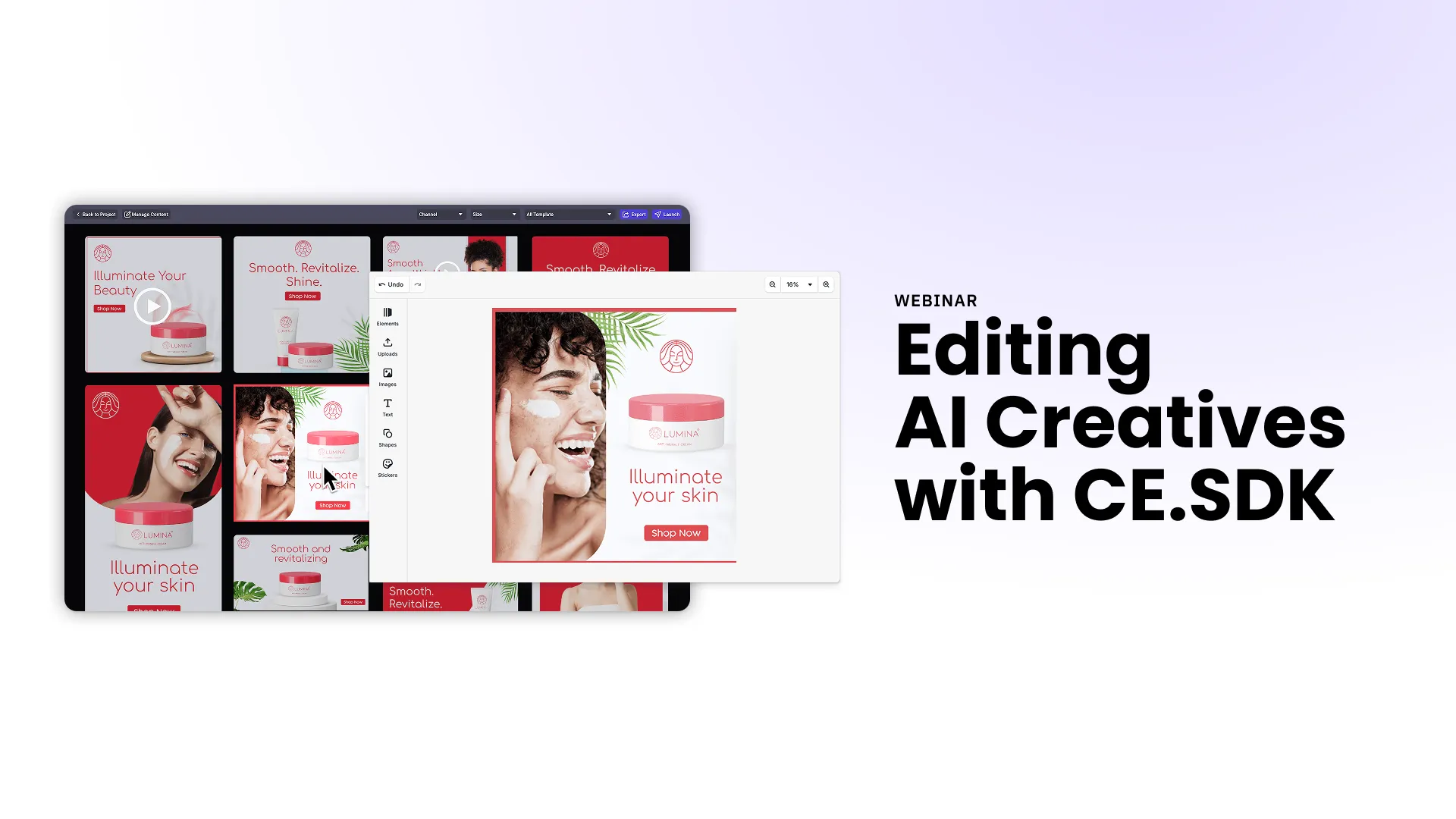
That parse-into-layers step is the heart of the integration. An AI-generated ad arrives as a composition, and CE.SDK exposes its backgrounds, text, and layout as discrete, editable elements. Customers don’t start from a finished image they can only crop; they start from a structured creative they can fully rework.
How They Implemented CE.SDK
Omneky embedded CE.SDK directly inside its existing approval and publishing flow, for both image and video workflows. When the AI generates an ad, the creative is parsed into editable components, backgrounds, text layers, and layouts, that the customer can adjust without leaving the platform.
The result is a single, continuous lifecycle: a customer generates a creative, refines it in the embedded editor, runs it through review, and launches it, all in one place. There’s no exporting to a separate design tool, no re-importing approved files, no context-switching between an AI product and a creative product. Non-designers can make meaningful edits because the editor is built into the workflow they already use, not bolted on beside it.
That continuity matters most where it’s hardest to see: in the handoff between systems. By eliminating the tool-switching between generation and editing, Omneky removed the seams where assets get lost, versions diverge, and review cycles stall.
The Results
The combination of from-scratch AI generation and a seamless editing layer changed Omneky’s growth curve. Once customers could auto-generate genuinely good-looking ads and then refine them in place, adoption took off.
We’re seeing the real breakthrough over the past couple of months, it’s quite a hockey-stick growth. We saw a 10× increase in new signups month over month in May, and that was the fact that you can now auto-generate really beautiful-looking ads from scratch with our technology, and that level of quality was not there previously.
The unified experience also raised Omneky’s confidence in its own product, enough to lower the barrier to entry. When generation and editing feel like one tool rather than two stitched together, a new user can get from sign-up to a finished, on-brand ad without hitting a wall.
We’re confident enough in our product that we offer a free 7-day trial. That wouldn’t be possible if we didn’t have a seamless experience across both AI generation and creative editing.
Internally, the payoff was the engineering time Omneky never had to spend. The editor was production-ready and supported, so the team kept building the AI, the data engine, and the advertising integrations, the work that compounds into the product’s actual moat.
Overall Impact
The less-visible win was organizational. By treating the editing layer as a partnership rather than a project, Omneky bought itself the freedom to keep its attention on what it does best.
The partnership with IMG.LY lets us focus on building the best AI, the best data-driven engine, the best advertising integrations, and the best ad generation. And then we can sleep easily that the image editing and video editing portions of the platform are well taken care of and well supported on the IMG.LY side.
There was a compounding effect, too. As IMG.LY’s editor improves with input from the wider customer base, Omneky inherits those gains without lifting a finger.
There’s a kind of network effect in working with IMG.LY. Feedback from other companies helps improve the product for us, too.
That’s the shape of the result: an AI company that stayed an AI company. Omneky generates over a thousand ads a day, lets customers refine every one of them in an embedded editor it didn’t have to build, and keeps its engineers pointed at the engine that sets it apart, while the creative layer takes care of itself.