Export your designs to multiple formats including PNG, JPEG, WebP, SVG, PDF, and MP4. CE.SDK handles all export processing entirely on the client side, giving you fine-grained control over format-specific options like compression, quality, and target dimensions.
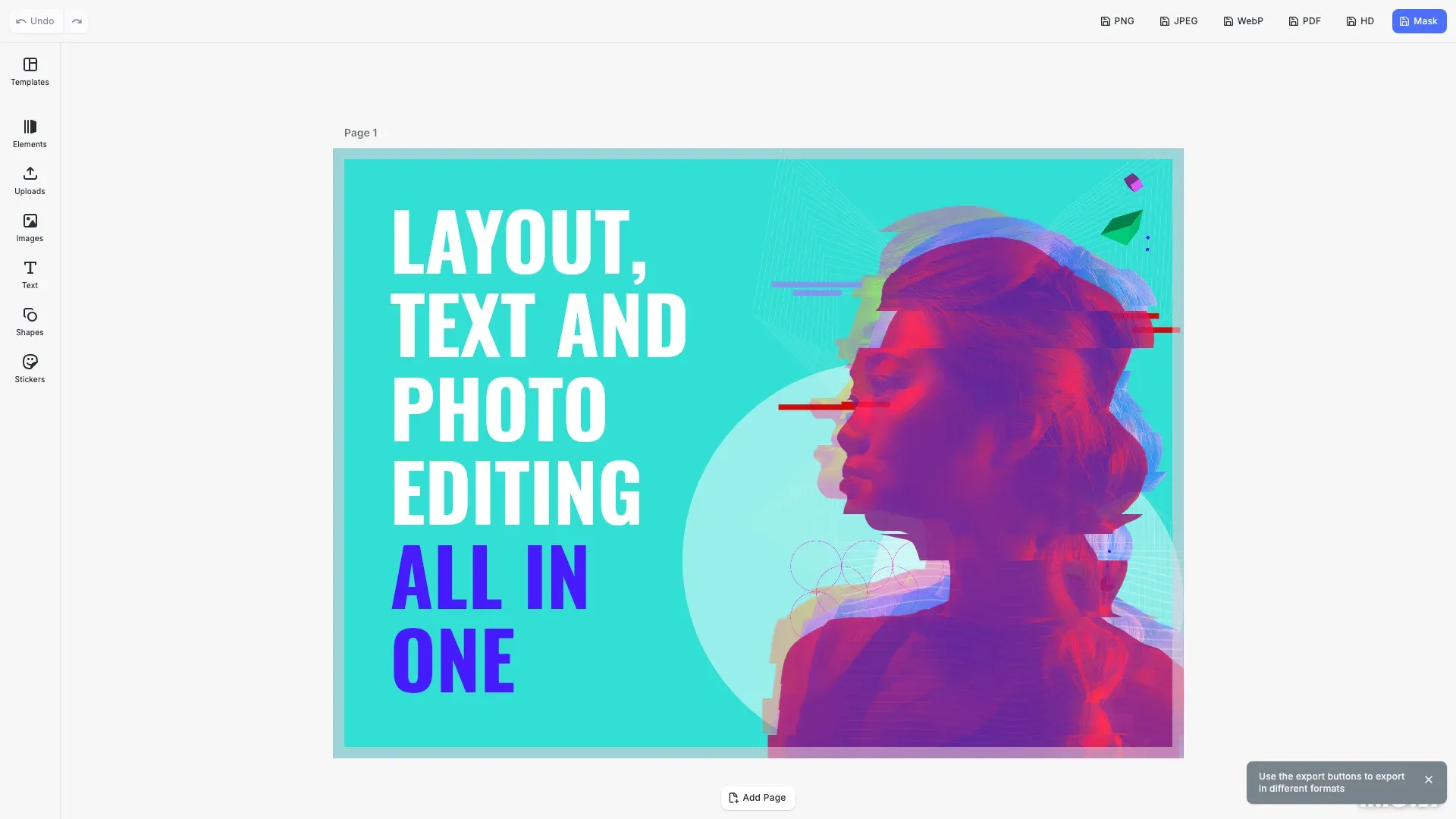
Whether you’re building a design tool, photo editor, or content automation workflow, understanding export options helps you deliver the right output for each use case. This guide covers supported formats, their options, and how to export programmatically or via the UI.
This guide covers how to export designs in different formats, configure format-specific options, check device limits, and download exports to the user’s device.
Supported Export Formats#
CE.SDK supports exporting scenes, pages, groups, or individual blocks in these formats:
| Format | MIME Type | Transparency | Best For |
|---|---|---|---|
| PNG | image/png |
Yes | Web graphics, UI elements, logos |
| JPEG | image/jpeg |
No | Photographs, web images |
| WebP | image/webp |
Yes (lossless) | Web delivery, smaller files |
| SVG | image/svg+xml |
Yes | Scalable graphics, web embedding, post-processing |
application/pdf |
Partial | Print, documents | |
| MP4 | video/mp4 |
No | Video content |
| Binary | application/octet-stream |
Yes | Raw data processing |
Each format serves different purposes. PNG preserves transparency and works well for graphics with sharp edges or text. JPEG compresses photographs efficiently but drops transparency. WebP provides excellent compression with optional lossless mode. SVG produces scalable vector output ideal for web embedding and post-processing with standard SVG tooling. PDF preserves vector information for print workflows. MP4 exports animated content as video.
Export Images#
Export to PNG#
PNG export uses lossless compression with a configurable compression level. Higher compression produces smaller files but takes longer to encode. Quality is not affected.
const pngBlob = await engine.block.export(page, { mimeType: 'image/png', pngCompressionLevel: 5 // 0-9, higher = smaller file, slower});The pngCompressionLevel ranges from 0 (no compression, fastest) to 9 (maximum compression, slowest). The default is 5, which balances file size and encoding speed.
Export to JPEG#
JPEG export uses lossy compression controlled by the quality setting. Lower quality produces smaller files but introduces visible artifacts.
const jpegBlob = await engine.block.export(page, { mimeType: 'image/jpeg', jpegQuality: 0.9 // 0-1, higher = better quality, larger file});The jpegQuality ranges from 0 to 1. Values above 0.9 provide excellent quality for most use cases. The default is 0.9.
Export to WebP#
WebP provides better compression than PNG or JPEG for web delivery. A quality of 1.0 enables lossless mode.
const webpBlob = await engine.block.export(page, { mimeType: 'image/webp', webpQuality: 1.0 // 1.0 = lossless, smaller files than PNG});The webpQuality ranges from 0 to 1. At 1.0, WebP uses lossless compression that typically produces smaller files than equivalent PNG exports.
Export to SVG#
SVG export produces scalable vector graphics that can be embedded directly in web pages, post-processed with standard SVG tooling, or scaled to any resolution without quality loss.
const blob = await engine.block.export(page, { mimeType: 'image/svg+xml'});await cesdk.utils.downloadFile(blob, 'image/svg+xml');Text is exported as vector paths to ensure consistent rendering across environments without requiring the original fonts. Shapes, strokes, and gradients are exported as native SVG elements.
Image Export Options#
| Option | Type | Default | Description |
|---|---|---|---|
mimeType |
string |
- | Output format: 'image/png', 'image/jpeg', 'image/webp', or 'image/svg+xml' |
pngCompressionLevel |
number |
5 |
PNG compression level (0-9). Higher = smaller file, slower encoding |
jpegQuality |
number |
0.9 |
JPEG quality (0-1). Higher = better quality, larger file |
webpQuality |
number |
0.8 |
WebP quality (0-1). Set to 1.0 for lossless compression |
targetWidth |
number |
- | Target output width in pixels |
targetHeight |
number |
- | Target output height in pixels |
Export PDF#
PDF export preserves vector information and supports print workflows. The high compatibility option rasterizes content for broader viewer support.
const pdfBlob = await engine.block.export(page, { mimeType: 'application/pdf', exportPdfWithHighCompatibility: true // Rasterize for broader viewer support});When exportPdfWithHighCompatibility is true (the default), images and effects are rasterized according to the scene’s DPI setting. Set it to false for faster exports, though gradients with transparency may not render correctly in Safari or macOS Preview.
The underlayer options are useful for print workflows where you need a solid base layer (often white ink) beneath the design elements. The underlayerSpotColorName should match a spot color defined in your print workflow.
PDF Export Options#
| Option | Type | Default | Description |
|---|---|---|---|
mimeType |
string |
- | Must be 'application/pdf' |
exportPdfWithHighCompatibility |
boolean |
true |
Rasterize images and effects (like gradients) according to the scene’s DPI setting for broader viewer support |
exportPdfWithUnderlayer |
boolean |
false |
Add an underlayer behind existing elements matching the shape of page content |
underlayerSpotColorName |
string |
'' |
Spot color name for the underlayer fill (used with print workflows) |
underlayerOffset |
number |
0 |
Size adjustment for the underlayer shape in design units |
targetWidth |
number |
- | Target output width in pixels |
targetHeight |
number |
- | Target output height in pixels |
Export with Color Mask#
Color mask export removes pixels matching a specific RGB color and generates two output files: the masked image with transparency applied, and an alpha mask showing which pixels were removed.
// Export with color mask - RGB values are in 0.0-1.0 range// Pure magenta (1.0, 0.0, 1.0) is commonly used for registration marksconst [maskedImage, alphaMask] = await engine.block.exportWithColorMask( page, 1.0, // maskColorR - red component 0.0, // maskColorG - green component 1.0, // maskColorB - blue component (RGB: pure magenta) { mimeType: 'image/png' });The exportWithColorMask() method accepts the block to export, three RGB color components (0.0-1.0 range), and optional export options. RGB values use floating-point notation where 1.0 equals 255 in standard color notation.
Common mask colors for print workflows:
- Pure red:
(1.0, 0.0, 0.0)— Registration marks - Pure magenta:
(1.0, 0.0, 1.0)— Distinctive marker color - Pure cyan:
(0.0, 1.0, 1.0)— Alternative marker color
The method returns a Promise resolving to an array of two Blobs: the masked image (with matched pixels made transparent) and the alpha mask (black pixels for removed areas, white for retained areas).
Color Mask Export Options#
The exportWithColorMask() method accepts the same options as image export:
| Option | Type | Default | Description |
|---|---|---|---|
mimeType |
string |
'image/png' |
Output format: 'image/png', 'image/jpeg', or 'image/webp' |
pngCompressionLevel |
number |
5 |
PNG compression level (0-9) |
jpegQuality |
number |
0.9 |
JPEG quality (0-1) |
webpQuality |
number |
0.8 |
WebP quality (0-1) |
targetWidth |
number |
- | Target output width in pixels |
targetHeight |
number |
- | Target output height in pixels |
Export Video#
Video export uses the H.264 codec and outputs MP4 or QuickTime files. Unlike image exports, video exports accept a progress callback to track encoding status.
const page = engine.scene.getCurrentPage();
const videoBlob = await engine.block.exportVideo(page, {  mimeType: 'video/mp4',  onProgress: (rendered, encoded, total) => {    console.log(`Progress: ${Math.round((encoded / total) * 100)}%`);  }});
Video Export Options#
Configure video encoding with these options:
| Option | Type | Default | Description |
|---|---|---|---|
mimeType |
'video/mp4' | 'video/quicktime' |
'video/mp4' |
Output video format |
h264Profile |
number |
77 (Main) |
H.264 profile: 66=Baseline, 77=Main, 100=High |
h264Level |
number |
52 |
Encoding level (multiply desired level by 10, e.g., 52 = level 5.2) |
videoBitrate |
number | 'System' | 'Auto' |
'System' |
Video bitrate in bits/second, or a named automatic mode. 'System' (the default, also selected by 0) lets the browser encoder choose, which can produce a very large, near-lossless file that may fail with an out-of-memory error. 'Auto' picks a bounded, resolution-aware bitrate and is recommended in the browser. A positive number sets an explicit bitrate (maximum determined by profile and level) |
audioBitrate |
number |
0 (auto) |
Audio bitrate in bits/second. Default auto-selects 128kbps for stereo AAC |
framerate |
number |
30 |
Target framerate in Hz |
targetWidth |
number |
- | Output width in pixels |
targetHeight |
number |
- | Output height in pixels |
timeOffset |
number |
0 |
Start time offset in seconds |
duration |
number |
scene duration | Video duration in seconds |
allowTextOverhang |
boolean |
false |
Include text bounding boxes that account for glyph overhangs |
abortSignal |
AbortSignal |
- | Signal to cancel export |
The h264Profile determines encoder quality and compatibility:
- Baseline (66): Broadest device compatibility, lowest quality
- Main (77): Good balance of quality and compatibility (default)
- High (100): Best quality, may not play on older devices
The videoBitrate option accepts a positive number (explicit bits per second) or one of two named automatic modes:
'System'(default): the browser’sVideoEncoderchooses the bitrate. It may pick a very high, near-lossless rate (Safari has reached ~300 Mbps), so large or long exports can fail with an out-of-memory error.'Auto': a bounded bitrate derived from the output resolution and framerate (for example 5 Mbps at 720p30, 8 Mbps at 1080p30, 12 Mbps at 1080p60, 40 Mbps at 4K30). Recommended in the browser to avoid out-of-memory failures.
Export Audio#
Export audio tracks from pages or audio blocks. Supported formats are WAV (uncompressed) and MP4 (AAC encoded).
const page = engine.scene.getCurrentPage();
const audioBlob = await engine.block.exportAudio(page, {  mimeType: 'audio/mp4', // or 'audio/wav'  onProgress: (rendered, encoded, total) => {    console.log(`Progress: ${Math.round((encoded / total) * 100)}%`);  }});
Audio Export Options#
Configure audio export with these options:
| Option | Type | Default | Description |
|---|---|---|---|
mimeType |
'audio/wav' | 'audio/mp4' |
'audio/wav' |
Output audio format |
sampleRate |
number |
48000 |
Sample rate in Hz |
numberOfChannels |
number |
2 |
Number of audio channels (1=mono, 2=stereo) |
timeOffset |
number |
0 |
Start time offset in seconds |
duration |
number |
block duration | Audio duration in seconds |
skipEncoding |
boolean |
false |
Return raw audio data without encoding |
abortSignal |
AbortSignal |
- | Signal to cancel export |
Use audio/wav for lossless quality when file size is not a concern. Use audio/mp4 (AAC) for compressed output suitable for web delivery.
Target Size Control#
You can export at specific dimensions regardless of the block’s actual size. The targetWidth and targetHeight options render the block large enough to fill the target size while maintaining aspect ratio.
const blob = await engine.block.export(page, { mimeType: 'image/png', targetWidth: 1920, targetHeight: 1080});If the target aspect ratio differs from the block’s aspect ratio, the output fills the target dimensions completely. The output may extend beyond the target size on one axis to preserve correct proportions.
Device Export Limits#
Before exporting large designs, check the device’s export capabilities. Memory constraints or GPU limitations may prevent exports that exceed certain dimensions.
const maxExportSize = engine.editor.getMaxExportSize();const availableMemory = engine.editor.getAvailableMemory();
console.log(`Max dimension: ${maxExportSize}px`);console.log(`Available memory: ${availableMemory / 1024 / 1024} MB`);
getMaxExportSize() returns the maximum width or height in pixels. Both dimensions must stay below this limit. getAvailableMemory() returns available memory in bytes, helping you assess whether large exports are feasible.
Built-in Export Action#
CE.SDK provides a built-in exportDesign action that handles export with progress dialogs and error handling. Use cesdk.utils.export() to export and cesdk.utils.downloadFile() to download the result.
Export an image:
const { blobs, options } = await cesdk.utils.export({ mimeType: 'image/png'});await cesdk.utils.downloadFile(blobs[0], options.mimeType);Export a PDF:
const { blobs, options } = await cesdk.utils.export({ mimeType: 'application/pdf'});await cesdk.utils.downloadFile(blobs[0], options.mimeType);Export a video:
const { blobs, options } = await cesdk.utils.export({ mimeType: 'video/mp4'});await cesdk.utils.downloadFile(blobs[0], options.mimeType);API Reference#
| Method | Description |
|---|---|
engine.block.export() |
Export a block with format and quality options |
engine.block.exportWithColorMask() |
Export a block with specific RGB color removed, returning masked image and alpha mask |
engine.block.exportVideo() |
Export a page as video with encoding options |
engine.block.exportAudio() |
Export audio from a page or audio block |
engine.editor.getMaxExportSize() |
Get maximum export dimension in pixels |
engine.editor.getAvailableMemory() |
Get available memory in bytes |
cesdk.utils.export() |
Export with progress dialog and error handling |
cesdk.utils.downloadFile() |
Download a blob or string to the user’s device |