Create and configure text blocks in CE.SDK with custom fonts, rich text styling, and dynamic sizing options.
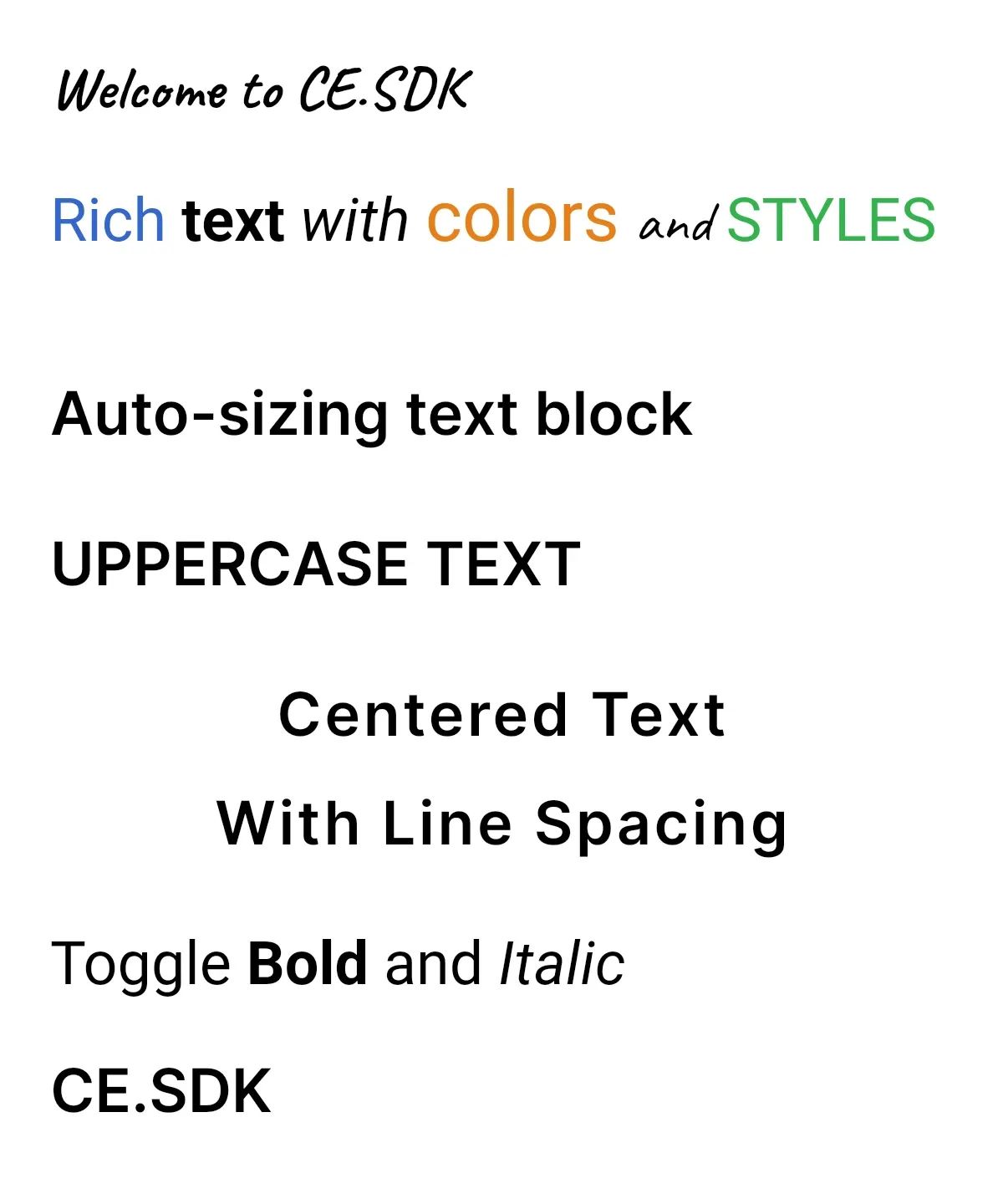
Text blocks are fundamental design elements for displaying titles, captions, labels, and body text. CE.SDK provides range-based styling APIs so a single text block can contain multiple colors, font weights, font styles, and text cases.
The snippets below assume you already have an Engine instance and the target page block you want to add text to.
Create Text Blocks#
Create a text block with engine.block.create(.text) and attach it to a page with appendChild(to:child:). Use replaceText(_:text:) for both the initial text and later text replacements.
let titleBlock = try engine.block.create(.text)try engine.block.appendChild(to: page, child: titleBlock)try engine.block.replaceText(titleBlock, text: "Welcome to CE.SDK")
try engine.block.setWidthMode(titleBlock, mode: .auto)try engine.block.setHeightMode(titleBlock, mode: .auto)try engine.block.setPositionX(titleBlock, value: 40)try engine.block.setPositionY(titleBlock, value: 40)
Text blocks can size themselves to their content. Set the width and height modes to .auto when the block should fit its text.
Apply Fonts and Typefaces#
Apply a font with setFont(_:fontFileURL:typeface:). Provide both the concrete font file URL and a Typeface that describes the font family and its available variants.
let caveatRegular = Font(  uri: baseURL.appendingPathComponent("ly.img.typeface/fonts/Caveat/Caveat-Regular.ttf"),  subFamily: "Regular",  weight: .normal,  style: .normal,)let caveatBold = Font(  uri: baseURL.appendingPathComponent("ly.img.typeface/fonts/Caveat/Caveat-Bold.ttf"),  subFamily: "Bold",  weight: .bold,  style: .normal,)let caveatTypeface = Typeface(name: "Caveat", fonts: [caveatRegular, caveatBold])
try engine.block.setFont(titleBlock, fontFileURL: caveatBold.uri, typeface: caveatTypeface)try engine.block.setTextFontSize(titleBlock, fontSize: 48)
Use setFont to replace the block’s active font file. Use setTypeface(_:typeface:in:) when you want CE.SDK to keep the current formatting — such as bold or italic — as far as the new typeface supports it.
The example builds font file URLs from a base URL that points at the CE.SDK asset location. Replace it with wherever your app bundles or hosts the CE.SDK font assets.
When later snippets apply weight, style, or toggle formatting, use a typeface that includes the variants those operations need.
let robotoRegular = Font( uri: baseURL.appendingPathComponent("ly.img.typeface/fonts/Roboto/Roboto-Regular.ttf"), subFamily: "Regular", weight: .normal, style: .normal,)let robotoTypeface = Typeface( name: "Roboto", fonts: [ robotoRegular, Font( uri: baseURL.appendingPathComponent("ly.img.typeface/fonts/Roboto/Roboto-Bold.ttf"), subFamily: "Bold", weight: .bold, style: .normal, ), Font( uri: baseURL.appendingPathComponent("ly.img.typeface/fonts/Roboto/Roboto-Italic.ttf"), subFamily: "Italic", weight: .normal, style: .italic, ), Font( uri: baseURL.appendingPathComponent("ly.img.typeface/fonts/Roboto/Roboto-BoldItalic.ttf"), subFamily: "Bold Italic", weight: .bold, style: .italic, ), ],)Style Text Ranges#
Style part of a text block by passing a range to the range-based text APIs. Swift ranges are Range<String.Index> values built from the text string with range(of:); omitting the range targets the whole block.
// "Rich" in blue.try engine.block.setTextColor(richTextBlock, color: .rgba(r: 0.2, g: 0.4, b: 0.8), in: richText.range(of: "Rich")!)// "text" in bold.try engine.block.setTextFontWeight(richTextBlock, fontWeight: .bold, in: richText.range(of: "text")!)// "with" in italic.try engine.block.setTextFontStyle(richTextBlock, fontStyle: .italic, in: richText.range(of: "with")!)// "colors" in orange and larger type.try engine.block.setTextColor(richTextBlock, color: .rgba(r: 0.9, g: 0.5, b: 0.1), in: richText.range(of: "colors")!)try engine.block.setTextFontSize(richTextBlock, fontSize: 56, in: richText.range(of: "colors")!)// "and" uses a different typeface.try engine.block.setTypeface(richTextBlock, typeface: caveatTypeface, in: richText.range(of: "and")!)// "styles" in green uppercase.try engine.block.setTextColor(richTextBlock, color: .rgba(r: 0.2, g: 0.7, b: 0.3), in: richText.range(of: "styles")!)try engine.block.setTextCase(richTextBlock, textCase: .uppercase, in: richText.range(of: "styles")!)The same range pattern applies to text colors, font weights, font styles, font sizes, typefaces, and text cases.
Configure Auto-Sizing#
Combine a fixed width with an automatic height when text should wrap and grow vertically with its content.
let autoSizeBlock = try engine.block.create(.text)try engine.block.appendChild(to: page, child: autoSizeBlock)try engine.block.replaceText(autoSizeBlock, text: "Auto-sizing text block")try engine.block.setPositionX(autoSizeBlock, value: 40)try engine.block.setPositionY(autoSizeBlock, value: 300)
try engine.block.setWidth(autoSizeBlock, value: 720)try engine.block.setWidthMode(autoSizeBlock, mode: .absolute)try engine.block.setHeightMode(autoSizeBlock, mode: .auto)try engine.block.setTextFontSize(autoSizeBlock, fontSize: 48)
Use .absolute when a dimension should use an explicit design-unit value, .percent when it should follow the parent size, and .auto when CE.SDK should derive it from the content.
Apply Text Case Transformations#
Use setTextCase(_:textCase:) to change the rendered casing without changing the underlying text string.
let caseBlock = try engine.block.create(.text)try engine.block.appendChild(to: page, child: caseBlock)try engine.block.replaceText(caseBlock, text: "uppercase text")try engine.block.setPositionX(caseBlock, value: 40)try engine.block.setPositionY(caseBlock, value: 420)try engine.block.setWidthMode(caseBlock, mode: .auto)try engine.block.setHeightMode(caseBlock, mode: .auto)try engine.block.setTextFontSize(caseBlock, fontSize: 48)
try engine.block.setTextCase(caseBlock, textCase: .uppercase)
Available text cases are .normal, .uppercase, .lowercase, and .titlecase.
Set Text Alignment and Spacing#
Set paragraph alignment with setTextHorizontalAlignment(_:alignment:), line height with setTextLineHeight(_:lineHeight:), and letter spacing with the text/letterSpacing float property.
let alignedBlock = try engine.block.create(.text)try engine.block.appendChild(to: page, child: alignedBlock)try engine.block.replaceText(alignedBlock, text: "Centered Text\nWith Line Spacing")try engine.block.setPositionX(alignedBlock, value: 40)try engine.block.setPositionY(alignedBlock, value: 540)try engine.block.setWidth(alignedBlock, value: 720)try engine.block.setWidthMode(alignedBlock, mode: .absolute)try engine.block.setHeightMode(alignedBlock, mode: .auto)try engine.block.setTextFontSize(alignedBlock, fontSize: 48)
try engine.block.setTextHorizontalAlignment(alignedBlock, alignment: .center)try engine.block.setTextLineHeight(alignedBlock, lineHeight: 1.5)try engine.block.setFloat(alignedBlock, property: "text/letterSpacing", value: 0.05)
Line height is a multiplier of the font size, so 1.5 means 150%. Letter spacing is a proportion of the font size.
Toggle Bold and Italic#
Use the toggle helpers when you want CE.SDK to switch between the normal and formatted variants. Check support first, because each toggle needs a matching counterpart variant for the current range and style. Include normal, bold, italic, and bold italic variants when both toggles should work across all four states.
let boldRange = toggleText.range(of: "Bold")!if try engine.block.canToggleBoldFont(toggleBlock, in: boldRange) {  try engine.block.toggleBoldFont(toggleBlock, in: boldRange)}
let italicRange = toggleText.range(of: "Italic")!if try engine.block.canToggleItalicFont(toggleBlock, in: italicRange) {  try engine.block.toggleItalicFont(toggleBlock, in: italicRange)}
The range argument targets the same text ranges used by the styling APIs.
Modify Text Content#
Use replaceText(_:text:in:) with a range to replace part of the text while keeping the surrounding content. Omitting the range replaces the full text string.
let helloWorld = "Hello World"let modifyBlock = try engine.block.create(.text)try engine.block.appendChild(to: page, child: modifyBlock)try engine.block.replaceText(modifyBlock, text: helloWorld)try engine.block.setPositionX(modifyBlock, value: 40)try engine.block.setPositionY(modifyBlock, value: 840)try engine.block.setWidthMode(modifyBlock, mode: .auto)try engine.block.setHeightMode(modifyBlock, mode: .auto)try engine.block.setTextFontSize(modifyBlock, fontSize: 48)
// Replace "World" while keeping the surrounding text.try engine.block.replaceText(modifyBlock, text: "CE.SDK", in: helloWorld.range(of: "World")!)// Remove the leading "Hello " to leave just "CE.SDK".try engine.block.removeText(modifyBlock, from: "Hello CE.SDK".range(of: "Hello ")!)
Use removeText(_:from:) with the same range convention when you need to delete text from a block.
Troubleshooting#
Text Not Displaying#
- Verify that
replaceTextset the text content. - Check that
appendChild(to:child:)attaches the text block to a page. - Ensure the text block has a width or uses automatic sizing.
Font Not Loading#
- Verify the font URL is reachable from the device.
- Check that the
Typefacemetadata matches the font files. - Include every font variant needed by the bold and italic toggles.
Range Styling Not Applying#
- Verify that the range is valid and non-empty for the current text.
- Check that the active typeface supports the requested font weight or style.
API Reference#
Methods#
| Method | Description |
|---|---|
engine.block.create(.text) |
Create a new text block. |
engine.block.appendChild(to:child:) |
Attach the text block to a page or scene hierarchy. |
engine.block.replaceText(_:text:) |
Set or replace the full text content. |
engine.block.replaceText(_:text:in:) |
Replace the text within a range. |
engine.block.removeText(_:from:) |
Remove the text within a range. |
engine.block.setFont(_:fontFileURL:typeface:) |
Bind a concrete font file and typeface to a text block. |
engine.block.setTypeface(_:typeface:in:) |
Apply a typeface while preserving compatible formatting. |
engine.block.setTextColor(_:color:in:) |
Apply text color to a range. |
engine.block.setTextFontWeight(_:fontWeight:in:) |
Apply font weight to a range. |
engine.block.setTextFontStyle(_:fontStyle:in:) |
Apply font style to a range. |
engine.block.setTextFontSize(_:fontSize:in:) |
Apply font size to the block or a range. |
engine.block.setTextCase(_:textCase:in:) |
Apply a visual text case transformation to the block or a range. |
engine.block.canToggleBoldFont(_:in:) |
Check whether a range can switch to or from bold. |
engine.block.toggleBoldFont(_:in:) |
Toggle bold styling for a range. |
engine.block.canToggleItalicFont(_:in:) |
Check whether a range can switch to or from italic. |
engine.block.toggleItalicFont(_:in:) |
Toggle italic styling for a range. |
engine.block.setWidthMode(_:mode:) |
Set how CE.SDK resolves a block width. |
engine.block.setHeightMode(_:mode:) |
Set how CE.SDK resolves a block height. |
engine.block.setWidth(_:value:) |
Set an explicit block width. |
engine.block.setPositionX(_:value:) |
Set a block’s horizontal position. |
engine.block.setPositionY(_:value:) |
Set a block’s vertical position. |
engine.block.setTextHorizontalAlignment(_:alignment:) |
Set horizontal alignment for the block. |
engine.block.setTextLineHeight(_:lineHeight:) |
Set line height for all paragraphs. |
engine.block.setFloat(_:property:value:) |
Set a float property, such as letter spacing. |
Properties#
| Property | Type | Description |
|---|---|---|
text/letterSpacing |
Float | Letter spacing as a proportion of the font size. |
Next Steps#
- Style Text - Apply fills, strokes, and backgrounds to text.
- Auto-Size Text - Configure text blocks to resize dynamically.
- Adjust Text Spacing - Fine-tune letter and line spacing.
- Add Emojis - Display emoji characters with custom fonts.
- Add Text Effects - Apply visual effects to text blocks.