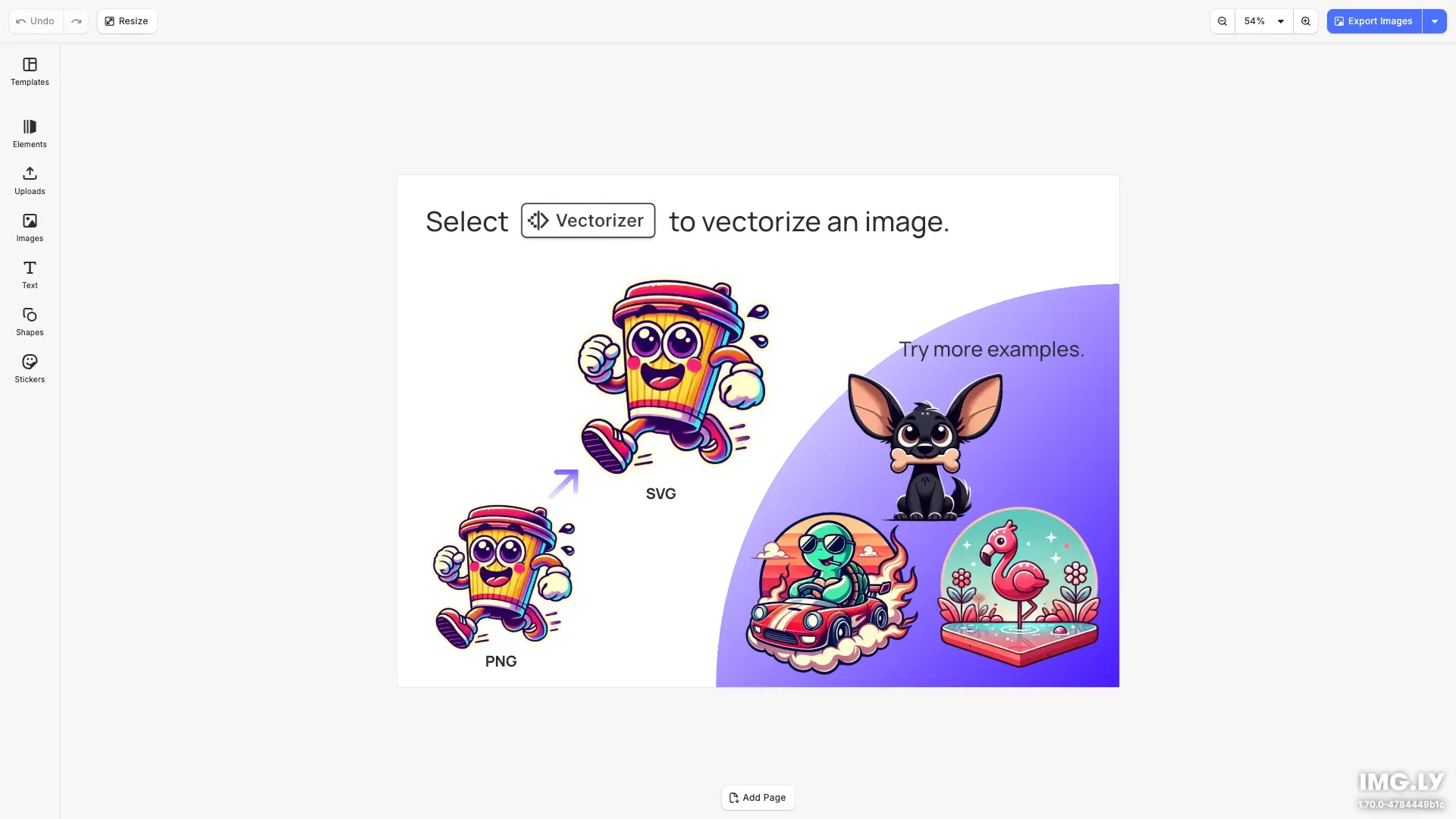
Transform your pixel-based images into scalable vector graphics with Vectorizer Plugin.
Prerequisites#
Before you begin, make sure you have the following:
- Node.js v22+ and npm installed locally – Download Node.js
- A supported browser – Chrome 114+, Edge 114+, Firefox 115+, Safari 15.6+
See Browser Support for the full list.
Get Started#
Run the Vectorizer Editor starter kit directly with Vite.
Step 1: Clone the Starter Kit#
git clone https://github.com/imgly/starterkit-vectorizer-editor-ts-web.git
cd starterkit-vectorizer-editor-ts-web
git clone https://github.com/imgly/starterkit-vectorizer-editor-ts-web.git
cd starterkit-vectorizer-editor-ts-webnpx degit imgly/starterkit-vectorizer-editor-ts-web my-project
cd my-projectnpx degit imgly/starterkit-vectorizer-editor-ts-web my-project
cd my-projectStep 2: Install Dependencies#
npm installnpm installpnpm installpnpm installyarn installyarn installStep 3: Download Assets#
CE.SDK requires engine assets (fonts, icons, UI elements) to function. These must be served as static files from your project’s public/ directory.
curl -O https://cdn.img.ly/packages/imgly/cesdk-js/1.84.0/imgly-assets.zip
unzip imgly-assets.zip -d public/
rm imgly-assets.zip
curl -O https://cdn.img.ly/packages/imgly/cesdk-js/1.84.0/imgly-assets.zip
unzip imgly-assets.zip -d public/
rm imgly-assets.zipStep 4: Run the Development Server#
npm run devnpm run devpnpm devpnpm devyarn devyarn devOpen http://localhost:5173 in your browser. Select an image and click “Vectorize” in the canvas menu to convert it to vectors.
Get Started#
Integrate the Vectorizer Editor into an existing vanilla JavaScript/TypeScript project. This adds the editor configuration to your current project structure.
Step 1: Clone#
cd your-projectcd your-projectClone the starter kit and copy the editor configuration to your project:
git clone https://github.com/imgly/starterkit-vectorizer-editor-ts-web.git
cp -r starterkit-vectorizer-editor-ts-web/src/imgly ./src/imgly
rm -rf starterkit-vectorizer-editor-ts-webgit clone https://github.com/imgly/starterkit-vectorizer-editor-ts-web.git
cp -r starterkit-vectorizer-editor-ts-web/src/imgly ./src/imgly
rm -rf starterkit-vectorizer-editor-ts-webnpx degit imgly/starterkit-vectorizer-editor-ts-web/src/imgly ./src/imglynpx degit imgly/starterkit-vectorizer-editor-ts-web/src/imgly ./src/imglyThe imgly/ folder contains the editor configuration:
imgly/├── config/│ ├── actions.ts # Export/import actions│ ├── features.ts # Feature toggles│ ├── i18n.ts # Translations│ ├── plugin.ts # Main configuration plugin│ ├── settings.ts # Engine settings│ └── ui/│ ├── canvas.ts # Canvas configuration│ ├── components.ts # Custom component registration│ ├── dock.ts # Dock layout configuration│ ├── index.ts # Combines UI customization exports│ ├── inspectorBar.ts # Inspector bar layout│ ├── navigationBar.ts # Navigation bar layout│ └── panel.ts # Panel configuration├── index.ts # Editor initialization function└── plugins/ └── vectorizer.tsStep 2: Install Dependencies#
Install the required packages for the editor:
Core Editor#
Install the Creative Editor SDK:
npm install @cesdk/cesdk-js@1.84.0npm install @cesdk/cesdk-js@1.84.0pnpm add @cesdk/cesdk-js@1.84.0pnpm add @cesdk/cesdk-js@1.84.0yarn add @cesdk/cesdk-js@1.84.0yarn add @cesdk/cesdk-js@1.84.0Vectorizer Plugin#
Add image vectorization:
npm install @imgly/plugin-vectorizer-web@1.84.0npm install @imgly/plugin-vectorizer-web@1.84.0pnpm add @imgly/plugin-vectorizer-web@1.84.0pnpm add @imgly/plugin-vectorizer-web@1.84.0yarn add @imgly/plugin-vectorizer-web@1.84.0yarn add @imgly/plugin-vectorizer-web@1.84.0@imgly/plugin-vectorizer-web– CE.SDK plugin that integrates image vectorization into the editor UI (canvas menu)
Step 3: Download Assets#
CE.SDK requires engine assets (fonts, icons, UI elements) to function. These must be served as static files from your project’s public/ directory.
curl -O https://cdn.img.ly/packages/imgly/cesdk-js/1.84.0/imgly-assets.zip
unzip imgly-assets.zip -d public/
rm imgly-assets.zipcurl -O https://cdn.img.ly/packages/imgly/cesdk-js/1.84.0/imgly-assets.zip
unzip imgly-assets.zip -d public/
rm imgly-assets.zipStep 4: Add a Container Element#
Add a container element to your HTML where the editor will be mounted:
<div id="cesdk_container" style="width: 100%; height: 100vh;"></div>Step 5: Initialize the Editor#
Import and call the initialization function from your entry point:
import CreativeEditorSDK from '@cesdk/cesdk-js';import { initVectorizerEditor } from './imgly';
const config = {  baseURL: '/assets'};
CreativeEditorSDK.create('#cesdk_container', config)  .then(async (cesdk) => {    await initVectorizerEditor(cesdk);  })  .catch((error) => {    console.error('Failed to initialize CE.SDK:', error);  });
Using Image Vectorization#
The editor provides vectorization via the canvas menu:
Via Canvas Menu#
- Select an image on the canvas
- Click the three-dot menu (canvas menu)
- Select “Vectorize” from the menu
- The image is converted to a scalable vector graphic
The vectorizer analyzes the image and creates clean vector paths that maintain quality at any scale.
Set Up a Scene#
CE.SDK offers multiple ways to load content into the editor. Choose the method that matches your use case:
// Create a blank design canvas - starts with an empty design sceneawait cesdk.actions.run('scene.create');
// Load from a template archive - restores a previously saved projectawait cesdk.load('https://example.com/template.zip');
// Load from an image URL - creates a new scene with the imageawait cesdk.createFromImage('https://example.com/image.jpg');
// Load from a scene file - restores a scene from JSONawait cesdk.load('https://example.com/scene.json');
The createDesignScene() method is ideal for design workflows, as it creates a blank canvas ready for content.
Customize Assets#
The Vectorizer Editor uses asset source plugins to provide built-in libraries for templates, stickers, shapes, and fonts. The starter kit includes a curated selection—customize what’s included based on your needs.
Asset sources are added via plugins in src/imgly/index.ts. Enable or disable individual sources:
import {  FiltersAssetSource,  StickerAssetSource,  TextAssetSource,  VectorShapeAssetSource,  EffectsAssetSource,  // ...} from '@cesdk/cesdk-js/plugins';
// Add only the sources you needawait cesdk.addPlugin(new FiltersAssetSource());await cesdk.addPlugin(new StickerAssetSource());await cesdk.addPlugin(new TextAssetSource());await cesdk.addPlugin(new VectorShapeAssetSource());await cesdk.addPlugin(new EffectsAssetSource());// ...For production deployments, self-hosting assets is required—the IMG.LY CDN is intended for development only. See Serve Assets for downloading assets, configuring baseURL, and excluding unused sources to optimize load times.
Configure Actions#
Actions are functions that handle user interactions like exporting designs, saving scenes, and importing files. CE.SDK provides built-in actions that you can run directly or override with custom implementations.
Key built-in actions:
exportDesign– Export the current design to PNG, JPEG, PDF, or other formatssaveScene– Save the scene as a JSON string for later editingimportScene– Import a previously saved scene (.imglyor.scene)exportScene– Export the scene as an.imglyfile, either the scene alone or an archive with all assetsuploadFile– Handle file uploads with progress tracking
Use cesdk.actions.run() to execute any action:
// Run a built-in actionawait cesdk.actions.run('exportDesign', { mimeType: 'image/png' });Export and Save#
// Register export action that downloads the edited designcesdk.actions.register('exportDesign', async (exportOptions) => { const { blobs, options } = await cesdk.utils.export(exportOptions); await cesdk.utils.downloadFile(blobs[0], options.mimeType);});Customize (Optional)#
Theming#
CE.SDK supports light and dark themes out of the box, plus automatic system preference detection. Switch between themes programmatically:
// 'light' | 'dark' | 'system' | (() => 'light' | 'dark')cesdk.ui.setTheme('dark');See Theming for custom color schemes, CSS variables, and advanced styling options.
Localization#
Customize UI labels and add support for multiple languages. The i18n system supports translation keys for all UI elements:
// Override specific labelscesdk.i18n.setTranslations({  en: {    'actions.export.image': 'Download Design',    'common.cancel': 'Cancel',    'common.apply': 'Apply'  }});
// Add a new languagecesdk.i18n.setTranslations({  de: {    'actions.export.image': 'Design herunterladen'  }});
// Set the active localecesdk.i18n.setLocale('de');
See Localization for supported languages, translation key reference, and right-to-left language support.
UI Layout#
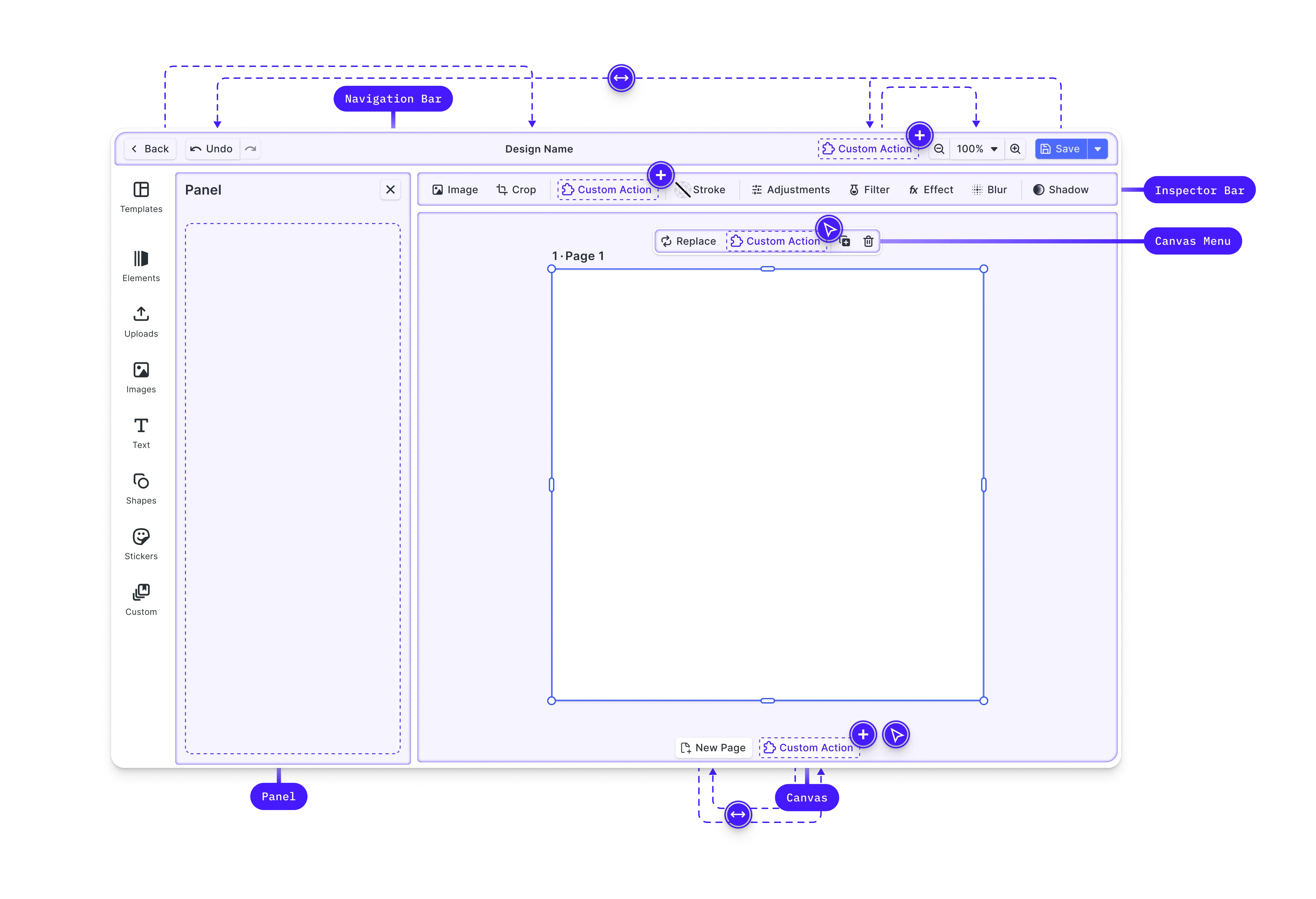
Customize the editor interface by modifying the dock, inspector bar, navigation bar, and canvas menu. CE.SDK provides Order APIs to control which components appear and in what sequence.
// Get current navigation bar componentsconst navOrder = cesdk.ui.getNavigationBarOrder();
// Add a custom button to the navigation barcesdk.ui.insertNavigationBarOrderComponent(  'ly.img.spacer',  { id: 'my-custom-action' },  'after');
// Rearrange dock itemscesdk.ui.setDockOrder([  'ly.img.assetLibrary.dock',  'ly.img.separator',  'my-custom-dock-item']);
See Dock, Inspector Bar, Navigation Bar, Canvas Menu, and Canvas for detailed layout customization options.
Key Capabilities#
The Vectorizer Editor includes image vectorization plus full design editing capabilities.
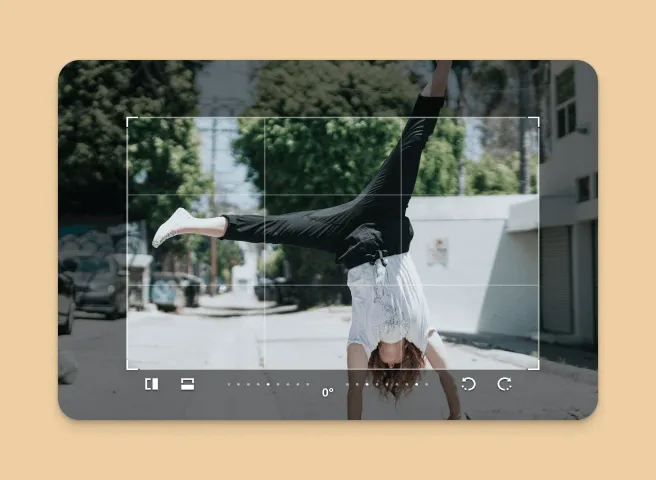
Image Vectorization
Convert raster images to scalable vector graphics. The AI-powered vectorizer creates clean paths that scale perfectly at any size.
Professional Filters
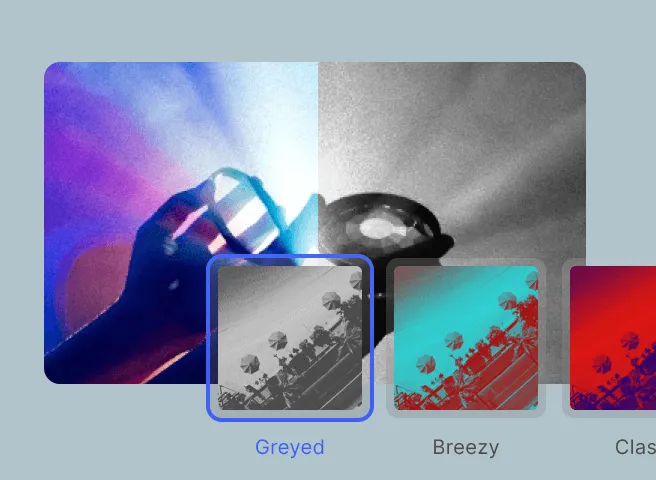
Apply color grading with LUT filters, duotone effects, and customizable image adjustments.
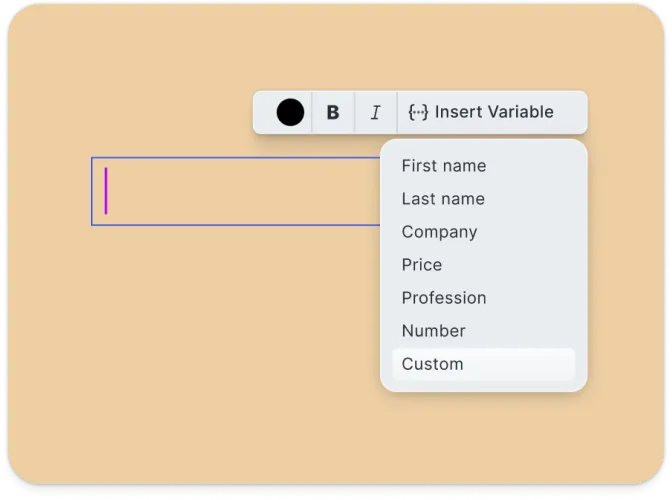
Text & Typography
Add styled text with comprehensive typography controls, fonts, and visual effects.
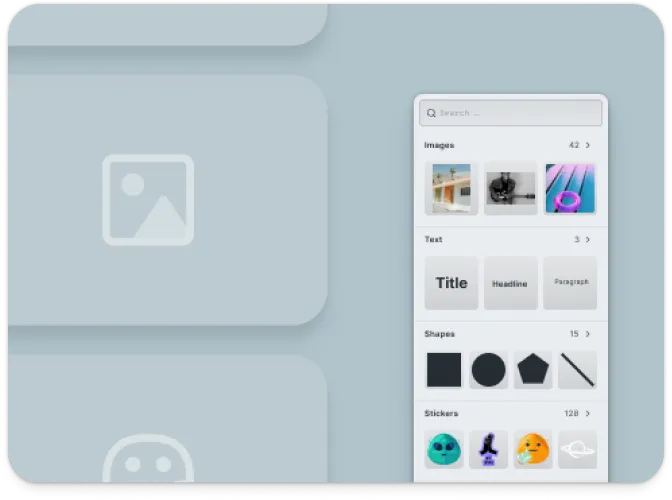
Asset Libraries
Access built-in collections of templates, stickers, shapes, and graphics, plus import custom assets.
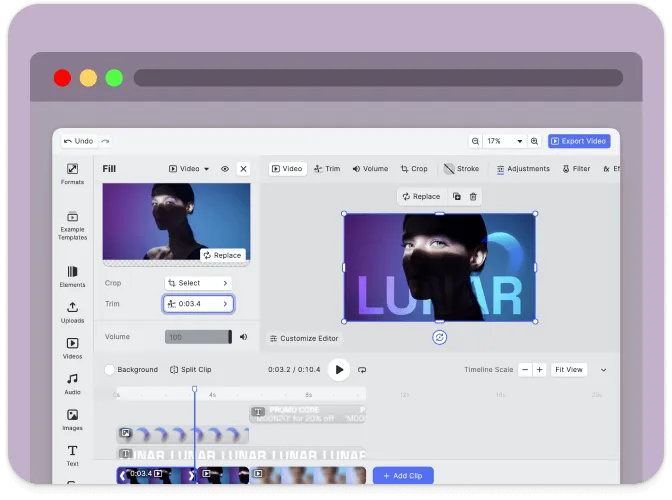
Privacy-First
All processing happens locally in the browser. No data is sent to external servers.
Export Options
Export to multiple formats including PNG, JPEG, and PDF with quality and size controls.
Troubleshooting#
Editor doesn’t load#
- Check the container element exists: Ensure your container element is in the DOM before calling
create() - Verify the baseURL: Assets must be accessible from the CDN or your self-hosted location
- Check console errors: Look for CORS or network errors in browser developer tools
Assets don’t appear#
- Check network requests: Open DevTools Network tab and look for failed requests to
cdn.img.ly - Self-host assets for production: See Serve Assets to host assets on your infrastructure
Vectorize option doesn’t appear#
- Check plugin installation: Ensure
@imgly/plugin-vectorizer-webis installed - Verify plugin setup: Check that
setupVectorizerPlugin(cesdk)is called during initialization - Select an image: The Vectorize option only appears when an image block is selected
Watermark appears in production#
- Add your license key: Set the
licenseproperty in your configuration - Get a license: Contact us at img.ly/forms/contact-sales/
Next Steps#
- Configuration – Complete list of initialization options
- Serve Assets – Self-host engine assets for production
- Actions – Build custom export and save workflows
- Theming – Customize colors and appearance
- Localization – Add translations and language support