Curve a text block so its characters follow an SVG path — an arch, a full circle, or any custom curve — instead of a straight baseline.
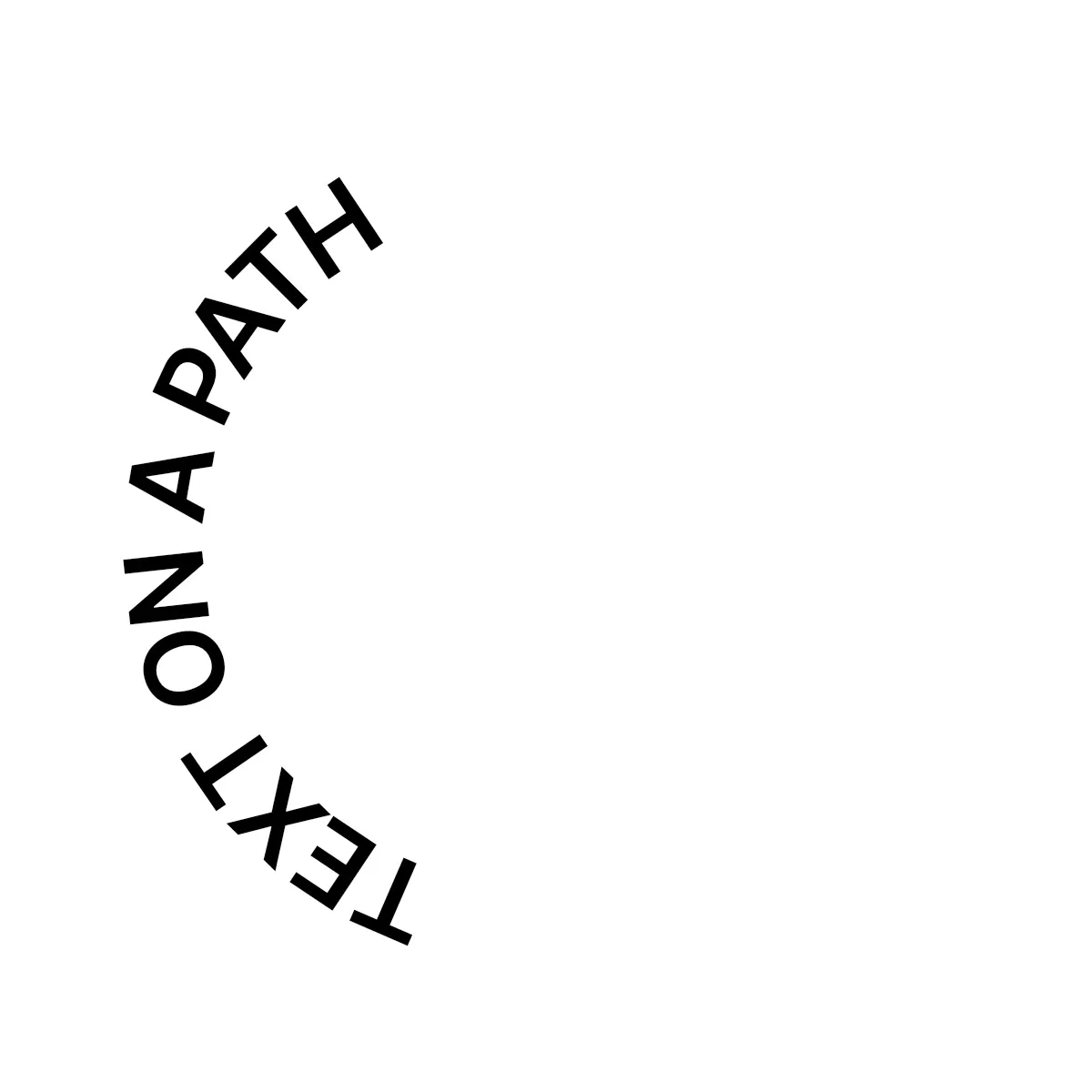
Text on a path makes a text block’s baseline follow an SVG curve instead of a straight line — useful for badges, circular seals, and arched headlines. It applies to text blocks only and disables word wrapping while a path is active: explicit line breaks in the text collapse to spaces. Setting a path resizes the block to match the path’s aspect ratio.
Using the Built-in Path UI#
On iOS, CE.SDK’s prebuilt editor lets users curve text interactively: select a text block and a Path button appears in the inspector bar. Tapping it opens a sheet of curve tiles, and None removes the path and restores the straight baseline. The default tiles are Circle, Arch, Wave, and Elevate. They are defined by the ly.img.text.curves asset source rather than the app, so the set can change with future asset versions or your own presets. Each tile is a style preset that replaces the block’s horizontal and vertical alignment, direction, and offset. The block keeps its text because the tile restyles an existing block. A preset sets the text only when it makes a new block. While a path is active, whether applied from a tile or set programmatically with a custom SVG string, the sheet shows Path Position (Top, Center, Bottom), Direction (Forward, Reversed), and an Offset slider below the tiles.
The rest of this guide covers the Engine API behind that experience, which applies text on a path programmatically on every Apple platform.
Applying Curved Text Presets from the Asset Library#
The same Curved Text presets shown in the Path sheet also surface in the asset library’s text section, and you can query the source directly with engine.asset.findAssets(sourceID:query:). Applying one in the Path sheet restyles the selected block: it keeps the block’s text while setting its path, offset, direction, and horizontal and vertical alignment. Inserting the same preset from the asset library creates a block with the preset’s text.
Creating the Text Block#
We create a text block, give it a short headline, and set a font size. Creating and styling text in depth is covered in Add Text and Text Styling.
let text = try engine.block.create(.text)try engine.block.appendChild(to: page, child: text)try engine.block.replaceText(text, text: "TEXT ON A PATH")try engine.block.setTextFontSize(text, fontSize: 48)The block starts out with a normal, straight baseline.
Placing Text on the Path#
We curve the text onto a circle with setTextOnPath(_:svgPath:), passing an SVG path string in the block’s local coordinate space. The path must contain exactly one subpath (a single leading M); the block resizes to match the path’s aspect ratio and word wrapping turns off.
let circlePath = "M 60,119.5 A 59.5,59.5 0 1,1 60.01,119.5 Z"try engine.block.setTextOnPath(text, svgPath: circlePath)The characters now follow the circle instead of a straight line.
Positioning the Text Vertically#
We set where the text sits relative to the path with setEnum(_:property:value:) on the text/verticalAlignment property — Top, Center, or Bottom.
try engine.block.setEnum(text, property: "text/verticalAlignment", value: "Center")Center runs the baseline through the middle of the glyphs, while Top and Bottom sit the text on the inner or outer edge of the curve.
Offsetting Along the Path#
We slide the text along the path with setTextOnPathOffset(_:offset:), a proportional value in the range [-1, 1] centered at zero, and read it back with getTextOnPathOffset(_:). The same value is exposed as the generic text/pathOffset float property. Both ends of the range wrap back to the same position as 0, so 1 and -1 don’t move the text further than a value just short of them.
try engine.block.setTextOnPathOffset(text, offset: 0.05)let pathOffset = try engine.block.getTextOnPathOffset(text)print("Path offset:", pathOffset)Positive values move the text forward along the path; negative values move it back.
Flipping the Direction#
We flip the text to the other side of the curve — reversing its direction — with setTextOnPathFlipped(_:flipped:), and read whether it’s flipped back with getTextOnPathFlipped(_:).
try engine.block.setTextOnPathFlipped(text, flipped: true)let isFlipped = try engine.block.getTextOnPathFlipped(text)print("Flipped:", isFlipped)Flipping is what turns the bottom half of a circular badge right-side up.
Reading and Clearing the Path#
We read the block’s current path with getTextOnPath(_:), which returns the SVG string or nil. To remove the curve and restore a straight, auto-sized baseline, pass nil to setTextOnPath(_:svgPath:).
let currentPath = try engine.block.getTextOnPath(text)print("Text on path:", currentPath ?? "none")
try engine.block.setTextOnPath(text, svgPath: nil)
Clearing the path returns the block to a normal, straight text block with automatic sizing.
Configuring Availability#
On iOS, the Path sheet is gated as a whole through its inspector-bar button — pass isVisible: { _ in false } to InspectorBar.Buttons.textOnPath(action:title:icon:isEnabled:isVisible:) to remove it, or isEnabled: { _ in false } to keep it visible but inactive. There’s no separate control for hiding only the offset slider or only the curve tiles, and the button’s closures don’t affect the other surfaces that list the same ly.img.text.curves presets — the text-presets sheet and the asset library’s text section. See Disable or Enable Features for the general isVisible/isEnabled pattern used across dock, inspector bar, and canvas menu buttons.
Troubleshooting#
- The path string is rejected:
setTextOnPath(_:svgPath:)throws anEngineErrorwhosecatalogCodeisEngineErrorCode.blockTextOnPathInvalidSvgPathwhen the value isn’t a valid SVG path — check thedattribute. - The path has multiple subpaths: throws with
catalogCodeEngineErrorCode.blockTextOnPathMultipleSubpaths— supply a single continuous contour with one leadingM. - The path has no measurable length: throws with
catalogCodeEngineErrorCode.blockTextOnPathNoMeasurableContour— a loneMhas zero length; give the path drawable length. - Text runs off the end of the path: the block isn’t grown to fit the text, so text longer than the path overflows. Shorten the text or enlarge the block.
- The block background disappears: a text block on a path draws no block background, because the rectangle does not follow the curve. The setting stays, and the background draws again when the path is removed. Use the background color of the text runs instead.
- The Path button doesn’t appear: on iOS, the selection isn’t a text block, or its
text/characterscope isn’t allowed (all scopes are allowed under the default Creator role).
API Reference#
Methods#
| Method | Description |
|---|---|
engine.block.create(_:) |
Create the text block to curve |
engine.block.replaceText(_:text:in:) |
Set the block’s text content |
engine.block.setTextFontSize(_:fontSize:in:) |
Set the block’s font size |
engine.block.setTextOnPath(_:svgPath:) |
Curve a text block along an SVG path (single subpath); pass nil to clear |
engine.block.getTextOnPath(_:) |
Get the block’s current path SVG string, or nil |
engine.block.setTextOnPathOffset(_:offset:) |
Set the proportional offset ([-1, 1]) of the text along the path |
engine.block.getTextOnPathOffset(_:) |
Get the current path offset |
engine.block.setTextOnPathFlipped(_:flipped:) |
Flip the text to the other side of the path (reverse direction) |
engine.block.getTextOnPathFlipped(_:) |
Get whether the text is flipped |
engine.block.setEnum(_:property:value:) |
Set text/verticalAlignment (Top/Center/Bottom) relative to the path |
Properties#
| Property | Type | Description |
|---|---|---|
text/verticalAlignment |
String enum | Position relative to the path — Top, Center, or Bottom (default Top); set with setEnum(_:property:value:) |
text/pathOffset |
Float | Equivalent to setTextOnPathOffset(_:offset:) — the proportional offset ([-1, 1]) along the path |
Next Steps#
- Text Styling — fonts, sizing, color, and alignment for the curved text
- Text Effects — add shadows and effects to the text
- Disable or Enable Features — on iOS, gate the Path button and other editor components with the
isVisible/isEnabledpattern