Add vector shapes and sticker assets to a CE.SDK scene on Android. Use the Engine API to create shape blocks, style them with fills or strokes, and materialize stickers from an asset source.
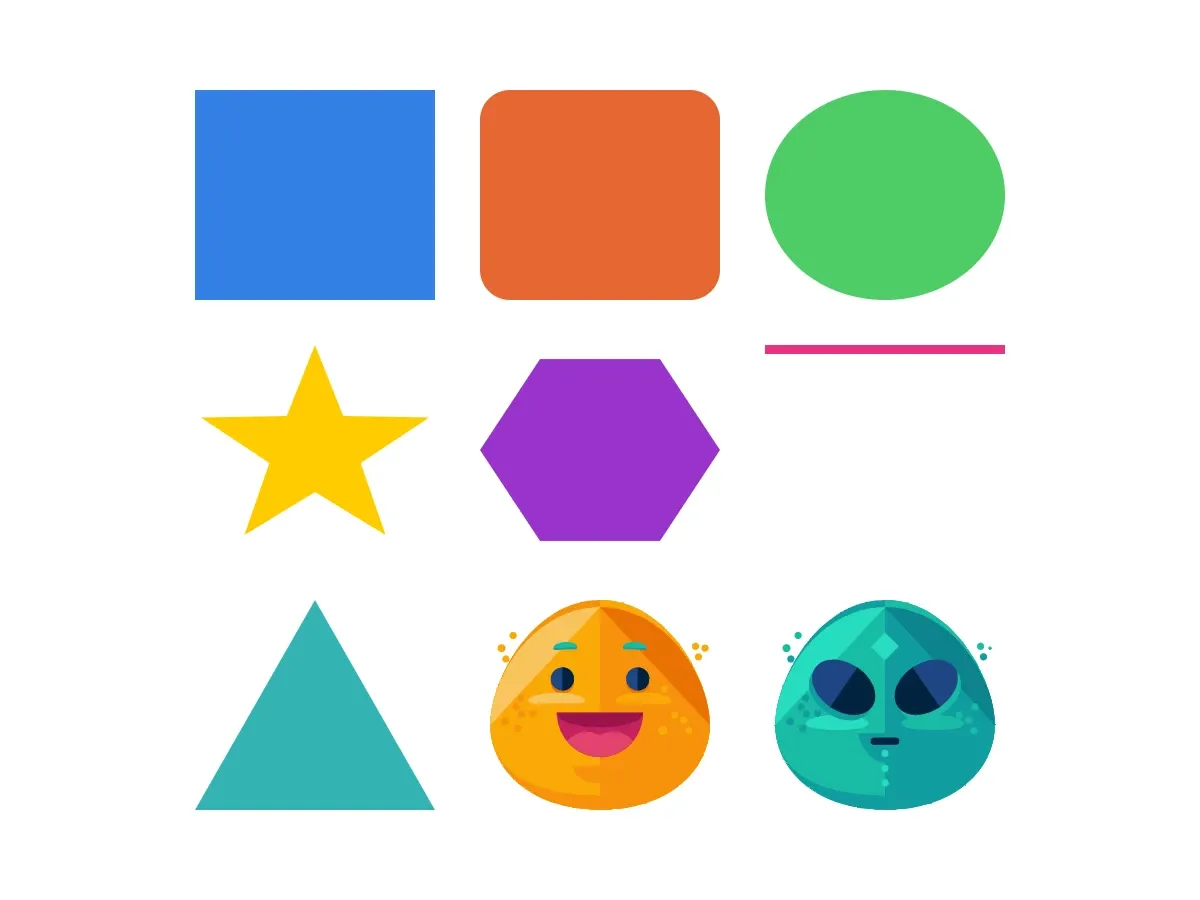
Shapes are vector graphics created with engine.block.createShape() and attached to graphic blocks. CE.SDK supports six Android shape types: ShapeType.Rect, ShapeType.Ellipse, ShapeType.Star, ShapeType.Polygon, ShapeType.Line, and ShapeType.VectorPath. Stickers are graphic blocks that usually use an image fill and the sticker block kind.
This guide covers creating each shape type, configuring shape-specific properties, applying fills, inserting stickers by hand, and querying stickers from the asset library.
Using the Built-in UI#
Shapes Panel#
The CE.SDK editor UI can expose shape entries through the asset library when your Android editor configuration includes a shape source such as ly.img.vector.shape. Users can place a shape on the canvas from the panel, then resize, rotate, position, and style the resulting block with the editor controls.
Stickers Panel#
Sticker entries appear in the asset library under their configured categories when your Android editor configuration includes a sticker source such as ly.img.sticker. Users can browse the available stickers and add them to the canvas from the panel. Inserted stickers keep their graphic-block behavior, so users can resize, rotate, align, and style them like other design elements.
Programmatic Shape Creation#
Prepare the Page and Asset Base URI#
The snippets below create a scene page for the inserted blocks and resolve sticker assets from a base URI. Use the asset base URI configured for your editor, or replace it with a self-hosted asset bundle URI that contains the ly.img.sticker source.
val scene = engine.scene.create()
val page = engine.block.create(DesignBlockType.Page)engine.block.setWidth(page, value = 800F)engine.block.setHeight(page, value = 600F)engine.block.appendChild(parent = scene, child = page)
val stickerAssetsBaseUri: Uri = defaultBaseUri
Check Shape Support#
Before attaching a shape to a block, confirm the block supports shapes with supportsShape(). Graphic blocks return true; text blocks return false.
val graphicBlock = engine.block.create(DesignBlockType.Graphic)val graphicSupportsShape = engine.block.supportsShape(graphicBlock)Log.i(TAG, "Graphic block supports shapes: $graphicSupportsShape")
val textBlock = engine.block.create(DesignBlockType.Text)val textSupportsShape = engine.block.supportsShape(textBlock)Log.i(TAG, "Text block supports shapes: $textSupportsShape")
engine.block.destroy(textBlock)engine.block.destroy(graphicBlock)
Create Rectangle#
Create rectangles with createShape(ShapeType.Rect) and attach them to a graphic block with setShape(). Apply a color fill to make the shape visible.
val rectBlock = engine.block.create(DesignBlockType.Graphic)val rectShape = engine.block.createShape(ShapeType.Rect)engine.block.setShape(block = rectBlock, shape = rectShape)
val rectFill = engine.block.createFill(FillType.Color)engine.block.setColor(    block = rectFill,    property = "fill/color/value",    value = Color.fromRGBA(r = 0.2F, g = 0.5F, b = 0.9F, a = 1F),)engine.block.setFill(block = rectBlock, fill = rectFill)
engine.block.setWidth(rectBlock, value = 160F)engine.block.setHeight(rectBlock, value = 140F)engine.block.appendChild(parent = page, child = rectBlock)
A graphic block needs both a shape and a fill before it renders as a visible filled shape.
Create Rounded Rectangle#
Rectangles support per-corner radii. Set each corner individually with setFloat() using shape/rect/cornerRadiusTL, shape/rect/cornerRadiusTR, shape/rect/cornerRadiusBL, and shape/rect/cornerRadiusBR.
val roundedBlock = engine.block.create(DesignBlockType.Graphic)val roundedShape = engine.block.createShape(ShapeType.Rect)engine.block.setShape(block = roundedBlock, shape = roundedShape)
engine.block.setFloat(roundedShape, property = "shape/rect/cornerRadiusTL", value = 20F)engine.block.setFloat(roundedShape, property = "shape/rect/cornerRadiusTR", value = 20F)engine.block.setFloat(roundedShape, property = "shape/rect/cornerRadiusBL", value = 20F)engine.block.setFloat(roundedShape, property = "shape/rect/cornerRadiusBR", value = 20F)
val roundedFill = engine.block.createFill(FillType.Color)engine.block.setColor(    block = roundedFill,    property = "fill/color/value",    value = Color.fromRGBA(r = 0.9F, g = 0.4F, b = 0.2F, a = 1F),)engine.block.setFill(block = roundedBlock, fill = roundedFill)
engine.block.setWidth(roundedBlock, value = 160F)engine.block.setHeight(roundedBlock, value = 140F)engine.block.appendChild(parent = page, child = roundedBlock)
Use the same value for every corner to create a uniformly rounded rectangle, or use different values for asymmetric rounding.
Create Ellipse#
Create circles and ovals with createShape(ShapeType.Ellipse). The block’s width and height determine the rendered shape: equal values render a circle, and unequal values render an oval.
val ellipseBlock = engine.block.create(DesignBlockType.Graphic)val ellipseShape = engine.block.createShape(ShapeType.Ellipse)engine.block.setShape(block = ellipseBlock, shape = ellipseShape)
val ellipseFill = engine.block.createFill(FillType.Color)engine.block.setColor(    block = ellipseFill,    property = "fill/color/value",    value = Color.fromRGBA(r = 0.3F, g = 0.8F, b = 0.4F, a = 1F),)engine.block.setFill(block = ellipseBlock, fill = ellipseFill)
engine.block.setWidth(ellipseBlock, value = 160F)engine.block.setHeight(ellipseBlock, value = 140F)engine.block.appendChild(parent = page, child = ellipseBlock)
Create Star#
Create stars with createShape(ShapeType.Star). Configure the point count with shape/star/points and the inner-to-outer diameter ratio with shape/star/innerDiameter.
val starBlock = engine.block.create(DesignBlockType.Graphic)val starShape = engine.block.createShape(ShapeType.Star)engine.block.setShape(block = starBlock, shape = starShape)
engine.block.setInt(starShape, property = "shape/star/points", value = 5)engine.block.setFloat(starShape, property = "shape/star/innerDiameter", value = 0.4F)
val starFill = engine.block.createFill(FillType.Color)engine.block.setColor(    block = starFill,    property = "fill/color/value",    value = Color.fromRGBA(r = 1F, g = 0.8F, b = 0F, a = 1F),)engine.block.setFill(block = starBlock, fill = starFill)
engine.block.setWidth(starBlock, value = 160F)engine.block.setHeight(starBlock, value = 140F)engine.block.appendChild(parent = page, child = starBlock)
Lower innerDiameter values produce thinner points, while higher values move the inner vertices closer to the outer radius.
Create Polygon#
Create regular polygons with createShape(ShapeType.Polygon). Set the number of sides with shape/polygon/sides to render triangles (3), pentagons (5), hexagons (6), and beyond.
val polygonBlock = engine.block.create(DesignBlockType.Graphic)val polygonShape = engine.block.createShape(ShapeType.Polygon)engine.block.setShape(block = polygonBlock, shape = polygonShape)
engine.block.setInt(polygonShape, property = "shape/polygon/sides", value = 6)
val polygonFill = engine.block.createFill(FillType.Color)engine.block.setColor(    block = polygonFill,    property = "fill/color/value",    value = Color.fromRGBA(r = 0.6F, g = 0.2F, b = 0.8F, a = 1F),)engine.block.setFill(block = polygonBlock, fill = polygonFill)
engine.block.setWidth(polygonBlock, value = 160F)engine.block.setHeight(polygonBlock, value = 140F)engine.block.appendChild(parent = page, child = polygonBlock)
Create Line#
Create lines with createShape(ShapeType.Line). Lines render through their stroke, so enable the stroke, set the color with setStrokeColor(), and set the thickness with setStrokeWidth().
val lineBlock = engine.block.create(DesignBlockType.Graphic)val lineShape = engine.block.createShape(ShapeType.Line)engine.block.setShape(block = lineBlock, shape = lineShape)
engine.block.setStrokeEnabled(lineBlock, enabled = true)engine.block.setStrokeWidth(lineBlock, width = 6F)engine.block.setStrokeColor(    block = lineBlock,    color = Color.fromRGBA(r = 0.9F, g = 0.2F, b = 0.5F, a = 1F),)
engine.block.setWidth(lineBlock, value = 160F)// Line shapes use block height as the visible stroke thickness.engine.block.setHeight(lineBlock, value = 6F)engine.block.appendChild(parent = page, child = lineBlock)
The sample sets the block height to the same value as the stroke width so the line’s bounding box matches the visible stroke.
Create Vector Path#
Create custom shapes with createShape(ShapeType.VectorPath). Set the SVG path with setString() using the shape/vector_path/path property. Path coordinates scale proportionally with the block’s width and height.
val vectorPathBlock = engine.block.create(DesignBlockType.Graphic)val vectorPathShape = engine.block.createShape(ShapeType.VectorPath)engine.block.setShape(block = vectorPathBlock, shape = vectorPathShape)
val trianglePath = "M 50,0 L 100,100 L 0,100 Z"engine.block.setString(    block = vectorPathShape,    property = "shape/vector_path/path",    value = trianglePath,)
val vectorPathFill = engine.block.createFill(FillType.Color)engine.block.setColor(    block = vectorPathFill,    property = "fill/color/value",    value = Color.fromRGBA(r = 0.2F, g = 0.7F, b = 0.7F, a = 1F),)engine.block.setFill(block = vectorPathBlock, fill = vectorPathFill)
engine.block.setWidth(vectorPathBlock, value = 160F)engine.block.setHeight(vectorPathBlock, value = 140F)engine.block.appendChild(parent = page, child = vectorPathBlock)
The example draws a triangle by moving to the top center, then to the bottom-right and bottom-left corners. CE.SDK accepts the SVG path subset supported by its parser; validate complex paths before shipping them.
Discover Shape Properties#
Use findAllProperties() to list every configurable property for a given shape. This helps when exploring an unfamiliar shape type or building generic editing tools.
val starProperties = engine.block.findAllProperties(starShape)Log.i(TAG, "Star shape properties: $starProperties")Each shape type exposes its own set of properties:
- Rectangle:
shape/rect/cornerRadiusTL,shape/rect/cornerRadiusTR,shape/rect/cornerRadiusBL,shape/rect/cornerRadiusBR - Star:
shape/star/points,shape/star/innerDiameter,shape/star/cornerRadius - Polygon:
shape/polygon/sides,shape/polygon/cornerRadius - Vector Path:
shape/vector_path/path,shape/vector_path/width,shape/vector_path/height,shape/vector_path/cornerRadius,shape/vector_path/fillRule
Programmatic Sticker Insertion#
Insert a Sticker#
A sticker is a graphic block with a rect shape and an image fill. Set the fill’s fill/image/imageFileURI property to the sticker URI, then tag the block as a sticker with setKind() so the editor categorizes it correctly.
val stickerBlock = engine.block.create(DesignBlockType.Graphic)val stickerShape = engine.block.createShape(ShapeType.Rect)engine.block.setShape(block = stickerBlock, shape = stickerShape)
val stickerFill = engine.block.createFill(FillType.Image)val stickerUri = stickerAssetsBaseUri.buildUpon()    .appendPath(DefaultAssetSource.STICKER.key)    .appendPath("images")    .appendPath("emoji")    .appendPath("emoji_happyface.svg")    .build()engine.block.setUri(    block = stickerFill,    property = "fill/image/imageFileURI",    value = stickerUri,)engine.block.setFill(block = stickerBlock, fill = stickerFill)
if (engine.block.supportsContentFillMode(stickerBlock)) {    engine.block.setContentFillMode(stickerBlock, mode = ContentFillMode.CONTAIN)}engine.block.setKind(stickerBlock, kind = "sticker")
engine.block.setWidth(stickerBlock, value = 160F)engine.block.setHeight(stickerBlock, value = 140F)engine.block.appendChild(parent = page, child = stickerBlock)
setContentFillMode() with ContentFillMode.CONTAIN preserves the sticker’s aspect ratio inside the block bounds. Guard the call with supportsContentFillMode() because not every block configuration exposes content fill modes.
Query Stickers From the Asset Library#
Populate the sticker asset source with the ly.img.sticker manifest when it is not already registered. Once the source is available, browse the catalog with findAssets().
val stickerSourceId = DefaultAssetSource.STICKER.keyif (stickerSourceId !in engine.asset.findAllSources()) {    engine.populateAssetSource(        id = stickerSourceId,        jsonUri = stickerAssetsBaseUri.buildUpon()            .appendPath(stickerSourceId)            .appendPath("content.json")            .build(),        replaceBaseUri = stickerAssetsBaseUri,    )}
var stickerResults = findStickerAssets(engine = engine, sourceId = stickerSourceId)var stickerAssetSourceId = stickerSourceIdif (stickerResults.assets.isEmpty()) {    try {        engine.populateAssetSource(            id = stickerSourceId,            jsonUri = stickerAssetsBaseUri.buildUpon()                .appendPath(stickerSourceId)                .appendPath("content.json")                .build(),            replaceBaseUri = stickerAssetsBaseUri,        )    } catch (error: Exception) {        Log.w(TAG, "Could not populate sticker source $stickerSourceId.", error)    }    stickerResults = findStickerAssets(engine = engine, sourceId = stickerSourceId)}if (stickerResults.assets.isEmpty()) {    stickerAssetSourceId = GUIDE_STICKER_SOURCE_ID    ensureGuideStickerAssetSource(engine = engine, stickerUri = stickerUri)    stickerResults = findStickerAssets(engine = engine, sourceId = stickerAssetSourceId)}Log.i(TAG, "Stickers in emoji category: ${stickerResults.total}")
The query parameter accepts a fuzzy search string; groups narrows the result to a single category. Omit query to remove the fuzzy-search filter for the selected group, or omit groups to retrieve stickers from the full source. For vector-based shape assets, use "ly.img.vector.shape" as the source ID.
Apply a Sticker From the Library#
applyAssetSourceAsset() returns a nullable block. A non-null result is already attached to the current scene and includes metadata such as shape, image fill, kind, and dimensions. Check for null before resizing or positioning the block because an asset source can decline to materialize a specific asset.
val stickerAsset = checkNotNull(stickerResults.assets.firstOrNull()) {    "No sticker assets found."}val stickerFromLibrary = checkNotNull(    engine.asset.applyAssetSourceAsset(sourceId = stickerAssetSourceId, asset = stickerAsset),) {    "The sticker asset source did not create a block."}
if (engine.block.supportsContentFillMode(stickerFromLibrary)) {    engine.block.setContentFillMode(stickerFromLibrary, mode = ContentFillMode.CONTAIN)}engine.block.setWidth(stickerFromLibrary, value = 160F)engine.block.setHeight(stickerFromLibrary, value = 140F)
This is the recommended path when the sticker URL comes from the asset library. Manual construction is useful when your app already knows the sticker URI.
Troubleshooting#
Shape Not Visible#
If a shape does not appear after creation:
- Verify a fill is applied. Shapes without fills are invisible. Create a fill with
createFill()and apply it withsetFill(). - Check the block is added to the page. Call
appendChild()to attach the block to the scene hierarchy. - Ensure dimensions are set. Call
setWidth()andsetHeight()to give the shape a size.
Line Not Visible#
Lines render through their stroke, not a fill. Enable the stroke with setStrokeEnabled() and set a stroke width before expecting the line to appear.
Sticker Appears Cropped#
Set setContentFillMode() to ContentFillMode.CONTAIN to preserve the sticker’s aspect ratio inside the block bounds. Check supportsContentFillMode() before calling it.
Invalid Shape Type#
Use the Android ShapeType values instead of deprecated string-based shape creation. Valid values are ShapeType.Rect, ShapeType.Ellipse, ShapeType.Star, ShapeType.Polygon, ShapeType.Line, and ShapeType.VectorPath.
No Assets Found#
Confirm that the expected source ID appears in findAllSources() and that its content.json URI is reachable. If you self-host the bundle, pass the corresponding base URI when populating the source.
Asset Does Not Create a Block#
Treat the return value of applyAssetSourceAsset() as nullable. A null result means the source did not create a scene block for the selected asset.
API Reference#
| Method | Description |
|---|---|
engine.scene.create() |
Create a scene that owns the page and inserted blocks |
engine.block.create(blockType=DesignBlockType.Graphic) |
Create a graphic block to host a shape or sticker |
engine.block.createShape(type=ShapeType.Rect) |
Create a shape of the specified ShapeType |
engine.block.supportsShape(block=_) |
Check whether a block supports shapes |
engine.block.setShape(block=_, shape=_) |
Attach a shape to a graphic block |
engine.block.findAllProperties(block=_) |
List every configurable property of a block |
engine.block.setInt(block=_, property="shape/star/points", value=_) |
Set an integer property, such as star points or polygon sides |
engine.block.setFloat(block=_, property="shape/star/innerDiameter", value=_) |
Set a float property, such as corner radius or star inner diameter |
engine.block.setString(block=_, property="shape/vector_path/path", value=_) |
Set a string property, such as an SVG vector path |
engine.block.createFill(fillType=FillType.Color) |
Create a fill of the specified FillType |
engine.block.setFill(block=_, fill=_) |
Apply a fill to a block |
engine.block.setColor(block=_, property="fill/color/value", value=_) |
Set a color property on a fill |
engine.block.setUri(block=_, property="fill/image/imageFileURI", value=_) |
Set a URI property on an image fill |
engine.block.setKind(block=_, kind=_) |
Set a block’s kind for categorization |
engine.block.setContentFillMode(block=_, mode=ContentFillMode.CONTAIN) |
Set how image content fits within the block bounds |
engine.block.supportsContentFillMode(block=_) |
Check whether the block supports content fill modes |
engine.block.setStrokeEnabled(block=_, enabled=_) |
Enable or disable a block’s stroke |
engine.block.setStrokeWidth(block=_, width=_) |
Set the stroke thickness |
engine.block.setStrokeColor(block=_, color=_) |
Set the stroke color |
engine.block.setWidth(block=_, value=_) |
Set the block width |
engine.block.setHeight(block=_, value=_) |
Set the block height |
engine.block.appendChild(parent=_, child=_) |
Attach a block to a parent |
engine.block.destroy(block=_) |
Destroy a temporary or no longer needed block |
engine.populateAssetSource(id=_, jsonUri=_, replaceBaseUri=_) |
Populate a default asset source from a content.json URI |
engine.asset.findAllSources() |
List registered asset source IDs before populating a source |
engine.asset.findAssets(sourceId=_, query=_) |
Query assets from a registered source |
engine.asset.applyAssetSourceAsset(sourceId=_, asset=_) |
Materialize a nullable block from an asset result |
Next Steps#
- Asset Library Basics — Understand sources, groups, and asset metadata
- Customize Asset Library — Control which sources and categories users can browse
- Colors - Work with colors, fills, and gradients
- Filters and Effects - Apply visual effects to design elements
- Position and Align - Position elements precisely on the canvas